5:00AM Saturday March 03, 2007
The story of how a young Englishman, George Hogg, took 60 orphans on a journey of hundreds of miles to safety across war-ravaged China in the winter of 1944 is one of the more remarkable tales of World War II.
In the town of Shandan, in Gansu province on the Mongolian border, Hogg and his friend and mentor, the New Zealand philanthropist Rewi Alley, are remembered with a statue and affection, but Hogg is little known outside China.
This is all set to change with a film called The Children of Huang Shi which is being made by the Canadian-born director Roger Spottiswoode.
With Japanese forces snapping at their heels as they made their western advance across China in 1944, and with the help of Mao Zedong's communist guerrillas, Hogg escorted the boys across 1100km of mountainous terrain in northwestern China to a temple town in Shandan. Just one year later, Hogg contracted tetanus after he injured his toe playing basketball with the students. With no medicines to stop lockjaw, he died, aged 29.
A privileged Oxford graduate, seemingly destined for middle-class security, Hogg landed in Shanghai at the tender age of 23 during a trip around the world. He worked as a journalist for the United Press news agency and among the historical events he witnessed was the brutal occupation by the Japanese of the then-capital Nanking, now Nanjing.
In China, no one talks about World War II. Instead people talk about the Anti-Japanese War, which ran from 1931, when the Japanese invaded Manchuria, until 1945 when the Japanese capitulated.
The war still has political ramifications in China and relations between the two Asian powers have yet to recover fully - the Chinese believe the Japanese have never expressed proper remorse.
In 1937 marauding Japanese troops began what has become known as the Rape of Nanking, killing many thousands of Chinese civilians. The massacre remains a contentious issue between the countries: China says that 300,000 people were killed, while some Japanese researchers consider the death toll to be between 100,000 and 200,000.
Hogg became involved with Alley, who had set up a scheme known as the Industrial Co-operative, a Chinese version of the American New Deal programme of industrial development. The co-operative's slogan - Gung Ho - has passed into the English language. In 1942 Alley set up a system of schools called the Bailie Schools after his friend Joseph Bailie, an American missionary who pioneered the idea of integrating theory and practice in education in China.
Hogg, who relates the story in his book I see a New China, ran the school at Shuangshipu, around 200km west of Xi'an, in Shaanxi province, with great success, but was forced to pack up the school on carts and head for Gansu as the war encroached.
It was a dangerous journey - poor mountainous roads, and Japanese soldiers everywhere. Two boys died during the journey. In Shandan, Alley rented a few old temples and turned them into classrooms and workshops, and appointed Hogg as headmaster.
The £10 million ($28 million) movie, which features epic battle scenes, a strong emotional dimension and a sympathetic reading of recent Chinese history, is due in cinemas early next year. The Rape of Nanking is set to feature in a number of Chinese and foreign film projects this year, but while being set in the China of its time, The Children of Huang Shi is not solely a movie about the atrocities of war but of one Briton's heroism and his journey of discovery.
- Independent
Saturday, March 03, 2007

Horroe Denial a festering sore
Horror denial a festering sore
5:00AM Saturday March 03, 2007By David NcNeill
Chinese students mourn the victims of the 1937 massacre in Nanjing during a memorial ceremony in 2001. Photo / Reuters
The photographs are sickening, a gallery of horrors from a gruesome war where the casualties were counted in the millions: Decapitated and disembowelled bodies, dead babies discarded in ditches, hollow-eyed skulls staring from a jumbled pile of human bones.
After five minutes, the mind starts to numb; 10 and the air in this converted warehouse feels still and heavy, like the weight of history is seeping through the doors.
The newly opened Chukiren Peace Museum nestles among swathes of identikit houses in a suburb north of Tokyo, watched over by a pensioner; a foot-soldier in what Czech writer Milan Kundera calls the struggle of memory against forgetting.
The 80-year-old curator, Fumiko Niki, has spent much of her life at war with Japan's conservatives.
"We are in a very dangerous period," she says. "Awareness of Japan's role in wartime is fading."
The core of the museum's collection is the testimony of 300 Japanese Imperial Army veterans who confessed while in custody in China to committing atrocities there, including rape, torture and infanticide.
Graphic video and photographic evidence showing some of the Army's most brutal crimes is held in the archives. Ultra-rightists have already threatened to burn the museum down and the elderly staff are studying the unfamiliar world of high-tech security.
"You won't find these things in school textbooks," says veteran Tsuyoshi Ebato, who helped compile this archive. The testimonies include an account of a sergeant-major who raped and killed a Chinese woman, then cannibalised her with his unit.
Ebato says he trained recruits to use captured Chinese for bayonet practice. "Terrible things like this happened all the time," he says.
"Now people are saying that they never happened. Japan wants to keep a lid on a stinking pot."
Across Tokyo is the office of the right-wing internet broadcaster Channel Sakura. There are no pictures of war atrocities here. Instead, swords and rising-sun flags decorate the walls along with portraits of the Emperor and poems to fallen Japanese soldiers.
Since it was set up two years ago, Sakura has pumped out nationalist programmes to its small audience. Now its president is planning to direct a big-budget documentary arguing the 1937 "Rape of Nanjing" - one of history's most notorious war crimes - was a hoax.
"Nanjing is a lie, it is as simple as that," says Satoru Mizushima. "It is Chinese propaganda, backed up by left-wingers in this country."
Mizushima says the photos in the peace museum are faked, that former Japanese soldiers like Ebato were "brainwashed" by "Chinese communists" while in captivity, and that the war crimes documented there never happened. "It is all perfectly clear and we're going to prove it."
Such views have long existed on the fringes of Japanese politics, but the movie is backed by at least a dozen lawmakers from the ruling Liberal Democratic (LDP) and opposition parties; Tokyo mayor, Shintaro Ishihara; and a panel of university lecturers. And in Prime Minister Shinzo Abe, the makers arguably have a leader who is closer to their world view than any Japanese premier in decades.
Abe has made no secret of his distaste for the way the history of the war in China has been recorded. Before becoming leader, he was one of a group of LDP politicians who strongly backed a history textbook downplaying or removing references to Japan's war crimes in Asia, including Nanjing.
The textbook refers to the rape of the city as "an incident" and rejects the higher casualty estimates. China claims 300,000 died; revisionist historians in Japan put the figure anywhere between zero and 40,000.
"Where did they dispose of all those bodies?" asks Mizushima, jabbing what he says are doctored photos from Iris Chang's 1997 bestseller The Rape of Nanking (Nanking is the English name for Nanjing).
"The Nazis had to build ovens to kill Jews. But we don't have the same ideology as the Nazis. We weren't trying to wipe out Nanjing or the Chinese."
Chang's book, criticised for its inaccuracies and use of doctored photos, called the rape and looting "the forgotten holocaust".
Nanjing continues to poison one of the world's most important bilateral relationships.
Over 80 per cent of young Chinese in a recent survey cited the rape as the issue they associated most with Japan. Anti-Japanese sentiment, fuelled by nationalism and government propaganda, has grown steadily in China, culminating in a series of riots and boycotts, and prompting Beijing and Tokyo to set up a joint education panel in an attempt to lay the historical ghosts to rest.
But the 20 academics on both sides admit they are struggling. "It is very difficult indeed," says Professor Shinichi Kitaoka, who is part of the Japanese delegation. "But we have to find some way of narrowing the gap between us."
Talk of hoaxes incenses Beijing. Foreign Ministry spokeswoman Jiang Yu, said recently there was "ironclad" evidence that the massacre took place.
A new United States movie on the rape, featuring Woody Harrelson, is being released and at least another half-dozen more are in the pipeline to mark the 70th anniversary of Nanjing.
Beijing plans its own film, based on Chang's book, a move that prompted Japanese politicians to announce their own "study group" to counter what they say is a looming wave of anti-Japanese sentiment.
It was the prospect of these new projects that also spurred Mizushima into action. "We cannot let these distorted views of history spread throughout the world. We're not doing it because we're anti-Chinese; we simply want to tell the truth."
He rejects all accusations of Japanese war crimes in Asia, including the sexual enslavement of 200,000 women and the forced employment of millions of Chinese and Korean labourers.
"Koreans and Chinese want to save face by saying that we enslaved them, but their own parents sold them into prostitution and slavery. They're crying like women about what happened to them."
- Independent
5:00AM Saturday March 03, 2007By David NcNeill
Chinese students mourn the victims of the 1937 massacre in Nanjing during a memorial ceremony in 2001. Photo / Reuters
The photographs are sickening, a gallery of horrors from a gruesome war where the casualties were counted in the millions: Decapitated and disembowelled bodies, dead babies discarded in ditches, hollow-eyed skulls staring from a jumbled pile of human bones.
After five minutes, the mind starts to numb; 10 and the air in this converted warehouse feels still and heavy, like the weight of history is seeping through the doors.
The newly opened Chukiren Peace Museum nestles among swathes of identikit houses in a suburb north of Tokyo, watched over by a pensioner; a foot-soldier in what Czech writer Milan Kundera calls the struggle of memory against forgetting.
The 80-year-old curator, Fumiko Niki, has spent much of her life at war with Japan's conservatives.
"We are in a very dangerous period," she says. "Awareness of Japan's role in wartime is fading."
The core of the museum's collection is the testimony of 300 Japanese Imperial Army veterans who confessed while in custody in China to committing atrocities there, including rape, torture and infanticide.
Graphic video and photographic evidence showing some of the Army's most brutal crimes is held in the archives. Ultra-rightists have already threatened to burn the museum down and the elderly staff are studying the unfamiliar world of high-tech security.
"You won't find these things in school textbooks," says veteran Tsuyoshi Ebato, who helped compile this archive. The testimonies include an account of a sergeant-major who raped and killed a Chinese woman, then cannibalised her with his unit.
Ebato says he trained recruits to use captured Chinese for bayonet practice. "Terrible things like this happened all the time," he says.
"Now people are saying that they never happened. Japan wants to keep a lid on a stinking pot."
Across Tokyo is the office of the right-wing internet broadcaster Channel Sakura. There are no pictures of war atrocities here. Instead, swords and rising-sun flags decorate the walls along with portraits of the Emperor and poems to fallen Japanese soldiers.
Since it was set up two years ago, Sakura has pumped out nationalist programmes to its small audience. Now its president is planning to direct a big-budget documentary arguing the 1937 "Rape of Nanjing" - one of history's most notorious war crimes - was a hoax.
"Nanjing is a lie, it is as simple as that," says Satoru Mizushima. "It is Chinese propaganda, backed up by left-wingers in this country."
Mizushima says the photos in the peace museum are faked, that former Japanese soldiers like Ebato were "brainwashed" by "Chinese communists" while in captivity, and that the war crimes documented there never happened. "It is all perfectly clear and we're going to prove it."
Such views have long existed on the fringes of Japanese politics, but the movie is backed by at least a dozen lawmakers from the ruling Liberal Democratic (LDP) and opposition parties; Tokyo mayor, Shintaro Ishihara; and a panel of university lecturers. And in Prime Minister Shinzo Abe, the makers arguably have a leader who is closer to their world view than any Japanese premier in decades.
Abe has made no secret of his distaste for the way the history of the war in China has been recorded. Before becoming leader, he was one of a group of LDP politicians who strongly backed a history textbook downplaying or removing references to Japan's war crimes in Asia, including Nanjing.
The textbook refers to the rape of the city as "an incident" and rejects the higher casualty estimates. China claims 300,000 died; revisionist historians in Japan put the figure anywhere between zero and 40,000.
"Where did they dispose of all those bodies?" asks Mizushima, jabbing what he says are doctored photos from Iris Chang's 1997 bestseller The Rape of Nanking (Nanking is the English name for Nanjing).
"The Nazis had to build ovens to kill Jews. But we don't have the same ideology as the Nazis. We weren't trying to wipe out Nanjing or the Chinese."
Chang's book, criticised for its inaccuracies and use of doctored photos, called the rape and looting "the forgotten holocaust".
Nanjing continues to poison one of the world's most important bilateral relationships.
Over 80 per cent of young Chinese in a recent survey cited the rape as the issue they associated most with Japan. Anti-Japanese sentiment, fuelled by nationalism and government propaganda, has grown steadily in China, culminating in a series of riots and boycotts, and prompting Beijing and Tokyo to set up a joint education panel in an attempt to lay the historical ghosts to rest.
But the 20 academics on both sides admit they are struggling. "It is very difficult indeed," says Professor Shinichi Kitaoka, who is part of the Japanese delegation. "But we have to find some way of narrowing the gap between us."
Talk of hoaxes incenses Beijing. Foreign Ministry spokeswoman Jiang Yu, said recently there was "ironclad" evidence that the massacre took place.
A new United States movie on the rape, featuring Woody Harrelson, is being released and at least another half-dozen more are in the pipeline to mark the 70th anniversary of Nanjing.
Beijing plans its own film, based on Chang's book, a move that prompted Japanese politicians to announce their own "study group" to counter what they say is a looming wave of anti-Japanese sentiment.
It was the prospect of these new projects that also spurred Mizushima into action. "We cannot let these distorted views of history spread throughout the world. We're not doing it because we're anti-Chinese; we simply want to tell the truth."
He rejects all accusations of Japanese war crimes in Asia, including the sexual enslavement of 200,000 women and the forced employment of millions of Chinese and Korean labourers.
"Koreans and Chinese want to save face by saying that we enslaved them, but their own parents sold them into prostitution and slavery. They're crying like women about what happened to them."
- Independent
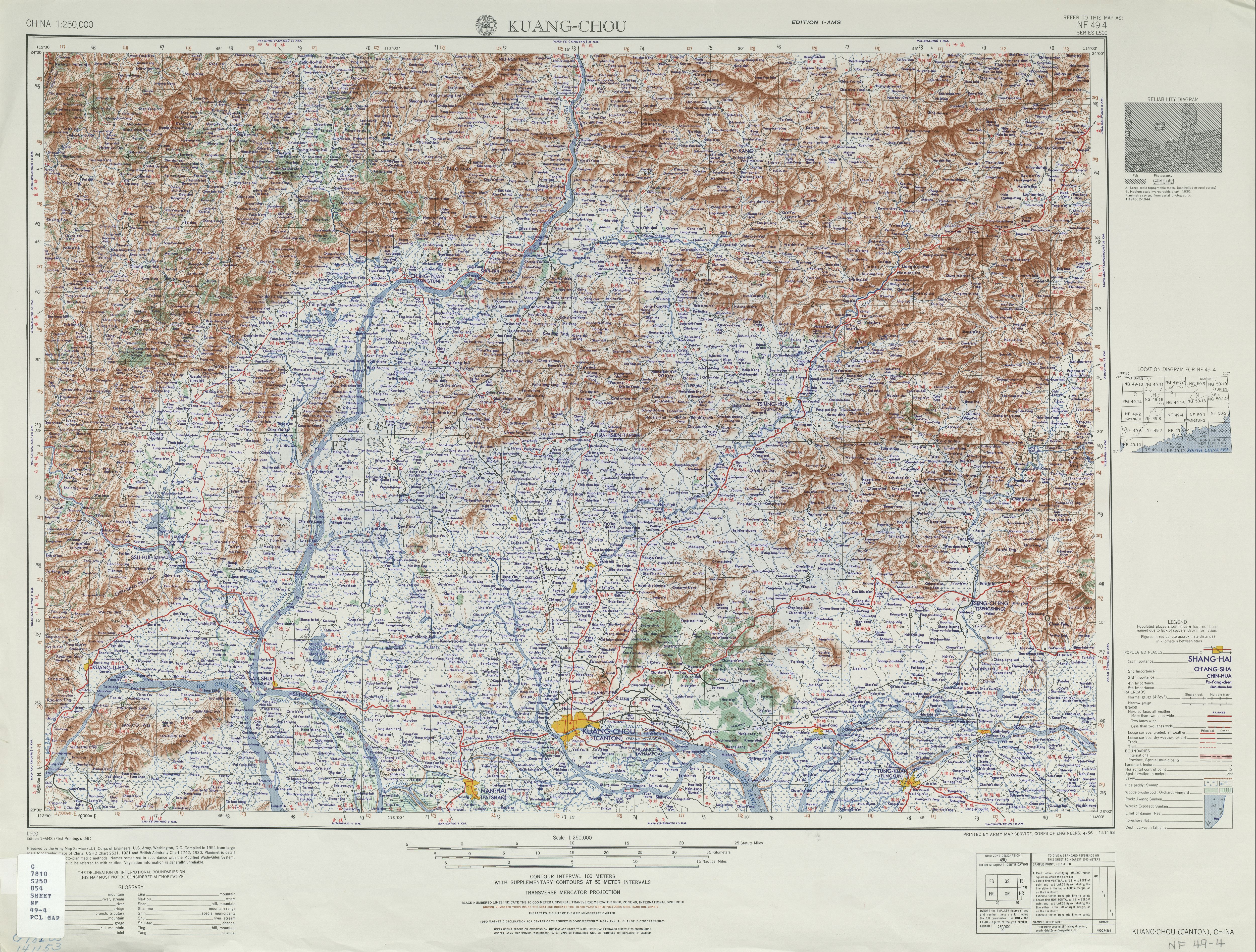
Map of Canton 1954 - US Army
http://www.suite101.com/external_link.cfm?elink=http://www.lib.utexas.edu/Libs/PCL/Map_collection/china.html
Enter
Look under Detailed Maps
China - Topographic Maps U.S. Army Map Service, Series L500 (China Series), original scale 1:250,000
Enter
Choose NF 49-4 KUANG-CHOU (6.2 MB)
or
NF 49-4 KUANG-CHOU (CANTON) AND VICINITY [verso] (3.1 MB)
Enter
Look under Detailed Maps
China - Topographic Maps U.S. Army Map Service, Series L500 (China Series), original scale 1:250,000
Enter
Choose NF 49-4 KUANG-CHOU (6.2 MB)
or
NF 49-4 KUANG-CHOU (CANTON) AND VICINITY [verso] (3.1 MB)
![NF 49-4 KUANG-CHOU (CANTON) AND VICINITY [verso]](http://www.lib.utexas.edu/maps/ams/china/txu-oclc-10552568-nf49-4-back.jpg)
Saturday, February 17, 2007
History of Choy Lee Fut as told by Chen Yong Fa,
http://www.clfsd.com/hist.html My great-great-grandfather, Chan Heung was from the village Ging Mui2 in the district of Ngi Sai, the county of Sun Wui, in the Kwuntung province. From the age of seven, Chan Heung was taught martial arts by his uncle/village elder3, Chan Yuen Wu.
Ka-Shue
LYNDA CHANWAI-EARLE Ka-Shue (Letters Home) Playwright’s Note I am Eurasian by ethnicity, a fourth-generation New Zealander. Based on the Chinese side of my family (the Tung clan of BakChuen), Ka-Shue uncovers some of the last 150 years of a buried history in New Zealand. There has been a noticeable absence of a Chinese voice in this country. Perhaps it is because the Chinese community has been producing its own work for its own people, but this work has been largely inaccessible to a wider public until now. The material has often been spoken in Chinese, and not produced for mainstream audiences. In writing Ka-Shue I have focused on the personal and domestic lives of three generations of a Chinese family. Ka-Shue spans the cultures of New Zealand and China, encompassing a broad sweep of the political events between the two countries as a backdrop for the personal dramas of the characters. This play is dedicated to my family. I am aware that this play is close to the bone as far as my family history is concerned, but I hope in the end that I have attempted a universal story about immigration, about the systematic alienation of particular immigrant groups. For me Ka-Shue is also a story about immigrant women, struggling to make for themselves a sense of home and identity. The play works most effectively with minimal props and furniture, which remain on stage throughout. Descriptions such as the venetian blinds of the hotel windows or Paw paw’s graveside can be lit areas played out to the audience. Ka-Shue is set in several time frames—1939, 1941, 1945, 1959, and 1989—and the scenes weave seamlessly between them. KaShue can be played by one actor or a full cast (as a series of monologues). If one actor is used, it is preferable to use only one costume and have the actor portray character changes through voice and body. Time and place can be evoked with the help of live music (preferably
Thursday, February 15, 2007
Assassin jailed for at least 17 years
10:30AM Thursday February 15, 2007
Tam Yam Ah was killed in 2005
Related nzherald links:
Read the full story behind the murder
A hitman who murdered a triad enforcer with a single shot to his chest will spend at least 17 years in jail.
Wan Yee Chow, 55, was jailed for life with a minimum non-parole period of 17 years today when he appeared for sentencing in the High Court in Auckland.
A jury last year found him guilty of murdering Tam Yam Ah, 37, in July 2005.
Tam, a long-time criminal and triad enforcer, was shot dead outside his karaoke bar in Symonds Street, Auckland.
Chow drove from the Hutt Valley to Auckland, donned black clothes and headgear, then shot Mr Tam.
Prosecutor Kieran Raftery told the court the murder was "a cold-blooded Chinese gang killing".
Tam arrived in New Zealand in the late 1980s.
He beat his wife, the court heard, and she retaliated by drugging him and hitting him with a meat cleaver.
She was acquitted on a charge of attempted murder after her lawyer argued she suffered battered women's syndrome.
Tam has previously served at least two jail terms for a variety of offences.
Tam Yam Ah was killed in 2005
Related nzherald links:
Read the full story behind the murder
A hitman who murdered a triad enforcer with a single shot to his chest will spend at least 17 years in jail.
Wan Yee Chow, 55, was jailed for life with a minimum non-parole period of 17 years today when he appeared for sentencing in the High Court in Auckland.
A jury last year found him guilty of murdering Tam Yam Ah, 37, in July 2005.
Tam, a long-time criminal and triad enforcer, was shot dead outside his karaoke bar in Symonds Street, Auckland.
Chow drove from the Hutt Valley to Auckland, donned black clothes and headgear, then shot Mr Tam.
Prosecutor Kieran Raftery told the court the murder was "a cold-blooded Chinese gang killing".
Tam arrived in New Zealand in the late 1980s.
He beat his wife, the court heard, and she retaliated by drugging him and hitting him with a meat cleaver.
She was acquitted on a charge of attempted murder after her lawyer argued she suffered battered women's syndrome.
Tam has previously served at least two jail terms for a variety of offences.
Saturday, February 10, 2007
Obituary: Eric Wong Ming
Saturday January 20, 2007 By Nigel Murphy and staff reporter
Eric Wong Ming, greengrocer, poll tax immigrant. Died aged 102.
Eric Wong Ming arrived in New Zealand in 1920, a time when Chinese immigrants were required to pay £100 as a poll tax or entry tax, the equivalent of about 10 years' wages.
They were also required to pass an education test that consisted of reading 100 words in English.
Eric raised the money by using land inherited from his father as collateral. He also took a three-month intensive English language course.
On his arrival he paid over the money and then prepared to sit his test. As he remembered it when he was 99, the Customs officer chose page one of the Fourth Pacific Reader, the standard fourth-form text in New Zealand. Eric had just begun, "Long ago, men wandered from place to place ... " when the officer stopped him, saying, "That's enough, you've passed."
Eric eventually found work in a Wellington fruit shop with a family from Jung Seng county in Guangdong, near his birthplace.
The intense racism of New Zealanders caught him so much by surprise that he considered returning home. But he realised New Zealand offered the chance of a better life so he accepted the challenge and stayed.
In 1930 Eric returned to China to get married. A number of women were paraded for his choice, but his eye fell on Wong Low She.
They married and Eric stayed in his home village of Gwa Liang for two years, but because there was no work, and because the immigration of Chinese women to New Zealand had been stopped in 1925, he returned here alone.
In 1937 he set up his own fruit shop in Blenheim and in 1940 his wife was finally able to join him, as a refugee from the Japanese war in China.
This respite was for two years only, as the law then stated that after that time the women and children, including any born in New Zealand during the two years, had to return home.
In 1947 the Government reluctantly decided to allow the refugees to stay.
Eric and his wife had four sons between 1940 and 1948. They moved to Auckland when Eric retired in 1964. He is survived by three sons.
Eric Wong Ming, greengrocer, poll tax immigrant. Died aged 102.
Eric Wong Ming arrived in New Zealand in 1920, a time when Chinese immigrants were required to pay £100 as a poll tax or entry tax, the equivalent of about 10 years' wages.
They were also required to pass an education test that consisted of reading 100 words in English.
Eric raised the money by using land inherited from his father as collateral. He also took a three-month intensive English language course.
On his arrival he paid over the money and then prepared to sit his test. As he remembered it when he was 99, the Customs officer chose page one of the Fourth Pacific Reader, the standard fourth-form text in New Zealand. Eric had just begun, "Long ago, men wandered from place to place ... " when the officer stopped him, saying, "That's enough, you've passed."
Eric eventually found work in a Wellington fruit shop with a family from Jung Seng county in Guangdong, near his birthplace.
The intense racism of New Zealanders caught him so much by surprise that he considered returning home. But he realised New Zealand offered the chance of a better life so he accepted the challenge and stayed.
In 1930 Eric returned to China to get married. A number of women were paraded for his choice, but his eye fell on Wong Low She.
They married and Eric stayed in his home village of Gwa Liang for two years, but because there was no work, and because the immigration of Chinese women to New Zealand had been stopped in 1925, he returned here alone.
In 1937 he set up his own fruit shop in Blenheim and in 1940 his wife was finally able to join him, as a refugee from the Japanese war in China.
This respite was for two years only, as the law then stated that after that time the women and children, including any born in New Zealand during the two years, had to return home.
In 1947 the Government reluctantly decided to allow the refugees to stay.
Eric and his wife had four sons between 1940 and 1948. They moved to Auckland when Eric retired in 1964. He is survived by three sons.
Delamere believed applications honest, lawful - lawyer
11:45AM Thursday February 08, 2007
Former immigration minister Tuariki John Delamere
Related nzherald links:
Former minister in court for fraud
Former immigration minister Tuariki John Delamere believed applications made to the Immigration Service on behalf of his Chinese migrant clients were honest and lawful, a defence lawyer told a jury today.
Delamere denies 20 fraud charges over applications made to the Immigration Service between 2001 and 2004 by his immigration consultancy, Tuariki Delamere and Associates.
On the second day of the trial in the High Court at Auckland, defence lawyer Paul Dacre, in his opening address, asked the jury to think about what was going on Delamere's mind when he made the applications.
"Was it some cynical approach or a genuine application?"
Mr Dacre said he disputed the Crown's case that the scheme was dishonest.
"Mr Delamere believed what he was doing was honest and also lawful."
Attempts to paint a scheme with a Chinese business partner as a "money-go-round" was a cynical ploy.
"It was perfectly legal, perfectly legitimate."
Mr Dacre said it was not a system that was designed to get around the Immigration Service. Documents used by Delamere were not dishonestly produced with the intention of misleading third parties, he said.
Delamere "at all times was acting legitimately, honestly and in his clients interests".
The trial is continuing
Former immigration minister Tuariki John Delamere
Related nzherald links:
Former minister in court for fraud
Former immigration minister Tuariki John Delamere believed applications made to the Immigration Service on behalf of his Chinese migrant clients were honest and lawful, a defence lawyer told a jury today.
Delamere denies 20 fraud charges over applications made to the Immigration Service between 2001 and 2004 by his immigration consultancy, Tuariki Delamere and Associates.
On the second day of the trial in the High Court at Auckland, defence lawyer Paul Dacre, in his opening address, asked the jury to think about what was going on Delamere's mind when he made the applications.
"Was it some cynical approach or a genuine application?"
Mr Dacre said he disputed the Crown's case that the scheme was dishonest.
"Mr Delamere believed what he was doing was honest and also lawful."
Attempts to paint a scheme with a Chinese business partner as a "money-go-round" was a cynical ploy.
"It was perfectly legal, perfectly legitimate."
Mr Dacre said it was not a system that was designed to get around the Immigration Service. Documents used by Delamere were not dishonestly produced with the intention of misleading third parties, he said.
Delamere "at all times was acting legitimately, honestly and in his clients interests".
The trial is continuing
Festival goes nuts over bananas
Wednesday December 13, 2006
Roseanne Liang and her husband Stephen Harris. Photo / Kelly Blizard
Auckland film-maker Roseanne Liang has won the Best Director For a Documentary Award at the Asian First Film Festival in Singapore.
The festival celebrates excellence for first-time producers, directors, cinematographers, writers, actors and documentary makers from the Asian region.
Liang's 55-minute documentary, Banana in a Nutshell, is about her falling in love with a Pakeha New Zealander and getting her parents to accept their relationship. Liang was born in New Zealand to Chinese parents. She graduated from Auckland University with a masters degree in screen writing and directing.
Banana in a Nutshell has also been awarded best documentary in the medium-length category at the NZ International Documentary Festival, and was a finalist in the AirNZ Screen Awards category for Best Digital Feature. Liang was the recipient of the SPADA New Film-maker of the Year Award last year.
Roseanne Liang and her husband Stephen Harris. Photo / Kelly Blizard
Auckland film-maker Roseanne Liang has won the Best Director For a Documentary Award at the Asian First Film Festival in Singapore.
The festival celebrates excellence for first-time producers, directors, cinematographers, writers, actors and documentary makers from the Asian region.
Liang's 55-minute documentary, Banana in a Nutshell, is about her falling in love with a Pakeha New Zealander and getting her parents to accept their relationship. Liang was born in New Zealand to Chinese parents. She graduated from Auckland University with a masters degree in screen writing and directing.
Banana in a Nutshell has also been awarded best documentary in the medium-length category at the NZ International Documentary Festival, and was a finalist in the AirNZ Screen Awards category for Best Digital Feature. Liang was the recipient of the SPADA New Film-maker of the Year Award last year.
Friday, January 26, 2007
Chinese Canadian Genealogy
http://www.vpl.ca/ccg/ The Chinese community in Canada has a long history dating back to the 19th century. The first Canadian-born baby of Chinese origin, Won Alexander Cumyow, was born in Port Douglas, B.C. in 1861. There are many resources available to Canadians of Chinese origin who would like to explore their personal connection to Chinese-Canadian history. The purpose of this website is to provide tools and information to support such research.
Japanese War Crime
Interagency Working Group Announces Press Availability for Experts on New Japanese War Crimes Records Volume and Records GuideJanuary 16, 2007http://www.archives.gov/press/press-releases/2007/nr07-45.html
Nanking - The Movie
Need your support for a movie about Nanking
Dear Friends, The following is a worthwhile cause, won't cost you a penny, just two minutes of your time to sign up. The world has heard and seen the Holocaust, but not the Nanking Massacre. This is our opportunity to show what Imperial Japan did to the Chinese.Ted Leonsis, Vice Chairman of AOL and owner of Washington Capitals hockey team, spent over a year and his own money to make a documentary film about the massacre in Nanking when the Japanese army invaded the city in 1937. During a two weeks period, the Japanese killed over hundreds of thousands of innocentChinese citizens and raped tens of thousands of women and young girls. It is a history that we cannot forget. But some Japanese nationalists tried to change history and deny what happened almost 70 years ago. Ted's team has done a great deal of research. They found and collected over 500 hours of historical film footage, interviewed many war survivors in China, and even talked to Japanese soldiers who took part of the killing. This is a very powerful movie. It is now accepted by Sundance Film Festival and will be shown at the festival in mid January 2007 (Check out Ted's Take - Nanking FilmAccepted at Sundance). Ted's goal of making this movie is to let every one in the world to see what the Japanese did to Chinese and he wanted the Japanese government to apologize to the Chinese people.Ted's team created a web site to educate people about the upcoming film and they wanted to collect one million petitions from people wanting to see the movie when it is coming out.Ted sent the following message to a group of people asking for help. As members of the Chinese community, I strongly encourage every one of us to support this effort by signing your own name, asking your family to sign their names, and forward the message to your friends and others in your community. I have signed my name already! Let's show the world that we care about the victims of our fellow Chinese citizens and history cannot be changed.Please visit the web
site:http://nankingthefilm.com/When you get there, please click on the following: "Please click here if you want to see this film"Then put your name, city, state, country and email to show your support for this movie.Please forward this request for support to your friends and family
Dear Friends, The following is a worthwhile cause, won't cost you a penny, just two minutes of your time to sign up. The world has heard and seen the Holocaust, but not the Nanking Massacre. This is our opportunity to show what Imperial Japan did to the Chinese.Ted Leonsis, Vice Chairman of AOL and owner of Washington Capitals hockey team, spent over a year and his own money to make a documentary film about the massacre in Nanking when the Japanese army invaded the city in 1937. During a two weeks period, the Japanese killed over hundreds of thousands of innocentChinese citizens and raped tens of thousands of women and young girls. It is a history that we cannot forget. But some Japanese nationalists tried to change history and deny what happened almost 70 years ago. Ted's team has done a great deal of research. They found and collected over 500 hours of historical film footage, interviewed many war survivors in China, and even talked to Japanese soldiers who took part of the killing. This is a very powerful movie. It is now accepted by Sundance Film Festival and will be shown at the festival in mid January 2007 (Check out Ted's Take - Nanking FilmAccepted at Sundance). Ted's goal of making this movie is to let every one in the world to see what the Japanese did to Chinese and he wanted the Japanese government to apologize to the Chinese people.Ted's team created a web site to educate people about the upcoming film and they wanted to collect one million petitions from people wanting to see the movie when it is coming out.Ted sent the following message to a group of people asking for help. As members of the Chinese community, I strongly encourage every one of us to support this effort by signing your own name, asking your family to sign their names, and forward the message to your friends and others in your community. I have signed my name already! Let's show the world that we care about the victims of our fellow Chinese citizens and history cannot be changed.Please visit the web
site:http://nankingthefilm.com/When you get there, please click on the following: "Please click here if you want to see this film"Then put your name, city, state, country and email to show your support for this movie.Please forward this request for support to your friends and family
Japan
Rape of a city too barbaric to ever forget
Saturday April 23, 2005 By David McNeill
Map of China, Japan and Korea locating Japanese military occupation in Eastern China during World War II and the Chinese city of Nanjing where some 300,000 civilians were killed. Picture / Reuters
Last weekend, 15-year-old Akari Shimoda sat down in Tokyo and watched as snarling protesters in Shanghai shouting "Japanese pigs out" filled her TV screen. Does she know why they are angry? "I think Japan did something to China in the past, I'm not sure what. It was such a long time ago." Japanese children's ignorance of Asian history, thanks to a curriculum that glosses over Imperial Japan's brutal colonial adventure until 1945, has been a source of controversy in Asia for decades. The contrast in China, where every 15-year-old is taught that wartime Emperor Hirohito's brainwashed troops butchered and looted their way across their country for 14 years, could not be starker. "Even though I like Japanese culture and products, we Chinese find it hard to forgive them for what they did to us," says Alice Lee, a saleswoman in Guangzhou, southern China. On December 13, 1937, Japanese troops poured into the wartime capital city of Nanjing after suffering heavy casualties in Shanghai. They began a six-week orgy of raping, killing and looting, carrying out what the United Human Rights Council called "the single worst atrocity during the World War II era in either the European or Pacific theatres of war". American eyewitness Minnie Vautrin, who kept a diary, wrote on December 16: "There probably is no crime that has not been committed in this city today." Soldiers practised with bayonets on tied-up prisoners, burned others alive and set dogs on children. Pregnant women were raped and bayoneted, decapitated heads were put on spikes or waved around like trophies, hundreds of unarmed civilians were mown down with machine guns. New York Times reporter Tillman Durdin, who called the rape of Nanjing "one of the great atrocities of modern times", wrote how he tried to drive to the river front. "The car just had to drive over these dead bodies. And the scene on the river front, as I waited for the launch ... was of a group of smoking, chattering Japanese officers overseeing the massacring of a battalion of Chinese captured troops." The most famous witness was John Rabe - the so-called Good Man of Nanjing, a businessman who ran the local Nazi party but became leader of an international safety zone that reportedly saved 250,000 lives. After weeks watching children and old women being raped and murdered, he wrote in his diary that the suffering "dumbfounded" him. Exactly how many were killed in Nanjing is one of the most contested statistics of World War II. The best-known account, by Chinese-American author Iris Chang, who committed suicide this year and who said she "felt rage" and suffered nightmares during her research, claims more than 300,000 Chinese died and at least 20,000 women were raped. Her 1997 book, The rape of Nanking: the forgotten holocaust of World War II, was the target of a vitriolic campaign by Japanese neo-nationalists who said it was full of lies and exaggerations. Today, Nanjing is a metropolis of more than 4 million people. It memorialises the winter of 1937 in a sparse concrete bunker where the figure "300,000" is carved in 1.2m black lettering on the museum wall. Inside, an exhibition of pictures of mutilated corpses and glass cases containing the bones of the victims concludes with a guestbook. "I cried when I learned what my country did," reads a comment from one Japanese visitor. In the catalogue of Japanese war crimes in China, Nanjing is rivalled only by the experiments of Unit 731, which was then the most elaborate biological warfare programme ever created; a 6.4km complex of buildings in Ping Fang, south of Harbin that turned diseases such as typhoid, anthrax, smallpox, cholera and dysentery into mass-produced killers. Live prisoners were dissected to determine the effects of pathogens on the human body. Yoshio Shinozuka, who was just 16 years old when he was dispatched by Tokyo to help the Unit 731 scientists, remembers the first time he assisted in an experiment on one of the prisoners who were dubbed "murata", or logs. "I knew the Chinese individual we dissected alive," he recalls. "At the vivisection I could not meet his eyes because of the hate in them. He was infected with plague germs and, ... his face and body became totally black. Still alive, he was brought on a stretcher to the autopsy room, where I was ordered to wash the body. I used a rubber hose and a deck brush to wash him ... The man's organs were excised one by one." The results harvested by military scientists from these experiments were, by 1940, being used to spread typhoid, cholera and plague across China. Soldiers dumped pathogens in rivers and water supplies. When this proved too slow and soldiers ended up poisoning themselves, military brains were racked for more efficient delivery systems. Shinozuka and his colleagues were put to work cultivating fleas. When Japanese planes flew over Chongshan village in Zheijiang Province in 1942, the residents saw a black cloud descending from the skies. Within days, many came down with fevers, headaches and swollen lymph nodes - the symptoms of the same flea-borne plague that wiped out much of the European population in the Middle Ages. Within two months, about 400 people, or a third of the village's population, had died. Estimates of casualties from Japan's germ warfare in China from 1932 to 1945 vary, but the most careful English-language study, by American historian Sheldon H. Harris, says that even by late 1942 the casualty count "fell into the six-figure range". Outbreaks of disease continued long after the scientists - whose parting gift was to release thousands of disease-ridden rats before dynamiting the germ factories - melted back into post-war civilian life back home. Few Japanese students know anything about Unit 731, even though, after years of denial, a Japanese court ruled in a lawsuit three years ago that the germ warfare programme did exist. Most Chinese know the whole tale, including the bitter sting at the end. While Shinozuka and other minions were sent to Chinese prisons as war criminals, the military mandarins who had built the programme and boasted of its war-winning potential to Tokyo were protected in exchange for their research findings. In documents released over the past decade, United States military scientists emphasised the "extreme value" of the information gained in Japanese germ-warfare tests. "The value to the US of Japanese biological warfare data is of such importance to national security as to far outweigh the value accruing from 'war crimes' prosecution," wrote one. The military seal of approval meant immunity for the key figures, including the programme's architect, Shiro Ishii, who died in Tokyo in 1959. Many had lucrative post-war careers in the medical industry. Unit 731 and its aftermath ranks, according to veteran Japanese civil rights lawyer Keiichiro Ichinose, with the worst of the Nazis' war crimes. "The Government here has got to come to terms with this before it can move forward with the rest of its Asian neighbours," he says. Japan's way of moving forward has been to sign normalisation agreements with its former enemies, ending all claims for compensation, and to hand over billions of dollars in development aid, an apology of sorts that means not having to say the word sorry. But its failure to make a clean break with the past has allowed Beijing to manipulate the issue of war guilt, ratcheting up patriotism, anti-Japanese and anti-US rhetoric as the social fallout from two decades of breakneck capitalism has grown. This patriotism threatens to take on a life of its own. As Japanese businesses and consulates in China cleaned up after the rioting, one of the sadder sights on TV was grown diplomats on both sides insisting that they had not said sorry. "It is Japan who should apologise first for its war history," said China's Vice Foreign Minister Wu Dawei. Meanwhile, Japan's Foreign Minister Nobutaka Machimura was telling the press in Tokyo that he had not expressed "deep apologies" during a private meeting with his Chinese counterpart Li Zhaoxing. "I said no such thing," he said. After all these years sorry, it seems, is still the hardest word. - INDEPENDENT
Saturday April 23, 2005 By David McNeill
Map of China, Japan and Korea locating Japanese military occupation in Eastern China during World War II and the Chinese city of Nanjing where some 300,000 civilians were killed. Picture / Reuters
Last weekend, 15-year-old Akari Shimoda sat down in Tokyo and watched as snarling protesters in Shanghai shouting "Japanese pigs out" filled her TV screen. Does she know why they are angry? "I think Japan did something to China in the past, I'm not sure what. It was such a long time ago." Japanese children's ignorance of Asian history, thanks to a curriculum that glosses over Imperial Japan's brutal colonial adventure until 1945, has been a source of controversy in Asia for decades. The contrast in China, where every 15-year-old is taught that wartime Emperor Hirohito's brainwashed troops butchered and looted their way across their country for 14 years, could not be starker. "Even though I like Japanese culture and products, we Chinese find it hard to forgive them for what they did to us," says Alice Lee, a saleswoman in Guangzhou, southern China. On December 13, 1937, Japanese troops poured into the wartime capital city of Nanjing after suffering heavy casualties in Shanghai. They began a six-week orgy of raping, killing and looting, carrying out what the United Human Rights Council called "the single worst atrocity during the World War II era in either the European or Pacific theatres of war". American eyewitness Minnie Vautrin, who kept a diary, wrote on December 16: "There probably is no crime that has not been committed in this city today." Soldiers practised with bayonets on tied-up prisoners, burned others alive and set dogs on children. Pregnant women were raped and bayoneted, decapitated heads were put on spikes or waved around like trophies, hundreds of unarmed civilians were mown down with machine guns. New York Times reporter Tillman Durdin, who called the rape of Nanjing "one of the great atrocities of modern times", wrote how he tried to drive to the river front. "The car just had to drive over these dead bodies. And the scene on the river front, as I waited for the launch ... was of a group of smoking, chattering Japanese officers overseeing the massacring of a battalion of Chinese captured troops." The most famous witness was John Rabe - the so-called Good Man of Nanjing, a businessman who ran the local Nazi party but became leader of an international safety zone that reportedly saved 250,000 lives. After weeks watching children and old women being raped and murdered, he wrote in his diary that the suffering "dumbfounded" him. Exactly how many were killed in Nanjing is one of the most contested statistics of World War II. The best-known account, by Chinese-American author Iris Chang, who committed suicide this year and who said she "felt rage" and suffered nightmares during her research, claims more than 300,000 Chinese died and at least 20,000 women were raped. Her 1997 book, The rape of Nanking: the forgotten holocaust of World War II, was the target of a vitriolic campaign by Japanese neo-nationalists who said it was full of lies and exaggerations. Today, Nanjing is a metropolis of more than 4 million people. It memorialises the winter of 1937 in a sparse concrete bunker where the figure "300,000" is carved in 1.2m black lettering on the museum wall. Inside, an exhibition of pictures of mutilated corpses and glass cases containing the bones of the victims concludes with a guestbook. "I cried when I learned what my country did," reads a comment from one Japanese visitor. In the catalogue of Japanese war crimes in China, Nanjing is rivalled only by the experiments of Unit 731, which was then the most elaborate biological warfare programme ever created; a 6.4km complex of buildings in Ping Fang, south of Harbin that turned diseases such as typhoid, anthrax, smallpox, cholera and dysentery into mass-produced killers. Live prisoners were dissected to determine the effects of pathogens on the human body. Yoshio Shinozuka, who was just 16 years old when he was dispatched by Tokyo to help the Unit 731 scientists, remembers the first time he assisted in an experiment on one of the prisoners who were dubbed "murata", or logs. "I knew the Chinese individual we dissected alive," he recalls. "At the vivisection I could not meet his eyes because of the hate in them. He was infected with plague germs and, ... his face and body became totally black. Still alive, he was brought on a stretcher to the autopsy room, where I was ordered to wash the body. I used a rubber hose and a deck brush to wash him ... The man's organs were excised one by one." The results harvested by military scientists from these experiments were, by 1940, being used to spread typhoid, cholera and plague across China. Soldiers dumped pathogens in rivers and water supplies. When this proved too slow and soldiers ended up poisoning themselves, military brains were racked for more efficient delivery systems. Shinozuka and his colleagues were put to work cultivating fleas. When Japanese planes flew over Chongshan village in Zheijiang Province in 1942, the residents saw a black cloud descending from the skies. Within days, many came down with fevers, headaches and swollen lymph nodes - the symptoms of the same flea-borne plague that wiped out much of the European population in the Middle Ages. Within two months, about 400 people, or a third of the village's population, had died. Estimates of casualties from Japan's germ warfare in China from 1932 to 1945 vary, but the most careful English-language study, by American historian Sheldon H. Harris, says that even by late 1942 the casualty count "fell into the six-figure range". Outbreaks of disease continued long after the scientists - whose parting gift was to release thousands of disease-ridden rats before dynamiting the germ factories - melted back into post-war civilian life back home. Few Japanese students know anything about Unit 731, even though, after years of denial, a Japanese court ruled in a lawsuit three years ago that the germ warfare programme did exist. Most Chinese know the whole tale, including the bitter sting at the end. While Shinozuka and other minions were sent to Chinese prisons as war criminals, the military mandarins who had built the programme and boasted of its war-winning potential to Tokyo were protected in exchange for their research findings. In documents released over the past decade, United States military scientists emphasised the "extreme value" of the information gained in Japanese germ-warfare tests. "The value to the US of Japanese biological warfare data is of such importance to national security as to far outweigh the value accruing from 'war crimes' prosecution," wrote one. The military seal of approval meant immunity for the key figures, including the programme's architect, Shiro Ishii, who died in Tokyo in 1959. Many had lucrative post-war careers in the medical industry. Unit 731 and its aftermath ranks, according to veteran Japanese civil rights lawyer Keiichiro Ichinose, with the worst of the Nazis' war crimes. "The Government here has got to come to terms with this before it can move forward with the rest of its Asian neighbours," he says. Japan's way of moving forward has been to sign normalisation agreements with its former enemies, ending all claims for compensation, and to hand over billions of dollars in development aid, an apology of sorts that means not having to say the word sorry. But its failure to make a clean break with the past has allowed Beijing to manipulate the issue of war guilt, ratcheting up patriotism, anti-Japanese and anti-US rhetoric as the social fallout from two decades of breakneck capitalism has grown. This patriotism threatens to take on a life of its own. As Japanese businesses and consulates in China cleaned up after the rioting, one of the sadder sights on TV was grown diplomats on both sides insisting that they had not said sorry. "It is Japan who should apologise first for its war history," said China's Vice Foreign Minister Wu Dawei. Meanwhile, Japan's Foreign Minister Nobutaka Machimura was telling the press in Tokyo that he had not expressed "deep apologies" during a private meeting with his Chinese counterpart Li Zhaoxing. "I said no such thing," he said. After all these years sorry, it seems, is still the hardest word. - INDEPENDENT
Subscribe to:
Posts (Atom)