5:00AM Monday April 30, 2007By Lincoln Tan
Is Lincoln right? Should we all be hyphenated New Zealanders?
I was waiting for a flight to Christchurch when an Asian man asked me where I was from. I instinctively said Singapore, then tried to qualify it by saying that I had been living in New Zealand for 10 years.
Introducing himself as a Korean-American who has lived in New York for the past 12 years, the man quipped that I would not have been forgiven by Americans had I lived 10 years in the United States and made a similar remark.
Americans, he said, considered it almost a mortal sin for anyone living there not to consider themselves American.
I told him the attitudes were quite different in New Zealand, and that I was actually on my way to Christchurch as a presenter at a forum on national identity to discuss the very issue of what makes a New Zealander.
Some people here would like to keep the term New Zealander as an exclusive term for people of New Zealand's main culture.
So, unlike the Americans, it does not come naturally for most ethnic minorities living here to identify themselves with a hyphenated term such as Chinese-New Zealander or Korean-New Zealander.
I told him about this column and the lambasting I got from readers following the column where I said some will never consider me 100 per cent Kiwi.
In that column, I also wrote about the shock I had when a third-generation local-born Chinese man said some New Zealanders don't consider him a Kiwi and he still faced taunts from people telling him to "go back to where you come from".
What I wrote drew letters to the editor labelling me as being misguided and obsessed with wanting to be Kiwi.
Garth George said in his last column that it was a fact of life for columnists that readers who disagree write letters to the editor and those who agree generally send lovely personal emails. I wish I could say it was the same for me, but it is not.
Most of the emails to me were even more vile and venomous than the ones sent to the editor.
One read: "The truth is, neither you nor any of your Chinese friends and relatives will ever be a Kiwi, so don't bother trying."
Another said: "I want to go somewhere where I will not have to read such ignorant, stupid and harmful views as yours. What right do you have to come here and make New Zealand worse for me?"
Bruce Morley argued that New Zealand is no different to China. He wrote: "If I were to spend 10 or even 20 years in Beijing, would that suddenly miraculously make me an Asian? Why should being a Kiwi be any easier or different?"
Charles Laing felt that New Zealand was no different to Japan and Korea where the people don't even realise that they are racist in excluding outsiders by claiming to be ethnically and culturally unique. But New Zealand is different and so is being a New Zealander.
Professor Francis Fukuyama, of John Hopkins University, wrote: "Japanese (like other old societies of Europe and Asia) were a people with shared histories long before democracies. They have other sources of identity besides politics. They have seen a variety of regimes come and go."
Societies such as those in Japan and France are very different from those in the US and New Zealand, or even Singapore for that matter, which were founded on the basis of a political idea.
On America, Prof Fukuyama wrote: "There was no American people or nation prior to the founding of the country, and national identity is civic rather than religious, cultural, racial or ethnic."
In many respects, New Zealand is like America. So while immigrants to Japan or China will never become Japanese or Chinese, ethnicity should not be the basis on who gets to become a New Zealander or American in countries where national identity is a civic one.
In the last Census, more than 11 per cent of the population categorised themselves as ethnic New Zealanders.
Reports tell us that in the previous Census they would have been put into the category of New Zealand Europeans.
Is this just another way for some in the majority culture to claim exclusive rights to the use of the term New Zealander?
In looking at the diverse ethnic makeup of the new New Zealand, in a country where a quarter of its people are born overseas, would it not be more advantageous if we took the American attitude in encouraging people to feel a greater sense of belonging and emotional attachment to their adopted country?
Perhaps adopting the American way of identifying people with hyphenated identities is the way forward.
I can't run away from the fact that I am ethnically Chinese, but New Zealand is where I belong so I'd be happy to be termed a Chinese-New Zealander.
Monday, April 30, 2007

Chinese students get shock on arrival in NZ, study finds
50PM Monday April 30, 2007By Reg Ponniah
Chinese students face a large gap between their expectations of New Zealand the reality, research has found.
Many felt lonely and isolated and found it hard to make New Zealand friends.
"They want to drive cars and be free and are not prepared adequately for the different lifestyle here and the culture shock," Waikato University researcher Elsie Ho said today.
"Together with freedom comes responsibility and they are unable to handle that."
They had problems that came with living on their own in a flat, far from their pampered lives in China, she said.
Language and cultural problems made it very difficult to adapt.
Emotional support was not always forthcoming from China as students were reluctant to reveal problems they faced.
However, almost half the Chinese students in New Zealand want to live here permanently, according to the study - which questioned more than 80 Chinese students in Auckland Rotorua, Hamilton and Christchurch.
Students in the study were at language schools, high schools and tertiary institutions.
Diverse backgrounds
They included new arrivals, as well as students who had been here for several years and came from diverse backgrounds, with different expectations.
Chinese students make up more than a third of 76,000 international students, bringing an estimated $700 million into New Zealand.
A 2004 Ministry of Education study showed Chinese were more dissatisfied than students from other countries.
However, they were also more likely to want to stay permanently, Dr Ho said.
It took much longer than they expected for their English to be good enough to study here, Dr Ho said.
"Students who came before 2003 tended to be more unhappy because they came with unrealistic expectations," she said.
"At that time NZ was a new study destination and very little was known about the country. They came here because it was a cheaper option and the exchange rate was favourable.
"Some of them came here after being rejected by other countries like Canada, Australia and the United States."
As the New Zealand dollar strengthened, the students complained of lower living standards, she said.
Later students came with a slightly better understanding of the education system here.
On average, they needed a year to obtain the required language skills for university.
Dr Ho urged immigration advisors in China to give better advice and prepare prospective students adequately before they arrived in New Zealand.
- NZPA
Chinese students face a large gap between their expectations of New Zealand the reality, research has found.
Many felt lonely and isolated and found it hard to make New Zealand friends.
"They want to drive cars and be free and are not prepared adequately for the different lifestyle here and the culture shock," Waikato University researcher Elsie Ho said today.
"Together with freedom comes responsibility and they are unable to handle that."
They had problems that came with living on their own in a flat, far from their pampered lives in China, she said.
Language and cultural problems made it very difficult to adapt.
Emotional support was not always forthcoming from China as students were reluctant to reveal problems they faced.
However, almost half the Chinese students in New Zealand want to live here permanently, according to the study - which questioned more than 80 Chinese students in Auckland Rotorua, Hamilton and Christchurch.
Students in the study were at language schools, high schools and tertiary institutions.
Diverse backgrounds
They included new arrivals, as well as students who had been here for several years and came from diverse backgrounds, with different expectations.
Chinese students make up more than a third of 76,000 international students, bringing an estimated $700 million into New Zealand.
A 2004 Ministry of Education study showed Chinese were more dissatisfied than students from other countries.
However, they were also more likely to want to stay permanently, Dr Ho said.
It took much longer than they expected for their English to be good enough to study here, Dr Ho said.
"Students who came before 2003 tended to be more unhappy because they came with unrealistic expectations," she said.
"At that time NZ was a new study destination and very little was known about the country. They came here because it was a cheaper option and the exchange rate was favourable.
"Some of them came here after being rejected by other countries like Canada, Australia and the United States."
As the New Zealand dollar strengthened, the students complained of lower living standards, she said.
Later students came with a slightly better understanding of the education system here.
On average, they needed a year to obtain the required language skills for university.
Dr Ho urged immigration advisors in China to give better advice and prepare prospective students adequately before they arrived in New Zealand.
- NZPA
Sunday, April 29, 2007
Wednesday, April 25, 2007
Translating cultures
http://www.vuw.ac.nz/stout-centre/documents/chinesenzbmoloughney.pdf
Brian Moloughney - Stout Seminar
Brian Moloughney - Stout Seminar

Unknown Chinaman Opunake

26 miles away from Hawera lies an unknown Chinaman. He comes from Sun Gai Village, died in 1918, at the age of 40. His name is Chan Lai Chun. According to the Poll Tax he arrived in 1906, at the age of 29. I am looking for more information on this man, and his fellow countryman, Chan Pakk Yue.
Monday, April 23, 2007
Lincoln Tan: Sharing stories will keep family memories alive
5:00AM Monday April 23, 2007By Lincoln Tan
If February is the month for love, then April must surely be the month dedicated to the dead.
This is the month when Christians remember the death of Jesus on Good Friday, Taoists/Buddhists remember their ancestors during the festival called Qing Ming, and New Zealanders too will be honouring their own glorious dead on Wednesday, Anzac Day.
As a child growing up in Singapore, it was an annual ritual at this time of the year for me to accompany my parents to the cemetery to clean up my two grandfathers' graves and to honour their memory.
Mum would wake early to prepare food, comprising a basket of fruit, some confectionery and coffee as if we were going for a picnic. There would also be a paper box filled with joss sticks, paper clothes and paper money.
The food was used as offerings for my two grandfathers and joss sticks were burned in their memory.
During the rituals, my parents would tell stories about the lives of my two grandfathers, and I had to update my dead grandfathers on how my life was progressing.
So even though I had never met either of my grandfathers, both of whom died before I was born, the Qing Ming rituals, which sadly we no longer practise since we became Catholics, made me feel like I knew them.
Over the years, I have heard many stories, but the ones that stuck in my mind were Mum's horror stories of the war years - which was also the first time she mentioned anything to me about New Zealand.
In one story, she spoke of how the Japanese soldiers came to the house for my maternal grandfather, promising him a job because he had been a civil servant under the British Government.
With hundreds of other men he was herded on to the military trucks. But instead of the office, they were taken to a rubber plantation to be shot.
Grandpa cheated death by timing his fall just before the bullets hit him during the mass execution, and crawled out after nightfall.
In another of Mum's stories, she spoke of how the arrival of soldiers from British India started another round of terror. With no enemy to fight, they instead went from house to house in search of women.
Had it not been for Grandpa grabbing her from the hands of one of these soldiers and flinging her over the second-storey balcony to safety, she too would have been raped by them, she said.
It was Mum's belief then that the last story before we left the graveyard had to be a happy one, so we walked away with happy memories.
In one of these stories, she told of when the real heroes came. Officers from a New Zealand battalion approached an aunt asking if her huge backyard could be used as a temporary base for his soldiers. She agreed.
For about three weeks, my aunt cooked for these soldiers and in exchange they gave her butter, milk powder and medicine, items which were near impossible to get at that time. It was the inability to access medicine that led to my paternal grandfather's death.
The New Zealand soldiers became friends of the family, and it was they who helped to restore Mum's faith and trust in uniformed men again, she said.
It was sad when the New Zealanders eventually had to leave my aunt's backyard for their base at Pulau Belakang Mati, an island now known as Sentosa.
But they left a strong enough impression for Mum to believe to this day that New Zealand men are true gentlemen.
On Anzac Day, New Zealand will remember its heroes from those who died in the Gallipoli conflict and the many others who have fought in Malaysia, Korea, Vietnam, East Timor, the Gulf and Afghanistan, among others.
But in the way Anzac Day is commemorated through parades, memorial services and wearing the poppy on the chest to honour our glorious dead, more can be done to share their stories to inspire the living.
Each one of these heroes is someone's father, grandfather or great-grandfather and surely, each one of their lives must have an interesting, colourful and inspirational story behind them. At last year's National Memorial Service, Dame Silvia Cartwright said: "It is in the faces of our young people who have not witnessed the horror of war and in the everyday freedoms we enjoy today, the freedoms we have come to expect in a way our grandparents never did or could."
Perhaps this Anzac Day, as we honour New Zealand's glorious dead, mums and dads could pack a picnic basket and make a conscious effort to share more stories of the Anzacs, our real heroes, to inspire our young Qing Ming style.
Email Lincoln Tan
If February is the month for love, then April must surely be the month dedicated to the dead.
This is the month when Christians remember the death of Jesus on Good Friday, Taoists/Buddhists remember their ancestors during the festival called Qing Ming, and New Zealanders too will be honouring their own glorious dead on Wednesday, Anzac Day.
As a child growing up in Singapore, it was an annual ritual at this time of the year for me to accompany my parents to the cemetery to clean up my two grandfathers' graves and to honour their memory.
Mum would wake early to prepare food, comprising a basket of fruit, some confectionery and coffee as if we were going for a picnic. There would also be a paper box filled with joss sticks, paper clothes and paper money.
The food was used as offerings for my two grandfathers and joss sticks were burned in their memory.
During the rituals, my parents would tell stories about the lives of my two grandfathers, and I had to update my dead grandfathers on how my life was progressing.
So even though I had never met either of my grandfathers, both of whom died before I was born, the Qing Ming rituals, which sadly we no longer practise since we became Catholics, made me feel like I knew them.
Over the years, I have heard many stories, but the ones that stuck in my mind were Mum's horror stories of the war years - which was also the first time she mentioned anything to me about New Zealand.
In one story, she spoke of how the Japanese soldiers came to the house for my maternal grandfather, promising him a job because he had been a civil servant under the British Government.
With hundreds of other men he was herded on to the military trucks. But instead of the office, they were taken to a rubber plantation to be shot.
Grandpa cheated death by timing his fall just before the bullets hit him during the mass execution, and crawled out after nightfall.
In another of Mum's stories, she spoke of how the arrival of soldiers from British India started another round of terror. With no enemy to fight, they instead went from house to house in search of women.
Had it not been for Grandpa grabbing her from the hands of one of these soldiers and flinging her over the second-storey balcony to safety, she too would have been raped by them, she said.
It was Mum's belief then that the last story before we left the graveyard had to be a happy one, so we walked away with happy memories.
In one of these stories, she told of when the real heroes came. Officers from a New Zealand battalion approached an aunt asking if her huge backyard could be used as a temporary base for his soldiers. She agreed.
For about three weeks, my aunt cooked for these soldiers and in exchange they gave her butter, milk powder and medicine, items which were near impossible to get at that time. It was the inability to access medicine that led to my paternal grandfather's death.
The New Zealand soldiers became friends of the family, and it was they who helped to restore Mum's faith and trust in uniformed men again, she said.
It was sad when the New Zealanders eventually had to leave my aunt's backyard for their base at Pulau Belakang Mati, an island now known as Sentosa.
But they left a strong enough impression for Mum to believe to this day that New Zealand men are true gentlemen.
On Anzac Day, New Zealand will remember its heroes from those who died in the Gallipoli conflict and the many others who have fought in Malaysia, Korea, Vietnam, East Timor, the Gulf and Afghanistan, among others.
But in the way Anzac Day is commemorated through parades, memorial services and wearing the poppy on the chest to honour our glorious dead, more can be done to share their stories to inspire the living.
Each one of these heroes is someone's father, grandfather or great-grandfather and surely, each one of their lives must have an interesting, colourful and inspirational story behind them. At last year's National Memorial Service, Dame Silvia Cartwright said: "It is in the faces of our young people who have not witnessed the horror of war and in the everyday freedoms we enjoy today, the freedoms we have come to expect in a way our grandparents never did or could."
Perhaps this Anzac Day, as we honour New Zealand's glorious dead, mums and dads could pack a picnic basket and make a conscious effort to share more stories of the Anzacs, our real heroes, to inspire our young Qing Ming style.
Email Lincoln Tan
Saturday, April 21, 2007
http://www.chsa.org/blog/?PHPSESSID=31110f978d58a4baa5253da11e203745
Chinese Historical Society of America Location:San Francisco, California, United States
Check back at our blog for items of interest concerning Chinese America. We'll post news from other historical & cultural organizations and other things that cross our radar - feel free to send us submissions for consideration!
Chinese Historical Society of America Location:San Francisco, California, United States
Check back at our blog for items of interest concerning Chinese America. We'll post news from other historical & cultural organizations and other things that cross our radar - feel free to send us submissions for consideration!
The Pioneer Chinese of Utah
http://historytogo.utah.gov/people/ethnic_cultures/the_peoples_of_utah/thepioneerchineseofutah.html
Don. Conley
The distance from the subtropical rice paddies of China's southernmost province to the mountainous desert of the Great Basin spans one-third of the earth's circumference. Along this tumultuous course of Pacific Ocean waves and Sierra Nevada mountain peaks came Chinese men to forge an integral but mostly forgotten link in Utah's frontier life.
The majority of the approximately one hundred thousand Chinese arriving at the port of San Francisco between 1860 and 1880 came from Kwangtung Province.1 In its capital, Kwangchow (Canton), the first trade between China and western nations flourished from 1760 to 1840.2 This commercial venture brought news of American current events, such as the California gold rush, that stimulated the imaginations of adventuresome Cantonese. The confrontation of two civilizations determined the future of many Chinese who found themselves toiling in factories, mines, chophouses, laundries, and building the first railroads in North America.
Don. Conley
The distance from the subtropical rice paddies of China's southernmost province to the mountainous desert of the Great Basin spans one-third of the earth's circumference. Along this tumultuous course of Pacific Ocean waves and Sierra Nevada mountain peaks came Chinese men to forge an integral but mostly forgotten link in Utah's frontier life.
The majority of the approximately one hundred thousand Chinese arriving at the port of San Francisco between 1860 and 1880 came from Kwangtung Province.1 In its capital, Kwangchow (Canton), the first trade between China and western nations flourished from 1760 to 1840.2 This commercial venture brought news of American current events, such as the California gold rush, that stimulated the imaginations of adventuresome Cantonese. The confrontation of two civilizations determined the future of many Chinese who found themselves toiling in factories, mines, chophouses, laundries, and building the first railroads in North America.
Saturday, April 14, 2007
Goodbye Little Sweetie
By Clifford Coonan in Beijing Published: 05 April 2007
Nina Wang leaves a fortune and an unsolved murder mystery
Nina Wang, Asia's richest woman, who looked like a manga cartoon character with her schoolgirl skirts, bobby socks and pigtails, has died in Hong Kong leaving an enormous property fortune and an unsolved kidnap and murder mystery.
In January, Forbes magazine named Mrs Wang, popularly known as "Little Sweetie'', the 11th richest person in China, Taiwan and Hong Kong and reckoned her wealth at well over £2bn.
Despite her fabulous riches, Shanghai-born Mrs Wang was famously frugal in her personal life - she spent just £200 on herself every month, favoured fast food over haute cuisine and was known to queue for cheap tickets when going to shows. She cut an unusual figure, even among Hong Kong's eccentric and flamboyant super-rich, with her brightly coloured, child-like clothes. This was a fashion look she held on to right until the end, aged 69. She could also be seen wearing traditional Chinese cheongsam dresses, most of them hand-stitched by her friends to save money.
"With deep sorrow and sadness the Chinachem Group announces the passing away of its chairlady Mrs Nina Kung Wang on 3 April 2007," the company spokesman said in a statement, adding that funeral arrangements would be made shortly.
Despite her frugal ways, understatement was simply not a word in Mrs Wang's vocabulary. She built Nina Tower 1 in the Tsuen Wan district of Hong Kong, the tallest building in the territory outside the central business district and the 22nd tallest building in the world. She named the tower after herself, but dedicated it to her husband Teddy, who disappeared after he was kidnapped leaving the Hong Kong Jockey Club in 1990. Mr Wang was declared dead nine years later and the internecine war over his financial legacy was the most brutal Hong Kong had ever seen. Mr Wang owned 400 companies around the world, but he left no heir, and his father was keen that his vast riches should remain in family hands. Nina Kung first met Teddy when she was a child. They were playmates - her father worked for the ICI chemical company, while Teddy's had a trading company called the China United Chemical Company, and both families were extremely close.
Nina and Teddy married in 1955, after both had moved to Hong Kong, and Teddy began his Chinachem business.
Mrs Wang always maintained her husband was alive and would eventually return. As co-director, she took control of his company and, through a series of canny deals, expanded Chinachem into Hong Kong's largest privately held property empire.
It was the second time Mr Wang had been abducted. Seven years earlier, he was released after being held inside a refrigerated lock-up after Mrs Wang paid a £5.5m ransom.
But this time, Mr Wang was not seen again. Mr Wang's father, Wang Din-shin, 96, campaigned hard to have his son declared dead, so that the estate could be settled.
Several years later, one of his kidnappers claimed Mr Wang, then 56, had been held on a sampan fishing boat and then thrown in the South China Sea.
In 1999, Wang Din-shin succeeded in having his son's death declared, and he launched a civil suit to claim his inheritance. Old Wang is quite a character himself, a former opium smoker who admits to having had a concubine and is very much a pre-Second World War kind of Chinese businessman.
But the matter was complicated by the fact that there were two, possibly three, wills.
In one will, from 1968, Mr Wang left his father everything. His father said the will was written after he told his son of his wife's infidelity with a warehouse manager. Furious, Mr Wang tore up an earlier 1960 will that split his fortune between his wife and his father.
Mrs Wang had a different version, a will from 1990 after Mr Wang had fallen off a horse, just one month before he was kidnapped. He left everything to his wife, and wrote the phrase, in English, "One love, one life".
A Hong Kong High Court judge ruled that this will was a fake, saying that part of it was "probably" written by Mrs Wang.
However, in 2005, the city's Court of Final Appeal overturned the verdict and said Mrs Wang should inherit all of the fortune.
After her death, thoughts quickly turned as to who would inherit her vast wealth. There were no details of how she died though there had been speculation for many months that she had developed ovarian cancer which had spread to her liver and other organs.
Nina Wang leaves a fortune and an unsolved murder mystery
Nina Wang, Asia's richest woman, who looked like a manga cartoon character with her schoolgirl skirts, bobby socks and pigtails, has died in Hong Kong leaving an enormous property fortune and an unsolved kidnap and murder mystery.
In January, Forbes magazine named Mrs Wang, popularly known as "Little Sweetie'', the 11th richest person in China, Taiwan and Hong Kong and reckoned her wealth at well over £2bn.
Despite her fabulous riches, Shanghai-born Mrs Wang was famously frugal in her personal life - she spent just £200 on herself every month, favoured fast food over haute cuisine and was known to queue for cheap tickets when going to shows. She cut an unusual figure, even among Hong Kong's eccentric and flamboyant super-rich, with her brightly coloured, child-like clothes. This was a fashion look she held on to right until the end, aged 69. She could also be seen wearing traditional Chinese cheongsam dresses, most of them hand-stitched by her friends to save money.
"With deep sorrow and sadness the Chinachem Group announces the passing away of its chairlady Mrs Nina Kung Wang on 3 April 2007," the company spokesman said in a statement, adding that funeral arrangements would be made shortly.
Despite her frugal ways, understatement was simply not a word in Mrs Wang's vocabulary. She built Nina Tower 1 in the Tsuen Wan district of Hong Kong, the tallest building in the territory outside the central business district and the 22nd tallest building in the world. She named the tower after herself, but dedicated it to her husband Teddy, who disappeared after he was kidnapped leaving the Hong Kong Jockey Club in 1990. Mr Wang was declared dead nine years later and the internecine war over his financial legacy was the most brutal Hong Kong had ever seen. Mr Wang owned 400 companies around the world, but he left no heir, and his father was keen that his vast riches should remain in family hands. Nina Kung first met Teddy when she was a child. They were playmates - her father worked for the ICI chemical company, while Teddy's had a trading company called the China United Chemical Company, and both families were extremely close.
Nina and Teddy married in 1955, after both had moved to Hong Kong, and Teddy began his Chinachem business.
Mrs Wang always maintained her husband was alive and would eventually return. As co-director, she took control of his company and, through a series of canny deals, expanded Chinachem into Hong Kong's largest privately held property empire.
It was the second time Mr Wang had been abducted. Seven years earlier, he was released after being held inside a refrigerated lock-up after Mrs Wang paid a £5.5m ransom.
But this time, Mr Wang was not seen again. Mr Wang's father, Wang Din-shin, 96, campaigned hard to have his son declared dead, so that the estate could be settled.
Several years later, one of his kidnappers claimed Mr Wang, then 56, had been held on a sampan fishing boat and then thrown in the South China Sea.
In 1999, Wang Din-shin succeeded in having his son's death declared, and he launched a civil suit to claim his inheritance. Old Wang is quite a character himself, a former opium smoker who admits to having had a concubine and is very much a pre-Second World War kind of Chinese businessman.
But the matter was complicated by the fact that there were two, possibly three, wills.
In one will, from 1968, Mr Wang left his father everything. His father said the will was written after he told his son of his wife's infidelity with a warehouse manager. Furious, Mr Wang tore up an earlier 1960 will that split his fortune between his wife and his father.
Mrs Wang had a different version, a will from 1990 after Mr Wang had fallen off a horse, just one month before he was kidnapped. He left everything to his wife, and wrote the phrase, in English, "One love, one life".
A Hong Kong High Court judge ruled that this will was a fake, saying that part of it was "probably" written by Mrs Wang.
However, in 2005, the city's Court of Final Appeal overturned the verdict and said Mrs Wang should inherit all of the fortune.
After her death, thoughts quickly turned as to who would inherit her vast wealth. There were no details of how she died though there had been speculation for many months that she had developed ovarian cancer which had spread to her liver and other organs.
Chan Paak Yue - Hawera

Was noted in Hawera 1913, and from Sun Gai Village China. No Date of Death. Who buried him? Was it his clansmen?
Wednesday, April 11, 2007


Sunday, April 08, 2007
Jackie Chan launches Chinese TV show
Jackie Chan on Saturday launched a Chinese TV competition aimed at scouting out new action movie talent, saying more than 100,000 people have already signed up for a shot at kung fu stardom.
"A lot of actors are good at fighting but (their style) is not beautiful," the Chinese star and stunt man, who turned 53 Saturday, said in Beijing.
"If you can incorporate dance with an ability to perform kung fu, that would be better," Chan told an audience that included a selected 20 of the show's contestants and some Chinese celebrities.
The TV show, whose English title is "The Disciple," is jointly produced by Chan and Beijing TV Station, known as BTV.
The show will run from March to October, with 10 winners appearing in a movie to be produced by Chan, organizers said. The movie will be released before the 2008 Beijing Olympics, Chan said.
"The Disciple" official Web site: http://long.btv.com.cn/
Jackie Chan's official Web site: http://www.jackiechan.com
"A lot of actors are good at fighting but (their style) is not beautiful," the Chinese star and stunt man, who turned 53 Saturday, said in Beijing.
"If you can incorporate dance with an ability to perform kung fu, that would be better," Chan told an audience that included a selected 20 of the show's contestants and some Chinese celebrities.
The TV show, whose English title is "The Disciple," is jointly produced by Chan and Beijing TV Station, known as BTV.
The show will run from March to October, with 10 winners appearing in a movie to be produced by Chan, organizers said. The movie will be released before the 2008 Beijing Olympics, Chan said.
"The Disciple" official Web site: http://long.btv.com.cn/
Jackie Chan's official Web site: http://www.jackiechan.com
Monday, April 02, 2007
Kaiping and diaolou
Situated in western Guangdong province, the xian of Kaiping was one of the centres of Chinese emigration in the nineteenth and twentieth centuries. This article is concerned with the diaolou built there at the end of the Empire and in the early years of the Republic. These fortified buildings were built with money from emigrants, trying to protect their village at a time when public order was very uncertain. They are notable for their combination of Chinese and Western architectural features[1]. http://www.cefc.com.hk/uk/pc/articles/art_ligne.php?num_art_ligne=6601
Saturday, March 03, 2007
Two heroes' journey to be a moving film
5:00AM Saturday March 03, 2007
The story of how a young Englishman, George Hogg, took 60 orphans on a journey of hundreds of miles to safety across war-ravaged China in the winter of 1944 is one of the more remarkable tales of World War II.
In the town of Shandan, in Gansu province on the Mongolian border, Hogg and his friend and mentor, the New Zealand philanthropist Rewi Alley, are remembered with a statue and affection, but Hogg is little known outside China.
This is all set to change with a film called The Children of Huang Shi which is being made by the Canadian-born director Roger Spottiswoode.
With Japanese forces snapping at their heels as they made their western advance across China in 1944, and with the help of Mao Zedong's communist guerrillas, Hogg escorted the boys across 1100km of mountainous terrain in northwestern China to a temple town in Shandan. Just one year later, Hogg contracted tetanus after he injured his toe playing basketball with the students. With no medicines to stop lockjaw, he died, aged 29.
A privileged Oxford graduate, seemingly destined for middle-class security, Hogg landed in Shanghai at the tender age of 23 during a trip around the world. He worked as a journalist for the United Press news agency and among the historical events he witnessed was the brutal occupation by the Japanese of the then-capital Nanking, now Nanjing.
In China, no one talks about World War II. Instead people talk about the Anti-Japanese War, which ran from 1931, when the Japanese invaded Manchuria, until 1945 when the Japanese capitulated.
The war still has political ramifications in China and relations between the two Asian powers have yet to recover fully - the Chinese believe the Japanese have never expressed proper remorse.
In 1937 marauding Japanese troops began what has become known as the Rape of Nanking, killing many thousands of Chinese civilians. The massacre remains a contentious issue between the countries: China says that 300,000 people were killed, while some Japanese researchers consider the death toll to be between 100,000 and 200,000.
Hogg became involved with Alley, who had set up a scheme known as the Industrial Co-operative, a Chinese version of the American New Deal programme of industrial development. The co-operative's slogan - Gung Ho - has passed into the English language. In 1942 Alley set up a system of schools called the Bailie Schools after his friend Joseph Bailie, an American missionary who pioneered the idea of integrating theory and practice in education in China.
Hogg, who relates the story in his book I see a New China, ran the school at Shuangshipu, around 200km west of Xi'an, in Shaanxi province, with great success, but was forced to pack up the school on carts and head for Gansu as the war encroached.
It was a dangerous journey - poor mountainous roads, and Japanese soldiers everywhere. Two boys died during the journey. In Shandan, Alley rented a few old temples and turned them into classrooms and workshops, and appointed Hogg as headmaster.
The £10 million ($28 million) movie, which features epic battle scenes, a strong emotional dimension and a sympathetic reading of recent Chinese history, is due in cinemas early next year. The Rape of Nanking is set to feature in a number of Chinese and foreign film projects this year, but while being set in the China of its time, The Children of Huang Shi is not solely a movie about the atrocities of war but of one Briton's heroism and his journey of discovery.
- Independent
The story of how a young Englishman, George Hogg, took 60 orphans on a journey of hundreds of miles to safety across war-ravaged China in the winter of 1944 is one of the more remarkable tales of World War II.
In the town of Shandan, in Gansu province on the Mongolian border, Hogg and his friend and mentor, the New Zealand philanthropist Rewi Alley, are remembered with a statue and affection, but Hogg is little known outside China.
This is all set to change with a film called The Children of Huang Shi which is being made by the Canadian-born director Roger Spottiswoode.
With Japanese forces snapping at their heels as they made their western advance across China in 1944, and with the help of Mao Zedong's communist guerrillas, Hogg escorted the boys across 1100km of mountainous terrain in northwestern China to a temple town in Shandan. Just one year later, Hogg contracted tetanus after he injured his toe playing basketball with the students. With no medicines to stop lockjaw, he died, aged 29.
A privileged Oxford graduate, seemingly destined for middle-class security, Hogg landed in Shanghai at the tender age of 23 during a trip around the world. He worked as a journalist for the United Press news agency and among the historical events he witnessed was the brutal occupation by the Japanese of the then-capital Nanking, now Nanjing.
In China, no one talks about World War II. Instead people talk about the Anti-Japanese War, which ran from 1931, when the Japanese invaded Manchuria, until 1945 when the Japanese capitulated.
The war still has political ramifications in China and relations between the two Asian powers have yet to recover fully - the Chinese believe the Japanese have never expressed proper remorse.
In 1937 marauding Japanese troops began what has become known as the Rape of Nanking, killing many thousands of Chinese civilians. The massacre remains a contentious issue between the countries: China says that 300,000 people were killed, while some Japanese researchers consider the death toll to be between 100,000 and 200,000.
Hogg became involved with Alley, who had set up a scheme known as the Industrial Co-operative, a Chinese version of the American New Deal programme of industrial development. The co-operative's slogan - Gung Ho - has passed into the English language. In 1942 Alley set up a system of schools called the Bailie Schools after his friend Joseph Bailie, an American missionary who pioneered the idea of integrating theory and practice in education in China.
Hogg, who relates the story in his book I see a New China, ran the school at Shuangshipu, around 200km west of Xi'an, in Shaanxi province, with great success, but was forced to pack up the school on carts and head for Gansu as the war encroached.
It was a dangerous journey - poor mountainous roads, and Japanese soldiers everywhere. Two boys died during the journey. In Shandan, Alley rented a few old temples and turned them into classrooms and workshops, and appointed Hogg as headmaster.
The £10 million ($28 million) movie, which features epic battle scenes, a strong emotional dimension and a sympathetic reading of recent Chinese history, is due in cinemas early next year. The Rape of Nanking is set to feature in a number of Chinese and foreign film projects this year, but while being set in the China of its time, The Children of Huang Shi is not solely a movie about the atrocities of war but of one Briton's heroism and his journey of discovery.
- Independent
Horroe Denial a festering sore
Horror denial a festering sore
5:00AM Saturday March 03, 2007By David NcNeill
Chinese students mourn the victims of the 1937 massacre in Nanjing during a memorial ceremony in 2001. Photo / Reuters
The photographs are sickening, a gallery of horrors from a gruesome war where the casualties were counted in the millions: Decapitated and disembowelled bodies, dead babies discarded in ditches, hollow-eyed skulls staring from a jumbled pile of human bones.
After five minutes, the mind starts to numb; 10 and the air in this converted warehouse feels still and heavy, like the weight of history is seeping through the doors.
The newly opened Chukiren Peace Museum nestles among swathes of identikit houses in a suburb north of Tokyo, watched over by a pensioner; a foot-soldier in what Czech writer Milan Kundera calls the struggle of memory against forgetting.
The 80-year-old curator, Fumiko Niki, has spent much of her life at war with Japan's conservatives.
"We are in a very dangerous period," she says. "Awareness of Japan's role in wartime is fading."
The core of the museum's collection is the testimony of 300 Japanese Imperial Army veterans who confessed while in custody in China to committing atrocities there, including rape, torture and infanticide.
Graphic video and photographic evidence showing some of the Army's most brutal crimes is held in the archives. Ultra-rightists have already threatened to burn the museum down and the elderly staff are studying the unfamiliar world of high-tech security.
"You won't find these things in school textbooks," says veteran Tsuyoshi Ebato, who helped compile this archive. The testimonies include an account of a sergeant-major who raped and killed a Chinese woman, then cannibalised her with his unit.
Ebato says he trained recruits to use captured Chinese for bayonet practice. "Terrible things like this happened all the time," he says.
"Now people are saying that they never happened. Japan wants to keep a lid on a stinking pot."
Across Tokyo is the office of the right-wing internet broadcaster Channel Sakura. There are no pictures of war atrocities here. Instead, swords and rising-sun flags decorate the walls along with portraits of the Emperor and poems to fallen Japanese soldiers.
Since it was set up two years ago, Sakura has pumped out nationalist programmes to its small audience. Now its president is planning to direct a big-budget documentary arguing the 1937 "Rape of Nanjing" - one of history's most notorious war crimes - was a hoax.
"Nanjing is a lie, it is as simple as that," says Satoru Mizushima. "It is Chinese propaganda, backed up by left-wingers in this country."
Mizushima says the photos in the peace museum are faked, that former Japanese soldiers like Ebato were "brainwashed" by "Chinese communists" while in captivity, and that the war crimes documented there never happened. "It is all perfectly clear and we're going to prove it."
Such views have long existed on the fringes of Japanese politics, but the movie is backed by at least a dozen lawmakers from the ruling Liberal Democratic (LDP) and opposition parties; Tokyo mayor, Shintaro Ishihara; and a panel of university lecturers. And in Prime Minister Shinzo Abe, the makers arguably have a leader who is closer to their world view than any Japanese premier in decades.
Abe has made no secret of his distaste for the way the history of the war in China has been recorded. Before becoming leader, he was one of a group of LDP politicians who strongly backed a history textbook downplaying or removing references to Japan's war crimes in Asia, including Nanjing.
The textbook refers to the rape of the city as "an incident" and rejects the higher casualty estimates. China claims 300,000 died; revisionist historians in Japan put the figure anywhere between zero and 40,000.
"Where did they dispose of all those bodies?" asks Mizushima, jabbing what he says are doctored photos from Iris Chang's 1997 bestseller The Rape of Nanking (Nanking is the English name for Nanjing).
"The Nazis had to build ovens to kill Jews. But we don't have the same ideology as the Nazis. We weren't trying to wipe out Nanjing or the Chinese."
Chang's book, criticised for its inaccuracies and use of doctored photos, called the rape and looting "the forgotten holocaust".
Nanjing continues to poison one of the world's most important bilateral relationships.
Over 80 per cent of young Chinese in a recent survey cited the rape as the issue they associated most with Japan. Anti-Japanese sentiment, fuelled by nationalism and government propaganda, has grown steadily in China, culminating in a series of riots and boycotts, and prompting Beijing and Tokyo to set up a joint education panel in an attempt to lay the historical ghosts to rest.
But the 20 academics on both sides admit they are struggling. "It is very difficult indeed," says Professor Shinichi Kitaoka, who is part of the Japanese delegation. "But we have to find some way of narrowing the gap between us."
Talk of hoaxes incenses Beijing. Foreign Ministry spokeswoman Jiang Yu, said recently there was "ironclad" evidence that the massacre took place.
A new United States movie on the rape, featuring Woody Harrelson, is being released and at least another half-dozen more are in the pipeline to mark the 70th anniversary of Nanjing.
Beijing plans its own film, based on Chang's book, a move that prompted Japanese politicians to announce their own "study group" to counter what they say is a looming wave of anti-Japanese sentiment.
It was the prospect of these new projects that also spurred Mizushima into action. "We cannot let these distorted views of history spread throughout the world. We're not doing it because we're anti-Chinese; we simply want to tell the truth."
He rejects all accusations of Japanese war crimes in Asia, including the sexual enslavement of 200,000 women and the forced employment of millions of Chinese and Korean labourers.
"Koreans and Chinese want to save face by saying that we enslaved them, but their own parents sold them into prostitution and slavery. They're crying like women about what happened to them."
- Independent
5:00AM Saturday March 03, 2007By David NcNeill
Chinese students mourn the victims of the 1937 massacre in Nanjing during a memorial ceremony in 2001. Photo / Reuters
The photographs are sickening, a gallery of horrors from a gruesome war where the casualties were counted in the millions: Decapitated and disembowelled bodies, dead babies discarded in ditches, hollow-eyed skulls staring from a jumbled pile of human bones.
After five minutes, the mind starts to numb; 10 and the air in this converted warehouse feels still and heavy, like the weight of history is seeping through the doors.
The newly opened Chukiren Peace Museum nestles among swathes of identikit houses in a suburb north of Tokyo, watched over by a pensioner; a foot-soldier in what Czech writer Milan Kundera calls the struggle of memory against forgetting.
The 80-year-old curator, Fumiko Niki, has spent much of her life at war with Japan's conservatives.
"We are in a very dangerous period," she says. "Awareness of Japan's role in wartime is fading."
The core of the museum's collection is the testimony of 300 Japanese Imperial Army veterans who confessed while in custody in China to committing atrocities there, including rape, torture and infanticide.
Graphic video and photographic evidence showing some of the Army's most brutal crimes is held in the archives. Ultra-rightists have already threatened to burn the museum down and the elderly staff are studying the unfamiliar world of high-tech security.
"You won't find these things in school textbooks," says veteran Tsuyoshi Ebato, who helped compile this archive. The testimonies include an account of a sergeant-major who raped and killed a Chinese woman, then cannibalised her with his unit.
Ebato says he trained recruits to use captured Chinese for bayonet practice. "Terrible things like this happened all the time," he says.
"Now people are saying that they never happened. Japan wants to keep a lid on a stinking pot."
Across Tokyo is the office of the right-wing internet broadcaster Channel Sakura. There are no pictures of war atrocities here. Instead, swords and rising-sun flags decorate the walls along with portraits of the Emperor and poems to fallen Japanese soldiers.
Since it was set up two years ago, Sakura has pumped out nationalist programmes to its small audience. Now its president is planning to direct a big-budget documentary arguing the 1937 "Rape of Nanjing" - one of history's most notorious war crimes - was a hoax.
"Nanjing is a lie, it is as simple as that," says Satoru Mizushima. "It is Chinese propaganda, backed up by left-wingers in this country."
Mizushima says the photos in the peace museum are faked, that former Japanese soldiers like Ebato were "brainwashed" by "Chinese communists" while in captivity, and that the war crimes documented there never happened. "It is all perfectly clear and we're going to prove it."
Such views have long existed on the fringes of Japanese politics, but the movie is backed by at least a dozen lawmakers from the ruling Liberal Democratic (LDP) and opposition parties; Tokyo mayor, Shintaro Ishihara; and a panel of university lecturers. And in Prime Minister Shinzo Abe, the makers arguably have a leader who is closer to their world view than any Japanese premier in decades.
Abe has made no secret of his distaste for the way the history of the war in China has been recorded. Before becoming leader, he was one of a group of LDP politicians who strongly backed a history textbook downplaying or removing references to Japan's war crimes in Asia, including Nanjing.
The textbook refers to the rape of the city as "an incident" and rejects the higher casualty estimates. China claims 300,000 died; revisionist historians in Japan put the figure anywhere between zero and 40,000.
"Where did they dispose of all those bodies?" asks Mizushima, jabbing what he says are doctored photos from Iris Chang's 1997 bestseller The Rape of Nanking (Nanking is the English name for Nanjing).
"The Nazis had to build ovens to kill Jews. But we don't have the same ideology as the Nazis. We weren't trying to wipe out Nanjing or the Chinese."
Chang's book, criticised for its inaccuracies and use of doctored photos, called the rape and looting "the forgotten holocaust".
Nanjing continues to poison one of the world's most important bilateral relationships.
Over 80 per cent of young Chinese in a recent survey cited the rape as the issue they associated most with Japan. Anti-Japanese sentiment, fuelled by nationalism and government propaganda, has grown steadily in China, culminating in a series of riots and boycotts, and prompting Beijing and Tokyo to set up a joint education panel in an attempt to lay the historical ghosts to rest.
But the 20 academics on both sides admit they are struggling. "It is very difficult indeed," says Professor Shinichi Kitaoka, who is part of the Japanese delegation. "But we have to find some way of narrowing the gap between us."
Talk of hoaxes incenses Beijing. Foreign Ministry spokeswoman Jiang Yu, said recently there was "ironclad" evidence that the massacre took place.
A new United States movie on the rape, featuring Woody Harrelson, is being released and at least another half-dozen more are in the pipeline to mark the 70th anniversary of Nanjing.
Beijing plans its own film, based on Chang's book, a move that prompted Japanese politicians to announce their own "study group" to counter what they say is a looming wave of anti-Japanese sentiment.
It was the prospect of these new projects that also spurred Mizushima into action. "We cannot let these distorted views of history spread throughout the world. We're not doing it because we're anti-Chinese; we simply want to tell the truth."
He rejects all accusations of Japanese war crimes in Asia, including the sexual enslavement of 200,000 women and the forced employment of millions of Chinese and Korean labourers.
"Koreans and Chinese want to save face by saying that we enslaved them, but their own parents sold them into prostitution and slavery. They're crying like women about what happened to them."
- Independent
Map of Canton 1954 - US Army
http://www.suite101.com/external_link.cfm?elink=http://www.lib.utexas.edu/Libs/PCL/Map_collection/china.html
Enter
Look under Detailed Maps
China - Topographic Maps U.S. Army Map Service, Series L500 (China Series), original scale 1:250,000
Enter
Choose NF 49-4 KUANG-CHOU (6.2 MB)
or
NF 49-4 KUANG-CHOU (CANTON) AND VICINITY [verso] (3.1 MB)
Enter
Look under Detailed Maps
China - Topographic Maps U.S. Army Map Service, Series L500 (China Series), original scale 1:250,000
Enter
Choose NF 49-4 KUANG-CHOU (6.2 MB)
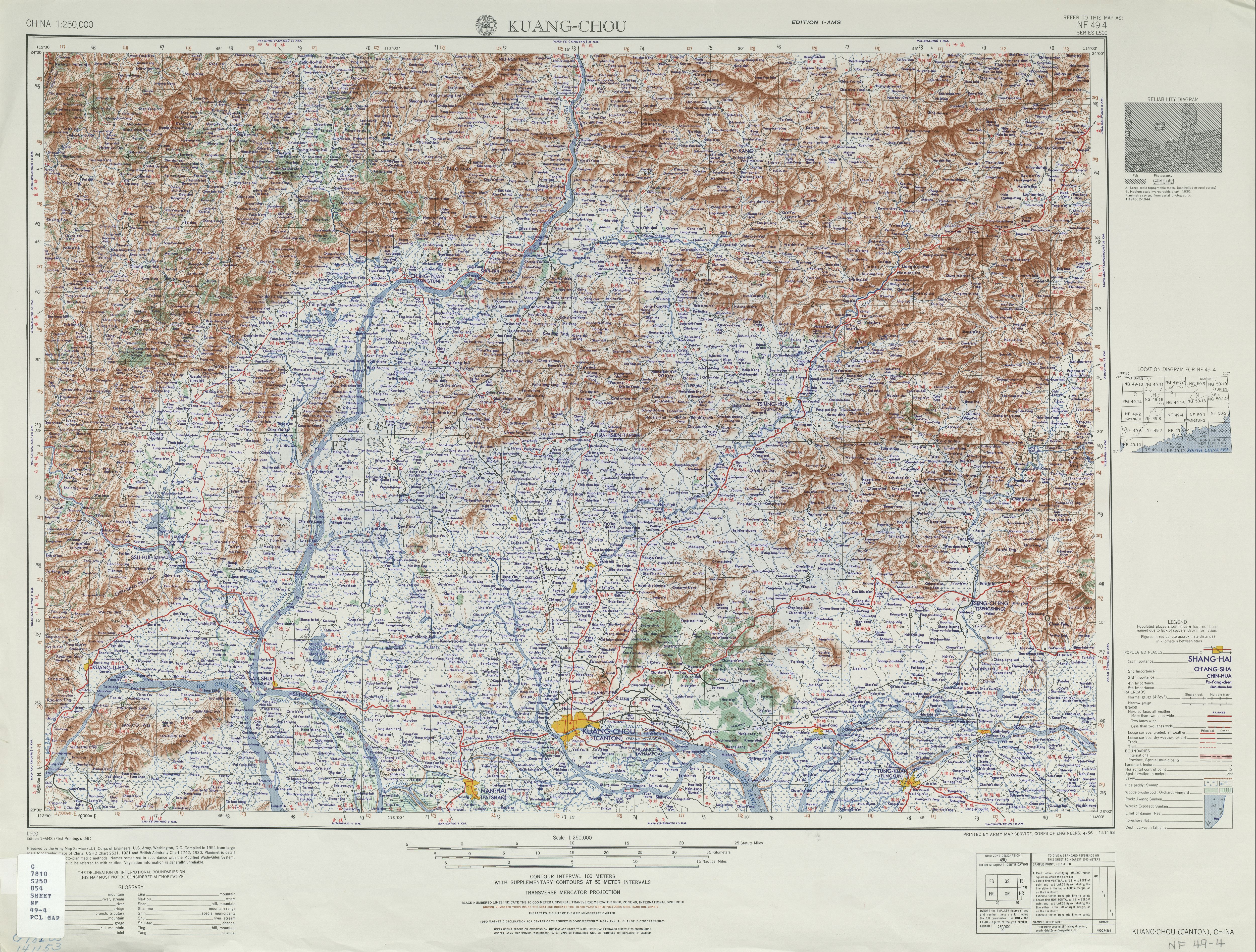
or
NF 49-4 KUANG-CHOU (CANTON) AND VICINITY [verso] (3.1 MB)
![NF 49-4 KUANG-CHOU (CANTON) AND VICINITY [verso]](http://www.lib.utexas.edu/maps/ams/china/txu-oclc-10552568-nf49-4-back.jpg)
Subscribe to:
Posts (Atom)