The Dominion Post Wednesday, 23 May 2007
NIKKI MACDONALD/Dominion Post
Zhaoxing is quickly making its mark on the tourist trail and it won't be long before it's inundated by visitors. By Nikki Macdonald.
The streets of Zhaoxing are paved with rice. Every tiny piece of flat ground in the storybook wooden village is lined with scruffy canvas mats spread with the new harvest drying in the sun.
On the other side of the road women in hand-dyed indigo traditional dress with legs and backs bowed by hard labour shuffle past a shop selling the latest cellphones.
This is the new China – a land of contradictions and growing chasms between the peasant life of the rural masses and the burgeoning middle class.
Zhaoxing is heartland, a subsistence village in southern Guizhou province, reliant on the endless staircases of paddy fields. It's three days to the nearest airport; three days on local buses lurching along unpaved roads in the brain-crunching heat. Three days sitting in the aisles on plastic kiddies' tea-party stools wedged between ducks and chickens on their way to or from market.
Pacing the flawless boutique-lined boulevards of Shanghai, flanked by trendy teens with feathered and blonded hair, and cellphone charms, it's easy to forget that only a fraction of China's 1.3 billion population are reaping the benefits of the country's incredible economic boom.
It is hard to imagine that this is what Karl Marx pictured when espousing the virtues of communism – the rich flourish as half the country's gross domestic product comes from private companies, while the poor still have to pay for their education and healthcare.
Zhaoxing at least has the drawcard of tourism. Populated by the colourful Dong ethnic minority, with swaths of egg-white-coated indigo cloth drying in droopy M shapes from balconies and buck-toothed old women yakking by the canals, the pedestrian village has a charm that transcends its relative poverty.
The trappings of tourist cash are already beginning to show – cafes with an English menu selling pizzas and banana smoothies, satellite dishes, guest houses under construction, an assortment of ethnic wares for sale in dingy shops.
A strangely familiar tune blares out from the barber's shop TV – "A, B, C, D . . .". An enterprising mother has bought a Learn your ABCs DVD for her young son, in a bid to get him learning English early. Too bad he's more interested in his super robot swap cards.
Fittingly, Zhaoxing means "beginning to prosper".
In 20 years, when the road has been upgraded, Zhaoxing will be awash with foreign and Chinese tourists, like countless other small towns and villages that have already captured travellers' imaginations.
But for now its residents are mostly still more interested in going about their daily lives than paying much attention to their curious guests.
Lulu's Place takes a very relaxed attitude to business – trying to find someone to take your money requires commitment and though the guesthouse has a menu including dubious delights such as cow bile and pork with fresh blood, there is no kitchen or chef to be seen.
Zhaoxing is one of those places where you can fritter away hours wandering, watching, absorbing the rustic scenes. Shrunken old men with drawn faces but beady eyes sit cross- legged in the shade of covered bridges, playing some kind of variant on chess.
Children practise their version of the Kiwi schoolyard favourite of elastics, cartwheeling over a raised rope.
Men and women, young and old, scale the surrounding hills to the rice paddies. Stalks are scythed, their heads thrust into treadle-powered barrel threshers to separate the edible grains. The crop is packed into great sacks and wobbled back down to town, one sack hung over either end of a pole, slung across the back of the neck.
Left on the field are browning bundles of stalks, standing like scarecrow sentries at a community meeting.
Back in town celebrations are afoot. A wedding perhaps? From the lantern-lit second-floor restaurant balcony, furnished with a cold beer, we watch as an explosion of firecrackers breaks the peace. What looks like an entire roll of double happies is lit and unravelled along the street, scattering sparks and waxy red paper and carrying its reverberating cackle to the door of the celebrations.
Small children follow hopefully in its wake, snatching at unexploded fragments, which they rebelliously light and toss into the river at the first sight of flames.
Zhaoxing is quickly making its mark on the tourist trail but nearby villages are not so fortunate. Caught out late afternoon with no bus connection, we stay in a town where tourists are rare and men stop to gawp at the white intruders. There is only one guesthouse of a standard that allows it to take foreigners, and that is modest. Poverty prevails and the marketplace is strewn with filth and flies.
It's a sight unremarkable in travelling terms but for the flashy opulence that seems to be increasingly synonymous with China's international image.
We share the pre-dawn bus out with a gaggle of men commuting to work – probably a factory in Liping about two hours away. This is the reality of life in the provinces – back-breaking labour in the fields or a four-hour daily commute.
Perhaps the most startling development is that their own countrymen are increasingly joining, if not supplanting, the stream of international tourists. With a middle class of more than 100 million and growing, many now use their brief holidays to sign on to a package tour to a scenic or rustic provincial destination.
And at home, in the cities with their lustrous sheen of new money, Lamborghini showrooms jockey for place with Louis Vuitton (the genuine article, that is).
Pet trainers, shoe designers and real estate brokers were among the list of new professions in 2006 and pets have become the latest accessory, paraded on seaside boulevards and through pedestrian precincts.
There can be little doubt that China is on the up. Or that it is a stunning, diverse and fascinating destination.
And who would deny the simple folk of Zhaoxing the chance to earn a healthy living without turning hunchback at middle age?
But for those seeking a slice of old time unspoilt by the endless drone of tour guide megaphones, the time to go is now.
Nikki Macdonald travelled courtesy of Cathay Pacific, Adventure World and Travel Indochina.
Wednesday, May 23, 2007

Saturday, May 19, 2007
No Olympic dream for Beijing's poor
5:00AM Saturday May 19, 2007
Beijing is clearing neighbourhoods to fulfil its Olympic dream. Photo / Reuters
BEIJING: Threatened with eviction but desperate not to leave, the residents of a derelict corner of China's capital cling to their crumbling homes like haggard castaways on a surging tide.
By day, the heart of the Guandong Dian neighbourhood teems with poor migrant workers buying cheap food and slurping hand-pulled noodles at stalls.
By night, prostitutes whisper at passers-by from doorways.
Its reeking alleyways and grey-brick huts lie in the shadows of luxury apartments and shimmering office blocks at the fringe of Beijing's brand new central business district.
But not for long. "By the end of this year, all of this will be gone," said snack vendor Wang Jinglong.
"People like me who rent and own stalls will have to find another place."
Guandong Dian, soon to be cleared to make way for an office block and a wider road, is one of dozens of crumbling shanty-towns pockmarking Beijing that have been earmarked for demolition before the Olympic Games in 2008.
Branding them "illegal urban villages", town planners demolished 55 of them in 2006 and started clearing another 25 as part of the city's "beautification" work.
Authorities are spending US$40 billion ($54.9 billion) to upgrade Beijing's creaky public transport system, build event venues and shift heavy industrial polluters far from city limits in line with a pledge to the International Olympic Committee to unclog congested roads and reduce air pollution for the games.
In a city of glittering skyscrapers, the shanty towns are inconvenient reminders of grinding poverty in China's heartland.
"There are at least 1000 of us here," said Wang, who once farmed a small plot in his home province of Henan, but now ekes out a living selling slices of "thousand-layer cake" from a hand-wheeled cart in Xiangjun Nanli. "Most of us are from outside of Beijing, from all over the country."
Wang is one of about four million migrant workers who live in Beijing but are not counted in its official population of 15 million.
Tens of thousands more arrive every year to wait at tables, work on construction sites or in the homes of the nouveau riche.
The dire poverty in China's heartland has created a drama played between Government officials determined to rid the city of its urban underclass and migrant workers equally determined not to leave.
For the poor people of Guandong Dian, the drama involves an obstacle course to basic rights including housing and health care.
Every day after waking up in an unheated room with a leaky roof, Wang wheels his cart past foul-smelling drains that quickly overflow when it rains.
Wang makes about 800 yuan ($137) a month from selling snacks. He can't afford to see a doctor if he gets sick and doesn't receive health care subsidies. He also hasn't seen his five-year-old daughter, whom he left in Henan with his mother, in over a year.
"Sure, it's tough here but I can make more than twice as much as I can at home," Wang said, adding he does not know where he will go. "But I won't be leaving the city."
- Reuters
Beijing is clearing neighbourhoods to fulfil its Olympic dream. Photo / Reuters
BEIJING: Threatened with eviction but desperate not to leave, the residents of a derelict corner of China's capital cling to their crumbling homes like haggard castaways on a surging tide.
By day, the heart of the Guandong Dian neighbourhood teems with poor migrant workers buying cheap food and slurping hand-pulled noodles at stalls.
By night, prostitutes whisper at passers-by from doorways.
Its reeking alleyways and grey-brick huts lie in the shadows of luxury apartments and shimmering office blocks at the fringe of Beijing's brand new central business district.
But not for long. "By the end of this year, all of this will be gone," said snack vendor Wang Jinglong.
"People like me who rent and own stalls will have to find another place."
Guandong Dian, soon to be cleared to make way for an office block and a wider road, is one of dozens of crumbling shanty-towns pockmarking Beijing that have been earmarked for demolition before the Olympic Games in 2008.
Branding them "illegal urban villages", town planners demolished 55 of them in 2006 and started clearing another 25 as part of the city's "beautification" work.
Authorities are spending US$40 billion ($54.9 billion) to upgrade Beijing's creaky public transport system, build event venues and shift heavy industrial polluters far from city limits in line with a pledge to the International Olympic Committee to unclog congested roads and reduce air pollution for the games.
In a city of glittering skyscrapers, the shanty towns are inconvenient reminders of grinding poverty in China's heartland.
"There are at least 1000 of us here," said Wang, who once farmed a small plot in his home province of Henan, but now ekes out a living selling slices of "thousand-layer cake" from a hand-wheeled cart in Xiangjun Nanli. "Most of us are from outside of Beijing, from all over the country."
Wang is one of about four million migrant workers who live in Beijing but are not counted in its official population of 15 million.
Tens of thousands more arrive every year to wait at tables, work on construction sites or in the homes of the nouveau riche.
The dire poverty in China's heartland has created a drama played between Government officials determined to rid the city of its urban underclass and migrant workers equally determined not to leave.
For the poor people of Guandong Dian, the drama involves an obstacle course to basic rights including housing and health care.
Every day after waking up in an unheated room with a leaky roof, Wang wheels his cart past foul-smelling drains that quickly overflow when it rains.
Wang makes about 800 yuan ($137) a month from selling snacks. He can't afford to see a doctor if he gets sick and doesn't receive health care subsidies. He also hasn't seen his five-year-old daughter, whom he left in Henan with his mother, in over a year.
"Sure, it's tough here but I can make more than twice as much as I can at home," Wang said, adding he does not know where he will go. "But I won't be leaving the city."
- Reuters
Obituary: Lei Guiying
5:00AM Saturday May 19, 2007
Lei Guiying, a Chinese woman who testified that she was forced to work in a brothel run by Japan's Imperial Army during World War II, has died at age 79.
Her death marks the passing of one of the few remaining known victims of sexual slavery during Japan's brutal invasion and occupation of much of China, Xinhua News Agency said.
Lei had said she was 13 when she was abducted and raped by Japanese soldiers, who four years earlier had sacked her hometown of Nanjing in the war's worst single atrocity.
She escaped after two years, but was unable to have children and remained silent about her experience for more than six decades.
Researchers say about 200,000 women, mainly from Korea, were forced to serve Japanese troops as prostitutes in army brothels during World War II.
In 1993 Japan's government issued an apology for running the brothels and two years later established a private fund to support the former slaves without conceding official responsibility.
Like most of the former slaves, Lei said she would reject any payment that did not include an official admission of guilt
Lei Guiying, a Chinese woman who testified that she was forced to work in a brothel run by Japan's Imperial Army during World War II, has died at age 79.
Her death marks the passing of one of the few remaining known victims of sexual slavery during Japan's brutal invasion and occupation of much of China, Xinhua News Agency said.
Lei had said she was 13 when she was abducted and raped by Japanese soldiers, who four years earlier had sacked her hometown of Nanjing in the war's worst single atrocity.
She escaped after two years, but was unable to have children and remained silent about her experience for more than six decades.
Researchers say about 200,000 women, mainly from Korea, were forced to serve Japanese troops as prostitutes in army brothels during World War II.
In 1993 Japan's government issued an apology for running the brothels and two years later established a private fund to support the former slaves without conceding official responsibility.
Like most of the former slaves, Lei said she would reject any payment that did not include an official admission of guilt
Saturday, May 05, 2007
Trade Me Ad
Potential are unlimited for this ex-loved family fruit and vegetable shop in Newtown's main street. Has a wide shop frontage (with existing shelfing)
Mid-Rangitikei History
Maori tribal land in this area has been lived on for over 500 years.
To the ancestors whose names still ring loud and clear over these mountain ranges from Kaimanawa to Tararua, Rest in the name of the lord not forgotten. Salutation to our sacred mountains, our rivers, and Mother Earth.
(Robertson 1995:15)
Pakeha history in the mid Rangitikei dates from 1839 when the first missionaries entered the area. The Rangitikei Block was purchased in 1849 for the Provincial Government, though a farming community was established only at the turn of the century.
There is reference in Robertson’s (1995:25) centennial history of Taihape to unemployment problems in the area as early as the 1890s.
‘Townships’ such as Mataroa, Ohingaiti and Mangaweka were once centres of activity, because of poor roads, and horse-drawn transport, sawmilling, building of the railway line and farming. In 1911 Mangaweka had a population of 600. There were once two grocers, two clothing shops, a tailor, a stationery shop, 2 garages, a Chinese fruit shop and many more shops and businesses. Today it has a population bordering on 200 and four shops or businesses: an adventure garage, a pub, an electrician and a secondhand furniture shop. Hunterville Primary had over 400 children attending in the early 1950s.
In 1960 the Railways Department was the biggest employer of boys and men in Taihape. For boys it was often work on the railways, or roads. One woman suggested that a choice of career for girls growing up in the area meant either "the telephone exchange or the post office". In rural areas farming was the favoured way of life; boys followed their dads onto the farm. Sport was crucial important, then and now. Football "was never played in Pohunui as we never had a piece of level ground large enough".
To the ancestors whose names still ring loud and clear over these mountain ranges from Kaimanawa to Tararua, Rest in the name of the lord not forgotten. Salutation to our sacred mountains, our rivers, and Mother Earth.
(Robertson 1995:15)
Pakeha history in the mid Rangitikei dates from 1839 when the first missionaries entered the area. The Rangitikei Block was purchased in 1849 for the Provincial Government, though a farming community was established only at the turn of the century.
There is reference in Robertson’s (1995:25) centennial history of Taihape to unemployment problems in the area as early as the 1890s.
‘Townships’ such as Mataroa, Ohingaiti and Mangaweka were once centres of activity, because of poor roads, and horse-drawn transport, sawmilling, building of the railway line and farming. In 1911 Mangaweka had a population of 600. There were once two grocers, two clothing shops, a tailor, a stationery shop, 2 garages, a Chinese fruit shop and many more shops and businesses. Today it has a population bordering on 200 and four shops or businesses: an adventure garage, a pub, an electrician and a secondhand furniture shop. Hunterville Primary had over 400 children attending in the early 1950s.
In 1960 the Railways Department was the biggest employer of boys and men in Taihape. For boys it was often work on the railways, or roads. One woman suggested that a choice of career for girls growing up in the area meant either "the telephone exchange or the post office". In rural areas farming was the favoured way of life; boys followed their dads onto the farm. Sport was crucial important, then and now. Football "was never played in Pohunui as we never had a piece of level ground large enough".

Better, cheaper and fresher' is the catch-cry
12:00AM Monday July 25, 2005 By Owen Hembry
Fruit World managing director Ronald Chan in his Ponsonby, Auckland, fruit shop.
The annual Roger Davies Trophy for services to horticulture has been awarded to a greengrocer who started selling fruit and vegetables to Aucklanders more than 50 years ago. Ronald Chan started work in his father's Auckland fruit and vegetable shop aged 13 after immigrating to New Zealand with his family in 1949 - 56 years later his Fruit World franchise has 19 stores and growing. Most people would call it a day after 56 years but at nearly 70, Chan still gets up in the dark six days a week to buy the freshest fruit and vegetables he can find at market - and looking 20 years younger than he should - he doesn't plan on retiring. "It's my hobby, my life, my dream forever," he said. "This industry is mine, it's me." The trophy was established by horticulture produce distributor Turners and Growers to commemorate the contribution of the late Roger Davies to the industry. Davies was president of the Kerikeri Fruitgrowers Association and was awarded the New Zealand Order of Merit for services to horticulture. Nominations are open to anyone involved in the manufacture, supply or sale of horticulture produce, with winners decided by the Turners and Growers board of directors. The winner must show leadership, enthusiasm, determination and innovation in achieving a project or development beneficial to the industry. In 1973 Chan and two partners won the contract to run the fruit and vegetable section of 3Guys retail chain. Their constant appearance at meetings with founder Albert Gubay left Chan pondering whether they were in fact the inspiration for the store's name. A break from greengrocery in 1986 took Chan to Hong Kong to try his hand at the jewellery business. But the grocery trade was in his blood and he was soon back in New Zealand looking to challenge the supermarkets with the co-founding of Vegie World in 1991. In 2001 he founded Fruit World before quickly expanding it to 19 stores around Auckland and Hamilton. An earlier meeting with Foodtown founder Tom Ah Chee inspired him to find a way to compete. "He said to me in 1970, by 1980 there will be no more fruit shops," he said. "But I am so happy the fruit shop still survives [and] we still make a good living out of it." Rather than hide from the supermarkets, Chan targets locations beside them, encouraging the shopper to walk just a little further to buy their fruit and vegetables. "We have to be better before [customers] come to us," he said. "We've got to be better, cheaper and fresher." A motivation to succeed still gets him to the market as early as 3am six days a week to buy the best quality at the best price. Chan demands a seven-days-a-week commitment from anyone wanting to own a Fruit World franchise. "If you don't love what you do, don't be in the game. You won't be successful." Although he lives and breathes the fruit and vegetable trade Chan does have another passion - performing Chinese opera. Not surprisingly his favourite role is as the emperor. The Winner * What: The Roger Davies Trophy. * Who : 2005 Winner, Ronald Chan, managing director Fruit World. * Why: For his contribution to the fruit and vegetable
Fruit World managing director Ronald Chan in his Ponsonby, Auckland, fruit shop.
The annual Roger Davies Trophy for services to horticulture has been awarded to a greengrocer who started selling fruit and vegetables to Aucklanders more than 50 years ago. Ronald Chan started work in his father's Auckland fruit and vegetable shop aged 13 after immigrating to New Zealand with his family in 1949 - 56 years later his Fruit World franchise has 19 stores and growing. Most people would call it a day after 56 years but at nearly 70, Chan still gets up in the dark six days a week to buy the freshest fruit and vegetables he can find at market - and looking 20 years younger than he should - he doesn't plan on retiring. "It's my hobby, my life, my dream forever," he said. "This industry is mine, it's me." The trophy was established by horticulture produce distributor Turners and Growers to commemorate the contribution of the late Roger Davies to the industry. Davies was president of the Kerikeri Fruitgrowers Association and was awarded the New Zealand Order of Merit for services to horticulture. Nominations are open to anyone involved in the manufacture, supply or sale of horticulture produce, with winners decided by the Turners and Growers board of directors. The winner must show leadership, enthusiasm, determination and innovation in achieving a project or development beneficial to the industry. In 1973 Chan and two partners won the contract to run the fruit and vegetable section of 3Guys retail chain. Their constant appearance at meetings with founder Albert Gubay left Chan pondering whether they were in fact the inspiration for the store's name. A break from greengrocery in 1986 took Chan to Hong Kong to try his hand at the jewellery business. But the grocery trade was in his blood and he was soon back in New Zealand looking to challenge the supermarkets with the co-founding of Vegie World in 1991. In 2001 he founded Fruit World before quickly expanding it to 19 stores around Auckland and Hamilton. An earlier meeting with Foodtown founder Tom Ah Chee inspired him to find a way to compete. "He said to me in 1970, by 1980 there will be no more fruit shops," he said. "But I am so happy the fruit shop still survives [and] we still make a good living out of it." Rather than hide from the supermarkets, Chan targets locations beside them, encouraging the shopper to walk just a little further to buy their fruit and vegetables. "We have to be better before [customers] come to us," he said. "We've got to be better, cheaper and fresher." A motivation to succeed still gets him to the market as early as 3am six days a week to buy the best quality at the best price. Chan demands a seven-days-a-week commitment from anyone wanting to own a Fruit World franchise. "If you don't love what you do, don't be in the game. You won't be successful." Although he lives and breathes the fruit and vegetable trade Chan does have another passion - performing Chinese opera. Not surprisingly his favourite role is as the emperor. The Winner * What: The Roger Davies Trophy. * Who : 2005 Winner, Ronald Chan, managing director Fruit World. * Why: For his contribution to the fruit and vegetable
The Village Mt Eden
Kong Chew "KC" Loo's fruit shop is a Mt Eden landmark and consistently rates in the "Best of Auckland" surveys.
KC opened shop in 1949 and wife Eileen joined him in 1953 and they have not missed a day since. KC arrived in New Zealand from China as a youngster in 1939, just after the outbreak of WWII.
He was one of the last immigrants from China to pay the notorious "poll" imposed to stem the flow of migrants.
The current site of KC Loo's fruit shop is in the prime retailing location in the Village. Its unique design marries well with the older style of the Village and adds to the Bohemian flavour of Mt Eden.
Barry and Jim by Don Long
Barry and Jim by Don Long
Just before school started for the term, Jin arrived from China. His mum and dad bought the fruit and vegetable shop.They moved into the flat behind.
At the same time, Barry arrived from the South Island.His mum and dad bought the bakery.They moved in upstairs.
Jin helped his mum and dad put out the fruit and vegetables.
Barry helped his mum and dad put out the cakes and pies.
The two shops opened on the same Saturday.
Barry and Jin started school together on Monday.The school was close to the shops.
“Good morning, Room 2. We have two new pupils today.Barry has just moved up from Dunedin and Jin comes from Canton.”
Barry and Jin didn’t look at anyone.They both felt shy.
When the lunch bell rang, Mrs Hurinui smiled at Barry and Jin.“Since you both live close by you are allowed to go home for lunch. Don’t forget to come back before the bell rings at 1.00 though.”
The two boys nodded and walked out to the road.
“Hello,” said Barry. “I’m Barry.”
“Hello,” said Jin, copying what Barry said.“I’m Jin.”
“Jim,” said Barry. “So you’re new too.”
Pretty soon, everyone was calling Jin “Jim”.
“Do like being called ‘Jim’?” Jin’s mum asked.
Jin nodded yes. He liked Barry.
“Okay,” his mum and dad said. “We’ll call you ‘Jim” too. That can be your New Zealand name.
“Could Barry come home for lunch with me one day?” asked Jim.
Jim’s mum looked at Jim’s dad.Jim’s dad looked at Jim’s mum.They were pleased that Jim had a friend.They both nodded.“You can invite him to come next week. We’ll talk to his parents.”
So on Monday, Barry didn’t go home to the bakery for lunch.He went home with Jim instead.
Behind the fruit and the vegetables and the cash register there was a bead curtain. Behind the bead curtain there was a world Barry had never seen before.
There were blue cups and Chinese newspapers.There were soy sauce and chop sticks.There were bags of rice and two ducks sitting in a cage.
Barry had never had chai chow fan before.He’d never eaten with chop sticks.Jim showed him how.Barry loved the taste of the fried rice Jim’s mum had made.He held his bowl the same way Jim and his mum did.It was easy.
The next day, Jim went to the bakery for lunch.“Pick what you want,” said Barry’s dad. “Barry’s mum is making cocoa upstairs.Jim picked out the same things Barry did.Then they took their hot pies and cream buns upstairs.
Barry’s mum smiled and put three mugs of cocoa on the table.“I’ve got to look after the shop,” she said. “I’ll be back in a bit. Will you two be okay?”
Barry nodded.
Barry put tomato sauce on his mince pie.So did Jim.Barry took a bite.So did Jim.
The mince pie was the strangest thingJim had ever tasted.He liked it. He took another bite.
Barry showed Jim how to take one bite of mince pie, one bite of cream bun, and a sip of cocoa and then swallow.
“That’s disgusting!” laughed Barry’s dad when he came up with his lunch. “Don’t let Mum catch you!”Then he did exactly the same.
Jim thought it tasted wonderful.
After that, Barry and Jim took turns having lunch at each other’s shops.Behind the fruit and vegetable shop Barry grew to love Chinese food, though he was a bit sad about the ducks.
And Jim fell in love with hot pies with tomato sauce and cream buns and apple turnovers.He especially liked potato top.
Slowly, Jim learned the names of things in English.
Barry learned how to say some things in Cantonese, which was the kind of Chinese that Jim spoke.
And they never stopped being best friends.
This story is dedicated to Jim Lai (28 May 1949 - 10 December 2004).
With thanks to Barry and Jim’s family, whose story this really is. Thank you all for giving me permission to tell it.
There are now as many people in New Zealand of Asian ancestry as people of Pacific Islands descent. People of Chinese descent form the largest group.
© Don Long
http://library.christchurch.org.nz/Kids/ChildrensAuthors/Stories/DonLong.asp
Just before school started for the term, Jin arrived from China. His mum and dad bought the fruit and vegetable shop.They moved into the flat behind.
At the same time, Barry arrived from the South Island.His mum and dad bought the bakery.They moved in upstairs.
Jin helped his mum and dad put out the fruit and vegetables.
Barry helped his mum and dad put out the cakes and pies.
The two shops opened on the same Saturday.
Barry and Jin started school together on Monday.The school was close to the shops.
“Good morning, Room 2. We have two new pupils today.Barry has just moved up from Dunedin and Jin comes from Canton.”
Barry and Jin didn’t look at anyone.They both felt shy.
When the lunch bell rang, Mrs Hurinui smiled at Barry and Jin.“Since you both live close by you are allowed to go home for lunch. Don’t forget to come back before the bell rings at 1.00 though.”
The two boys nodded and walked out to the road.
“Hello,” said Barry. “I’m Barry.”
“Hello,” said Jin, copying what Barry said.“I’m Jin.”
“Jim,” said Barry. “So you’re new too.”
Pretty soon, everyone was calling Jin “Jim”.
“Do like being called ‘Jim’?” Jin’s mum asked.
Jin nodded yes. He liked Barry.
“Okay,” his mum and dad said. “We’ll call you ‘Jim” too. That can be your New Zealand name.
“Could Barry come home for lunch with me one day?” asked Jim.
Jim’s mum looked at Jim’s dad.Jim’s dad looked at Jim’s mum.They were pleased that Jim had a friend.They both nodded.“You can invite him to come next week. We’ll talk to his parents.”
So on Monday, Barry didn’t go home to the bakery for lunch.He went home with Jim instead.
Behind the fruit and the vegetables and the cash register there was a bead curtain. Behind the bead curtain there was a world Barry had never seen before.
There were blue cups and Chinese newspapers.There were soy sauce and chop sticks.There were bags of rice and two ducks sitting in a cage.
Barry had never had chai chow fan before.He’d never eaten with chop sticks.Jim showed him how.Barry loved the taste of the fried rice Jim’s mum had made.He held his bowl the same way Jim and his mum did.It was easy.
The next day, Jim went to the bakery for lunch.“Pick what you want,” said Barry’s dad. “Barry’s mum is making cocoa upstairs.Jim picked out the same things Barry did.Then they took their hot pies and cream buns upstairs.
Barry’s mum smiled and put three mugs of cocoa on the table.“I’ve got to look after the shop,” she said. “I’ll be back in a bit. Will you two be okay?”
Barry nodded.
Barry put tomato sauce on his mince pie.So did Jim.Barry took a bite.So did Jim.
The mince pie was the strangest thingJim had ever tasted.He liked it. He took another bite.
Barry showed Jim how to take one bite of mince pie, one bite of cream bun, and a sip of cocoa and then swallow.
“That’s disgusting!” laughed Barry’s dad when he came up with his lunch. “Don’t let Mum catch you!”Then he did exactly the same.
Jim thought it tasted wonderful.
After that, Barry and Jim took turns having lunch at each other’s shops.Behind the fruit and vegetable shop Barry grew to love Chinese food, though he was a bit sad about the ducks.
And Jim fell in love with hot pies with tomato sauce and cream buns and apple turnovers.He especially liked potato top.
Slowly, Jim learned the names of things in English.
Barry learned how to say some things in Cantonese, which was the kind of Chinese that Jim spoke.
And they never stopped being best friends.
This story is dedicated to Jim Lai (28 May 1949 - 10 December 2004).
With thanks to Barry and Jim’s family, whose story this really is. Thank you all for giving me permission to tell it.
There are now as many people in New Zealand of Asian ancestry as people of Pacific Islands descent. People of Chinese descent form the largest group.
© Don Long
http://library.christchurch.org.nz/Kids/ChildrensAuthors/Stories/DonLong.asp
Tuesday, May 01, 2007
Elders of the Yiu Ming Society Speak
elders of the Yiu Ming Society speak about their experiences as Chinese in Australia
HARRY CHOY
Company director; President, Yiu Ming Society; Chairman, Tiy Loy & Co
I was born in Hong Kong in 1938 and then taken back to China when I was three months old. My mother had given birth to ten children, but only three had survived and it was safer to deliver a child in Hong Kong. I was the only son. My grandfather was a judge in mainland China and had seven daughters and five sons. He owned about 18 acres and 15 houses and had two male servants and two female servants. The family fortunes declined when the daughters were married off, as each of them needed dowry. My father had been sent to work in Australia in 1908 although he went back to China once or twice a year.
My village is known as Datangbian/Taitongbian, in Gaoyao/Gouyiu county. Our village had a temple known as Song Jian/Song Gan, similar to the Yiu Ming temple. There were many village celebrations; we would parade the temple figures during the Mid-autumn festival on 15 August. The lion dance was common in the countryside also. Weddings were celebrated at Song Gan, and funerals were held there as well. The bodies were left there one or two days, covered by a piece of cloth, for blessing and protection by Guanyin/Gunyom [Bodhisattva or Goddess of Mercy] and then they were dressed for the nether world before they were put into coffins. Prayers were also held at Song Gan before going abroad. In 1950 when the Communists came, they demolished the temple, and also burned the figures and all scriptures. This happened at every village, not only my village. It became unsafe to leave me at home as I was the only son from a big landlord family so l was brought out by my father to Australia. My mother had a very bad time. She stayed in China and was beaten with stones and spat on. I eventually brought her and my sister out in 1957.
http://www.teachingheritage.nsw.edu.au/d_reshaping/wd3_yiuelders.html
HARRY CHOY
Company director; President, Yiu Ming Society; Chairman, Tiy Loy & Co
I was born in Hong Kong in 1938 and then taken back to China when I was three months old. My mother had given birth to ten children, but only three had survived and it was safer to deliver a child in Hong Kong. I was the only son. My grandfather was a judge in mainland China and had seven daughters and five sons. He owned about 18 acres and 15 houses and had two male servants and two female servants. The family fortunes declined when the daughters were married off, as each of them needed dowry. My father had been sent to work in Australia in 1908 although he went back to China once or twice a year.
My village is known as Datangbian/Taitongbian, in Gaoyao/Gouyiu county. Our village had a temple known as Song Jian/Song Gan, similar to the Yiu Ming temple. There were many village celebrations; we would parade the temple figures during the Mid-autumn festival on 15 August. The lion dance was common in the countryside also. Weddings were celebrated at Song Gan, and funerals were held there as well. The bodies were left there one or two days, covered by a piece of cloth, for blessing and protection by Guanyin/Gunyom [Bodhisattva or Goddess of Mercy] and then they were dressed for the nether world before they were put into coffins. Prayers were also held at Song Gan before going abroad. In 1950 when the Communists came, they demolished the temple, and also burned the figures and all scriptures. This happened at every village, not only my village. It became unsafe to leave me at home as I was the only son from a big landlord family so l was brought out by my father to Australia. My mother had a very bad time. She stayed in China and was beaten with stones and spat on. I eventually brought her and my sister out in 1957.
http://www.teachingheritage.nsw.edu.au/d_reshaping/wd3_yiuelders.html
Author and teacher, Elizabeth Chong Cooking School, Melbourne)
The spirit of Melbourne's Chinese community shines in Elizabeth Chong, an amazingly youthful and energetic woman. She thrives on the joys of Chinese food, teaches it, and demonstrates its preparation on television. She takes tours through her beloved Chinatown, and promotes its activities in many ways.
The Chong family, however, has exercised real influence over Australia's eating habits since 1945 when Elizabeth's father, William Wing Young, began the restaurant Wing Lee's, and produced the first dim sim.
"My father was the first to create the style and shape and the commercial production of the dim sim," says Elizabeth.
"He chose the thick skin for ease of transport; he used to deliver them in his Chevy to the football where he set up in competition with the Four-and-Twenty pie. Before long, his factory was producing thousands of them for sale throughout Australia."
Elizabeth recalls living in Franklin Street opposite Victoria Market and beside the dim sim factory. Her father was also a wholesale fruiterer, one of the largest in the market, and was known, according to Elizabeth, both as the Chicken Roll King and the Peanut King.
"Food and cooks were always a part of my life," says Elizabeth. "I stopped briefly to have four children, but found I needed to express myself out of the home scene. I started giving talks to the parents of children in my son's class, and they asked me to give them cooking lessons. So the cooking school began in 1961." Elizabeth demonstrates - this is good for the eye-sight and that for prosperity - Chinese tradtion explains every ingredient.
http://www.miettas.com.au/chefs/mietta_friends/chong.html
The Chong family, however, has exercised real influence over Australia's eating habits since 1945 when Elizabeth's father, William Wing Young, began the restaurant Wing Lee's, and produced the first dim sim.
"My father was the first to create the style and shape and the commercial production of the dim sim," says Elizabeth.
"He chose the thick skin for ease of transport; he used to deliver them in his Chevy to the football where he set up in competition with the Four-and-Twenty pie. Before long, his factory was producing thousands of them for sale throughout Australia."
Elizabeth recalls living in Franklin Street opposite Victoria Market and beside the dim sim factory. Her father was also a wholesale fruiterer, one of the largest in the market, and was known, according to Elizabeth, both as the Chicken Roll King and the Peanut King.
"Food and cooks were always a part of my life," says Elizabeth. "I stopped briefly to have four children, but found I needed to express myself out of the home scene. I started giving talks to the parents of children in my son's class, and they asked me to give them cooking lessons. So the cooking school began in 1961." Elizabeth demonstrates - this is good for the eye-sight and that for prosperity - Chinese tradtion explains every ingredient.
http://www.miettas.com.au/chefs/mietta_friends/chong.html
The Poys of Australia
The name Poy, which is my married name, comes from the Poys of Australia. My husband’s grandfather migrated to Australia at the end of the 19th century from Toisan in South China. The Poys lived in Chiltern, Victoria, where Grandfather owned a general store called Willie Ah Poy Fruiterer and Confectioner. The Poys have increased and prospered in Australia, the only one having left being my father-in-law. As the eldest son, he was sent back to the village in China in his late teens. He made his way to Hong Kong, got married, started his family and the entire family moved to Canada in 1942. As for members of my own family, a few have also immigrated to Australia in recent years and have prospered.
http://www.sen.parl.gc.ca/vpoy/english/Special_Interests/speeches/Nortel_Networks_July00.htm
http://www.sen.parl.gc.ca/vpoy/english/Special_Interests/speeches/Nortel_Networks_July00.htm
http://takaoclub.com/personalities/Stent/index.htm
In 1882 George Carter Stent was assigned to Takow by the Chinese Maritime Customs. By the end of 1884 he was dead and buried in the Takow Foreign Cemetery. Despite his modest beginnings, Stent built a successful career in China, became a Freemason, and made solid literary achievements with several books and dictionaries. Perhaps, above all, George Carter Stent offers a fascinating glimpse into the lifestyle of an Englishman in China and the East in the latter part of the 19th century
In 1882 George Carter Stent was assigned to Takow by the Chinese Maritime Customs. By the end of 1884 he was dead and buried in the Takow Foreign Cemetery. Despite his modest beginnings, Stent built a successful career in China, became a Freemason, and made solid literary achievements with several books and dictionaries. Perhaps, above all, George Carter Stent offers a fascinating glimpse into the lifestyle of an Englishman in China and the East in the latter part of the 19th century
The Chinese-Australian Historical Images in Australia
http://www.chia.chinesemuseum.com.au/home.html
The Chinese-Australian Historical Images in Australia (CHIA) database is a catalogue of historical images of Chinese, Chinese immigrants and their descendants held in Australia. It primarily draws on the photographic holdings of the Chinese Museum but also includes photographs from other online archives, publications and private family collections. Built into the database is the beginnings of an encyclopaedia of Chinese-Australian history, complete with bibliography, which provides contextual information about the images in the database.
The Chinese-Australian Historical Images in Australia (CHIA) database is a catalogue of historical images of Chinese, Chinese immigrants and their descendants held in Australia. It primarily draws on the photographic holdings of the Chinese Museum but also includes photographs from other online archives, publications and private family collections. Built into the database is the beginnings of an encyclopaedia of Chinese-Australian history, complete with bibliography, which provides contextual information about the images in the database.
Monday, April 30, 2007
Linking two cultures good way to express nationality
5:00AM Monday April 30, 2007By Lincoln Tan
Is Lincoln right? Should we all be hyphenated New Zealanders?
I was waiting for a flight to Christchurch when an Asian man asked me where I was from. I instinctively said Singapore, then tried to qualify it by saying that I had been living in New Zealand for 10 years.
Introducing himself as a Korean-American who has lived in New York for the past 12 years, the man quipped that I would not have been forgiven by Americans had I lived 10 years in the United States and made a similar remark.
Americans, he said, considered it almost a mortal sin for anyone living there not to consider themselves American.
I told him the attitudes were quite different in New Zealand, and that I was actually on my way to Christchurch as a presenter at a forum on national identity to discuss the very issue of what makes a New Zealander.
Some people here would like to keep the term New Zealander as an exclusive term for people of New Zealand's main culture.
So, unlike the Americans, it does not come naturally for most ethnic minorities living here to identify themselves with a hyphenated term such as Chinese-New Zealander or Korean-New Zealander.
I told him about this column and the lambasting I got from readers following the column where I said some will never consider me 100 per cent Kiwi.
In that column, I also wrote about the shock I had when a third-generation local-born Chinese man said some New Zealanders don't consider him a Kiwi and he still faced taunts from people telling him to "go back to where you come from".
What I wrote drew letters to the editor labelling me as being misguided and obsessed with wanting to be Kiwi.
Garth George said in his last column that it was a fact of life for columnists that readers who disagree write letters to the editor and those who agree generally send lovely personal emails. I wish I could say it was the same for me, but it is not.
Most of the emails to me were even more vile and venomous than the ones sent to the editor.
One read: "The truth is, neither you nor any of your Chinese friends and relatives will ever be a Kiwi, so don't bother trying."
Another said: "I want to go somewhere where I will not have to read such ignorant, stupid and harmful views as yours. What right do you have to come here and make New Zealand worse for me?"
Bruce Morley argued that New Zealand is no different to China. He wrote: "If I were to spend 10 or even 20 years in Beijing, would that suddenly miraculously make me an Asian? Why should being a Kiwi be any easier or different?"
Charles Laing felt that New Zealand was no different to Japan and Korea where the people don't even realise that they are racist in excluding outsiders by claiming to be ethnically and culturally unique. But New Zealand is different and so is being a New Zealander.
Professor Francis Fukuyama, of John Hopkins University, wrote: "Japanese (like other old societies of Europe and Asia) were a people with shared histories long before democracies. They have other sources of identity besides politics. They have seen a variety of regimes come and go."
Societies such as those in Japan and France are very different from those in the US and New Zealand, or even Singapore for that matter, which were founded on the basis of a political idea.
On America, Prof Fukuyama wrote: "There was no American people or nation prior to the founding of the country, and national identity is civic rather than religious, cultural, racial or ethnic."
In many respects, New Zealand is like America. So while immigrants to Japan or China will never become Japanese or Chinese, ethnicity should not be the basis on who gets to become a New Zealander or American in countries where national identity is a civic one.
In the last Census, more than 11 per cent of the population categorised themselves as ethnic New Zealanders.
Reports tell us that in the previous Census they would have been put into the category of New Zealand Europeans.
Is this just another way for some in the majority culture to claim exclusive rights to the use of the term New Zealander?
In looking at the diverse ethnic makeup of the new New Zealand, in a country where a quarter of its people are born overseas, would it not be more advantageous if we took the American attitude in encouraging people to feel a greater sense of belonging and emotional attachment to their adopted country?
Perhaps adopting the American way of identifying people with hyphenated identities is the way forward.
I can't run away from the fact that I am ethnically Chinese, but New Zealand is where I belong so I'd be happy to be termed a Chinese-New Zealander.
Is Lincoln right? Should we all be hyphenated New Zealanders?
I was waiting for a flight to Christchurch when an Asian man asked me where I was from. I instinctively said Singapore, then tried to qualify it by saying that I had been living in New Zealand for 10 years.
Introducing himself as a Korean-American who has lived in New York for the past 12 years, the man quipped that I would not have been forgiven by Americans had I lived 10 years in the United States and made a similar remark.
Americans, he said, considered it almost a mortal sin for anyone living there not to consider themselves American.
I told him the attitudes were quite different in New Zealand, and that I was actually on my way to Christchurch as a presenter at a forum on national identity to discuss the very issue of what makes a New Zealander.
Some people here would like to keep the term New Zealander as an exclusive term for people of New Zealand's main culture.
So, unlike the Americans, it does not come naturally for most ethnic minorities living here to identify themselves with a hyphenated term such as Chinese-New Zealander or Korean-New Zealander.
I told him about this column and the lambasting I got from readers following the column where I said some will never consider me 100 per cent Kiwi.
In that column, I also wrote about the shock I had when a third-generation local-born Chinese man said some New Zealanders don't consider him a Kiwi and he still faced taunts from people telling him to "go back to where you come from".
What I wrote drew letters to the editor labelling me as being misguided and obsessed with wanting to be Kiwi.
Garth George said in his last column that it was a fact of life for columnists that readers who disagree write letters to the editor and those who agree generally send lovely personal emails. I wish I could say it was the same for me, but it is not.
Most of the emails to me were even more vile and venomous than the ones sent to the editor.
One read: "The truth is, neither you nor any of your Chinese friends and relatives will ever be a Kiwi, so don't bother trying."
Another said: "I want to go somewhere where I will not have to read such ignorant, stupid and harmful views as yours. What right do you have to come here and make New Zealand worse for me?"
Bruce Morley argued that New Zealand is no different to China. He wrote: "If I were to spend 10 or even 20 years in Beijing, would that suddenly miraculously make me an Asian? Why should being a Kiwi be any easier or different?"
Charles Laing felt that New Zealand was no different to Japan and Korea where the people don't even realise that they are racist in excluding outsiders by claiming to be ethnically and culturally unique. But New Zealand is different and so is being a New Zealander.
Professor Francis Fukuyama, of John Hopkins University, wrote: "Japanese (like other old societies of Europe and Asia) were a people with shared histories long before democracies. They have other sources of identity besides politics. They have seen a variety of regimes come and go."
Societies such as those in Japan and France are very different from those in the US and New Zealand, or even Singapore for that matter, which were founded on the basis of a political idea.
On America, Prof Fukuyama wrote: "There was no American people or nation prior to the founding of the country, and national identity is civic rather than religious, cultural, racial or ethnic."
In many respects, New Zealand is like America. So while immigrants to Japan or China will never become Japanese or Chinese, ethnicity should not be the basis on who gets to become a New Zealander or American in countries where national identity is a civic one.
In the last Census, more than 11 per cent of the population categorised themselves as ethnic New Zealanders.
Reports tell us that in the previous Census they would have been put into the category of New Zealand Europeans.
Is this just another way for some in the majority culture to claim exclusive rights to the use of the term New Zealander?
In looking at the diverse ethnic makeup of the new New Zealand, in a country where a quarter of its people are born overseas, would it not be more advantageous if we took the American attitude in encouraging people to feel a greater sense of belonging and emotional attachment to their adopted country?
Perhaps adopting the American way of identifying people with hyphenated identities is the way forward.
I can't run away from the fact that I am ethnically Chinese, but New Zealand is where I belong so I'd be happy to be termed a Chinese-New Zealander.
Chinese students get shock on arrival in NZ, study finds
50PM Monday April 30, 2007By Reg Ponniah
Chinese students face a large gap between their expectations of New Zealand the reality, research has found.
Many felt lonely and isolated and found it hard to make New Zealand friends.
"They want to drive cars and be free and are not prepared adequately for the different lifestyle here and the culture shock," Waikato University researcher Elsie Ho said today.
"Together with freedom comes responsibility and they are unable to handle that."
They had problems that came with living on their own in a flat, far from their pampered lives in China, she said.
Language and cultural problems made it very difficult to adapt.
Emotional support was not always forthcoming from China as students were reluctant to reveal problems they faced.
However, almost half the Chinese students in New Zealand want to live here permanently, according to the study - which questioned more than 80 Chinese students in Auckland Rotorua, Hamilton and Christchurch.
Students in the study were at language schools, high schools and tertiary institutions.
Diverse backgrounds
They included new arrivals, as well as students who had been here for several years and came from diverse backgrounds, with different expectations.
Chinese students make up more than a third of 76,000 international students, bringing an estimated $700 million into New Zealand.
A 2004 Ministry of Education study showed Chinese were more dissatisfied than students from other countries.
However, they were also more likely to want to stay permanently, Dr Ho said.
It took much longer than they expected for their English to be good enough to study here, Dr Ho said.
"Students who came before 2003 tended to be more unhappy because they came with unrealistic expectations," she said.
"At that time NZ was a new study destination and very little was known about the country. They came here because it was a cheaper option and the exchange rate was favourable.
"Some of them came here after being rejected by other countries like Canada, Australia and the United States."
As the New Zealand dollar strengthened, the students complained of lower living standards, she said.
Later students came with a slightly better understanding of the education system here.
On average, they needed a year to obtain the required language skills for university.
Dr Ho urged immigration advisors in China to give better advice and prepare prospective students adequately before they arrived in New Zealand.
- NZPA
Chinese students face a large gap between their expectations of New Zealand the reality, research has found.
Many felt lonely and isolated and found it hard to make New Zealand friends.
"They want to drive cars and be free and are not prepared adequately for the different lifestyle here and the culture shock," Waikato University researcher Elsie Ho said today.
"Together with freedom comes responsibility and they are unable to handle that."
They had problems that came with living on their own in a flat, far from their pampered lives in China, she said.
Language and cultural problems made it very difficult to adapt.
Emotional support was not always forthcoming from China as students were reluctant to reveal problems they faced.
However, almost half the Chinese students in New Zealand want to live here permanently, according to the study - which questioned more than 80 Chinese students in Auckland Rotorua, Hamilton and Christchurch.
Students in the study were at language schools, high schools and tertiary institutions.
Diverse backgrounds
They included new arrivals, as well as students who had been here for several years and came from diverse backgrounds, with different expectations.
Chinese students make up more than a third of 76,000 international students, bringing an estimated $700 million into New Zealand.
A 2004 Ministry of Education study showed Chinese were more dissatisfied than students from other countries.
However, they were also more likely to want to stay permanently, Dr Ho said.
It took much longer than they expected for their English to be good enough to study here, Dr Ho said.
"Students who came before 2003 tended to be more unhappy because they came with unrealistic expectations," she said.
"At that time NZ was a new study destination and very little was known about the country. They came here because it was a cheaper option and the exchange rate was favourable.
"Some of them came here after being rejected by other countries like Canada, Australia and the United States."
As the New Zealand dollar strengthened, the students complained of lower living standards, she said.
Later students came with a slightly better understanding of the education system here.
On average, they needed a year to obtain the required language skills for university.
Dr Ho urged immigration advisors in China to give better advice and prepare prospective students adequately before they arrived in New Zealand.
- NZPA
Sunday, April 29, 2007
Wednesday, April 25, 2007
Translating cultures
http://www.vuw.ac.nz/stout-centre/documents/chinesenzbmoloughney.pdf
Brian Moloughney - Stout Seminar
Brian Moloughney - Stout Seminar

Unknown Chinaman Opunake

26 miles away from Hawera lies an unknown Chinaman. He comes from Sun Gai Village, died in 1918, at the age of 40. His name is Chan Lai Chun. According to the Poll Tax he arrived in 1906, at the age of 29. I am looking for more information on this man, and his fellow countryman, Chan Pakk Yue.
Monday, April 23, 2007
Lincoln Tan: Sharing stories will keep family memories alive
5:00AM Monday April 23, 2007By Lincoln Tan
If February is the month for love, then April must surely be the month dedicated to the dead.
This is the month when Christians remember the death of Jesus on Good Friday, Taoists/Buddhists remember their ancestors during the festival called Qing Ming, and New Zealanders too will be honouring their own glorious dead on Wednesday, Anzac Day.
As a child growing up in Singapore, it was an annual ritual at this time of the year for me to accompany my parents to the cemetery to clean up my two grandfathers' graves and to honour their memory.
Mum would wake early to prepare food, comprising a basket of fruit, some confectionery and coffee as if we were going for a picnic. There would also be a paper box filled with joss sticks, paper clothes and paper money.
The food was used as offerings for my two grandfathers and joss sticks were burned in their memory.
During the rituals, my parents would tell stories about the lives of my two grandfathers, and I had to update my dead grandfathers on how my life was progressing.
So even though I had never met either of my grandfathers, both of whom died before I was born, the Qing Ming rituals, which sadly we no longer practise since we became Catholics, made me feel like I knew them.
Over the years, I have heard many stories, but the ones that stuck in my mind were Mum's horror stories of the war years - which was also the first time she mentioned anything to me about New Zealand.
In one story, she spoke of how the Japanese soldiers came to the house for my maternal grandfather, promising him a job because he had been a civil servant under the British Government.
With hundreds of other men he was herded on to the military trucks. But instead of the office, they were taken to a rubber plantation to be shot.
Grandpa cheated death by timing his fall just before the bullets hit him during the mass execution, and crawled out after nightfall.
In another of Mum's stories, she spoke of how the arrival of soldiers from British India started another round of terror. With no enemy to fight, they instead went from house to house in search of women.
Had it not been for Grandpa grabbing her from the hands of one of these soldiers and flinging her over the second-storey balcony to safety, she too would have been raped by them, she said.
It was Mum's belief then that the last story before we left the graveyard had to be a happy one, so we walked away with happy memories.
In one of these stories, she told of when the real heroes came. Officers from a New Zealand battalion approached an aunt asking if her huge backyard could be used as a temporary base for his soldiers. She agreed.
For about three weeks, my aunt cooked for these soldiers and in exchange they gave her butter, milk powder and medicine, items which were near impossible to get at that time. It was the inability to access medicine that led to my paternal grandfather's death.
The New Zealand soldiers became friends of the family, and it was they who helped to restore Mum's faith and trust in uniformed men again, she said.
It was sad when the New Zealanders eventually had to leave my aunt's backyard for their base at Pulau Belakang Mati, an island now known as Sentosa.
But they left a strong enough impression for Mum to believe to this day that New Zealand men are true gentlemen.
On Anzac Day, New Zealand will remember its heroes from those who died in the Gallipoli conflict and the many others who have fought in Malaysia, Korea, Vietnam, East Timor, the Gulf and Afghanistan, among others.
But in the way Anzac Day is commemorated through parades, memorial services and wearing the poppy on the chest to honour our glorious dead, more can be done to share their stories to inspire the living.
Each one of these heroes is someone's father, grandfather or great-grandfather and surely, each one of their lives must have an interesting, colourful and inspirational story behind them. At last year's National Memorial Service, Dame Silvia Cartwright said: "It is in the faces of our young people who have not witnessed the horror of war and in the everyday freedoms we enjoy today, the freedoms we have come to expect in a way our grandparents never did or could."
Perhaps this Anzac Day, as we honour New Zealand's glorious dead, mums and dads could pack a picnic basket and make a conscious effort to share more stories of the Anzacs, our real heroes, to inspire our young Qing Ming style.
Email Lincoln Tan
If February is the month for love, then April must surely be the month dedicated to the dead.
This is the month when Christians remember the death of Jesus on Good Friday, Taoists/Buddhists remember their ancestors during the festival called Qing Ming, and New Zealanders too will be honouring their own glorious dead on Wednesday, Anzac Day.
As a child growing up in Singapore, it was an annual ritual at this time of the year for me to accompany my parents to the cemetery to clean up my two grandfathers' graves and to honour their memory.
Mum would wake early to prepare food, comprising a basket of fruit, some confectionery and coffee as if we were going for a picnic. There would also be a paper box filled with joss sticks, paper clothes and paper money.
The food was used as offerings for my two grandfathers and joss sticks were burned in their memory.
During the rituals, my parents would tell stories about the lives of my two grandfathers, and I had to update my dead grandfathers on how my life was progressing.
So even though I had never met either of my grandfathers, both of whom died before I was born, the Qing Ming rituals, which sadly we no longer practise since we became Catholics, made me feel like I knew them.
Over the years, I have heard many stories, but the ones that stuck in my mind were Mum's horror stories of the war years - which was also the first time she mentioned anything to me about New Zealand.
In one story, she spoke of how the Japanese soldiers came to the house for my maternal grandfather, promising him a job because he had been a civil servant under the British Government.
With hundreds of other men he was herded on to the military trucks. But instead of the office, they were taken to a rubber plantation to be shot.
Grandpa cheated death by timing his fall just before the bullets hit him during the mass execution, and crawled out after nightfall.
In another of Mum's stories, she spoke of how the arrival of soldiers from British India started another round of terror. With no enemy to fight, they instead went from house to house in search of women.
Had it not been for Grandpa grabbing her from the hands of one of these soldiers and flinging her over the second-storey balcony to safety, she too would have been raped by them, she said.
It was Mum's belief then that the last story before we left the graveyard had to be a happy one, so we walked away with happy memories.
In one of these stories, she told of when the real heroes came. Officers from a New Zealand battalion approached an aunt asking if her huge backyard could be used as a temporary base for his soldiers. She agreed.
For about three weeks, my aunt cooked for these soldiers and in exchange they gave her butter, milk powder and medicine, items which were near impossible to get at that time. It was the inability to access medicine that led to my paternal grandfather's death.
The New Zealand soldiers became friends of the family, and it was they who helped to restore Mum's faith and trust in uniformed men again, she said.
It was sad when the New Zealanders eventually had to leave my aunt's backyard for their base at Pulau Belakang Mati, an island now known as Sentosa.
But they left a strong enough impression for Mum to believe to this day that New Zealand men are true gentlemen.
On Anzac Day, New Zealand will remember its heroes from those who died in the Gallipoli conflict and the many others who have fought in Malaysia, Korea, Vietnam, East Timor, the Gulf and Afghanistan, among others.
But in the way Anzac Day is commemorated through parades, memorial services and wearing the poppy on the chest to honour our glorious dead, more can be done to share their stories to inspire the living.
Each one of these heroes is someone's father, grandfather or great-grandfather and surely, each one of their lives must have an interesting, colourful and inspirational story behind them. At last year's National Memorial Service, Dame Silvia Cartwright said: "It is in the faces of our young people who have not witnessed the horror of war and in the everyday freedoms we enjoy today, the freedoms we have come to expect in a way our grandparents never did or could."
Perhaps this Anzac Day, as we honour New Zealand's glorious dead, mums and dads could pack a picnic basket and make a conscious effort to share more stories of the Anzacs, our real heroes, to inspire our young Qing Ming style.
Email Lincoln Tan
Saturday, April 21, 2007
http://www.chsa.org/blog/?PHPSESSID=31110f978d58a4baa5253da11e203745
Chinese Historical Society of America Location:San Francisco, California, United States
Check back at our blog for items of interest concerning Chinese America. We'll post news from other historical & cultural organizations and other things that cross our radar - feel free to send us submissions for consideration!
Chinese Historical Society of America Location:San Francisco, California, United States
Check back at our blog for items of interest concerning Chinese America. We'll post news from other historical & cultural organizations and other things that cross our radar - feel free to send us submissions for consideration!
The Pioneer Chinese of Utah
http://historytogo.utah.gov/people/ethnic_cultures/the_peoples_of_utah/thepioneerchineseofutah.html
Don. Conley
The distance from the subtropical rice paddies of China's southernmost province to the mountainous desert of the Great Basin spans one-third of the earth's circumference. Along this tumultuous course of Pacific Ocean waves and Sierra Nevada mountain peaks came Chinese men to forge an integral but mostly forgotten link in Utah's frontier life.
The majority of the approximately one hundred thousand Chinese arriving at the port of San Francisco between 1860 and 1880 came from Kwangtung Province.1 In its capital, Kwangchow (Canton), the first trade between China and western nations flourished from 1760 to 1840.2 This commercial venture brought news of American current events, such as the California gold rush, that stimulated the imaginations of adventuresome Cantonese. The confrontation of two civilizations determined the future of many Chinese who found themselves toiling in factories, mines, chophouses, laundries, and building the first railroads in North America.
Don. Conley
The distance from the subtropical rice paddies of China's southernmost province to the mountainous desert of the Great Basin spans one-third of the earth's circumference. Along this tumultuous course of Pacific Ocean waves and Sierra Nevada mountain peaks came Chinese men to forge an integral but mostly forgotten link in Utah's frontier life.
The majority of the approximately one hundred thousand Chinese arriving at the port of San Francisco between 1860 and 1880 came from Kwangtung Province.1 In its capital, Kwangchow (Canton), the first trade between China and western nations flourished from 1760 to 1840.2 This commercial venture brought news of American current events, such as the California gold rush, that stimulated the imaginations of adventuresome Cantonese. The confrontation of two civilizations determined the future of many Chinese who found themselves toiling in factories, mines, chophouses, laundries, and building the first railroads in North America.
Saturday, April 14, 2007
Goodbye Little Sweetie
By Clifford Coonan in Beijing Published: 05 April 2007
Nina Wang leaves a fortune and an unsolved murder mystery
Nina Wang, Asia's richest woman, who looked like a manga cartoon character with her schoolgirl skirts, bobby socks and pigtails, has died in Hong Kong leaving an enormous property fortune and an unsolved kidnap and murder mystery.
In January, Forbes magazine named Mrs Wang, popularly known as "Little Sweetie'', the 11th richest person in China, Taiwan and Hong Kong and reckoned her wealth at well over £2bn.
Despite her fabulous riches, Shanghai-born Mrs Wang was famously frugal in her personal life - she spent just £200 on herself every month, favoured fast food over haute cuisine and was known to queue for cheap tickets when going to shows. She cut an unusual figure, even among Hong Kong's eccentric and flamboyant super-rich, with her brightly coloured, child-like clothes. This was a fashion look she held on to right until the end, aged 69. She could also be seen wearing traditional Chinese cheongsam dresses, most of them hand-stitched by her friends to save money.
"With deep sorrow and sadness the Chinachem Group announces the passing away of its chairlady Mrs Nina Kung Wang on 3 April 2007," the company spokesman said in a statement, adding that funeral arrangements would be made shortly.
Despite her frugal ways, understatement was simply not a word in Mrs Wang's vocabulary. She built Nina Tower 1 in the Tsuen Wan district of Hong Kong, the tallest building in the territory outside the central business district and the 22nd tallest building in the world. She named the tower after herself, but dedicated it to her husband Teddy, who disappeared after he was kidnapped leaving the Hong Kong Jockey Club in 1990. Mr Wang was declared dead nine years later and the internecine war over his financial legacy was the most brutal Hong Kong had ever seen. Mr Wang owned 400 companies around the world, but he left no heir, and his father was keen that his vast riches should remain in family hands. Nina Kung first met Teddy when she was a child. They were playmates - her father worked for the ICI chemical company, while Teddy's had a trading company called the China United Chemical Company, and both families were extremely close.
Nina and Teddy married in 1955, after both had moved to Hong Kong, and Teddy began his Chinachem business.
Mrs Wang always maintained her husband was alive and would eventually return. As co-director, she took control of his company and, through a series of canny deals, expanded Chinachem into Hong Kong's largest privately held property empire.
It was the second time Mr Wang had been abducted. Seven years earlier, he was released after being held inside a refrigerated lock-up after Mrs Wang paid a £5.5m ransom.
But this time, Mr Wang was not seen again. Mr Wang's father, Wang Din-shin, 96, campaigned hard to have his son declared dead, so that the estate could be settled.
Several years later, one of his kidnappers claimed Mr Wang, then 56, had been held on a sampan fishing boat and then thrown in the South China Sea.
In 1999, Wang Din-shin succeeded in having his son's death declared, and he launched a civil suit to claim his inheritance. Old Wang is quite a character himself, a former opium smoker who admits to having had a concubine and is very much a pre-Second World War kind of Chinese businessman.
But the matter was complicated by the fact that there were two, possibly three, wills.
In one will, from 1968, Mr Wang left his father everything. His father said the will was written after he told his son of his wife's infidelity with a warehouse manager. Furious, Mr Wang tore up an earlier 1960 will that split his fortune between his wife and his father.
Mrs Wang had a different version, a will from 1990 after Mr Wang had fallen off a horse, just one month before he was kidnapped. He left everything to his wife, and wrote the phrase, in English, "One love, one life".
A Hong Kong High Court judge ruled that this will was a fake, saying that part of it was "probably" written by Mrs Wang.
However, in 2005, the city's Court of Final Appeal overturned the verdict and said Mrs Wang should inherit all of the fortune.
After her death, thoughts quickly turned as to who would inherit her vast wealth. There were no details of how she died though there had been speculation for many months that she had developed ovarian cancer which had spread to her liver and other organs.
Nina Wang leaves a fortune and an unsolved murder mystery
Nina Wang, Asia's richest woman, who looked like a manga cartoon character with her schoolgirl skirts, bobby socks and pigtails, has died in Hong Kong leaving an enormous property fortune and an unsolved kidnap and murder mystery.
In January, Forbes magazine named Mrs Wang, popularly known as "Little Sweetie'', the 11th richest person in China, Taiwan and Hong Kong and reckoned her wealth at well over £2bn.
Despite her fabulous riches, Shanghai-born Mrs Wang was famously frugal in her personal life - she spent just £200 on herself every month, favoured fast food over haute cuisine and was known to queue for cheap tickets when going to shows. She cut an unusual figure, even among Hong Kong's eccentric and flamboyant super-rich, with her brightly coloured, child-like clothes. This was a fashion look she held on to right until the end, aged 69. She could also be seen wearing traditional Chinese cheongsam dresses, most of them hand-stitched by her friends to save money.
"With deep sorrow and sadness the Chinachem Group announces the passing away of its chairlady Mrs Nina Kung Wang on 3 April 2007," the company spokesman said in a statement, adding that funeral arrangements would be made shortly.
Despite her frugal ways, understatement was simply not a word in Mrs Wang's vocabulary. She built Nina Tower 1 in the Tsuen Wan district of Hong Kong, the tallest building in the territory outside the central business district and the 22nd tallest building in the world. She named the tower after herself, but dedicated it to her husband Teddy, who disappeared after he was kidnapped leaving the Hong Kong Jockey Club in 1990. Mr Wang was declared dead nine years later and the internecine war over his financial legacy was the most brutal Hong Kong had ever seen. Mr Wang owned 400 companies around the world, but he left no heir, and his father was keen that his vast riches should remain in family hands. Nina Kung first met Teddy when she was a child. They were playmates - her father worked for the ICI chemical company, while Teddy's had a trading company called the China United Chemical Company, and both families were extremely close.
Nina and Teddy married in 1955, after both had moved to Hong Kong, and Teddy began his Chinachem business.
Mrs Wang always maintained her husband was alive and would eventually return. As co-director, she took control of his company and, through a series of canny deals, expanded Chinachem into Hong Kong's largest privately held property empire.
It was the second time Mr Wang had been abducted. Seven years earlier, he was released after being held inside a refrigerated lock-up after Mrs Wang paid a £5.5m ransom.
But this time, Mr Wang was not seen again. Mr Wang's father, Wang Din-shin, 96, campaigned hard to have his son declared dead, so that the estate could be settled.
Several years later, one of his kidnappers claimed Mr Wang, then 56, had been held on a sampan fishing boat and then thrown in the South China Sea.
In 1999, Wang Din-shin succeeded in having his son's death declared, and he launched a civil suit to claim his inheritance. Old Wang is quite a character himself, a former opium smoker who admits to having had a concubine and is very much a pre-Second World War kind of Chinese businessman.
But the matter was complicated by the fact that there were two, possibly three, wills.
In one will, from 1968, Mr Wang left his father everything. His father said the will was written after he told his son of his wife's infidelity with a warehouse manager. Furious, Mr Wang tore up an earlier 1960 will that split his fortune between his wife and his father.
Mrs Wang had a different version, a will from 1990 after Mr Wang had fallen off a horse, just one month before he was kidnapped. He left everything to his wife, and wrote the phrase, in English, "One love, one life".
A Hong Kong High Court judge ruled that this will was a fake, saying that part of it was "probably" written by Mrs Wang.
However, in 2005, the city's Court of Final Appeal overturned the verdict and said Mrs Wang should inherit all of the fortune.
After her death, thoughts quickly turned as to who would inherit her vast wealth. There were no details of how she died though there had been speculation for many months that she had developed ovarian cancer which had spread to her liver and other organs.
Chan Paak Yue - Hawera

Was noted in Hawera 1913, and from Sun Gai Village China. No Date of Death. Who buried him? Was it his clansmen?
Wednesday, April 11, 2007


Sunday, April 08, 2007
Jackie Chan launches Chinese TV show
Jackie Chan on Saturday launched a Chinese TV competition aimed at scouting out new action movie talent, saying more than 100,000 people have already signed up for a shot at kung fu stardom.
"A lot of actors are good at fighting but (their style) is not beautiful," the Chinese star and stunt man, who turned 53 Saturday, said in Beijing.
"If you can incorporate dance with an ability to perform kung fu, that would be better," Chan told an audience that included a selected 20 of the show's contestants and some Chinese celebrities.
The TV show, whose English title is "The Disciple," is jointly produced by Chan and Beijing TV Station, known as BTV.
The show will run from March to October, with 10 winners appearing in a movie to be produced by Chan, organizers said. The movie will be released before the 2008 Beijing Olympics, Chan said.
"The Disciple" official Web site: http://long.btv.com.cn/
Jackie Chan's official Web site: http://www.jackiechan.com
"A lot of actors are good at fighting but (their style) is not beautiful," the Chinese star and stunt man, who turned 53 Saturday, said in Beijing.
"If you can incorporate dance with an ability to perform kung fu, that would be better," Chan told an audience that included a selected 20 of the show's contestants and some Chinese celebrities.
The TV show, whose English title is "The Disciple," is jointly produced by Chan and Beijing TV Station, known as BTV.
The show will run from March to October, with 10 winners appearing in a movie to be produced by Chan, organizers said. The movie will be released before the 2008 Beijing Olympics, Chan said.
"The Disciple" official Web site: http://long.btv.com.cn/
Jackie Chan's official Web site: http://www.jackiechan.com
Monday, April 02, 2007
Kaiping and diaolou
Situated in western Guangdong province, the xian of Kaiping was one of the centres of Chinese emigration in the nineteenth and twentieth centuries. This article is concerned with the diaolou built there at the end of the Empire and in the early years of the Republic. These fortified buildings were built with money from emigrants, trying to protect their village at a time when public order was very uncertain. They are notable for their combination of Chinese and Western architectural features[1]. http://www.cefc.com.hk/uk/pc/articles/art_ligne.php?num_art_ligne=6601
Saturday, March 03, 2007
Two heroes' journey to be a moving film
5:00AM Saturday March 03, 2007
The story of how a young Englishman, George Hogg, took 60 orphans on a journey of hundreds of miles to safety across war-ravaged China in the winter of 1944 is one of the more remarkable tales of World War II.
In the town of Shandan, in Gansu province on the Mongolian border, Hogg and his friend and mentor, the New Zealand philanthropist Rewi Alley, are remembered with a statue and affection, but Hogg is little known outside China.
This is all set to change with a film called The Children of Huang Shi which is being made by the Canadian-born director Roger Spottiswoode.
With Japanese forces snapping at their heels as they made their western advance across China in 1944, and with the help of Mao Zedong's communist guerrillas, Hogg escorted the boys across 1100km of mountainous terrain in northwestern China to a temple town in Shandan. Just one year later, Hogg contracted tetanus after he injured his toe playing basketball with the students. With no medicines to stop lockjaw, he died, aged 29.
A privileged Oxford graduate, seemingly destined for middle-class security, Hogg landed in Shanghai at the tender age of 23 during a trip around the world. He worked as a journalist for the United Press news agency and among the historical events he witnessed was the brutal occupation by the Japanese of the then-capital Nanking, now Nanjing.
In China, no one talks about World War II. Instead people talk about the Anti-Japanese War, which ran from 1931, when the Japanese invaded Manchuria, until 1945 when the Japanese capitulated.
The war still has political ramifications in China and relations between the two Asian powers have yet to recover fully - the Chinese believe the Japanese have never expressed proper remorse.
In 1937 marauding Japanese troops began what has become known as the Rape of Nanking, killing many thousands of Chinese civilians. The massacre remains a contentious issue between the countries: China says that 300,000 people were killed, while some Japanese researchers consider the death toll to be between 100,000 and 200,000.
Hogg became involved with Alley, who had set up a scheme known as the Industrial Co-operative, a Chinese version of the American New Deal programme of industrial development. The co-operative's slogan - Gung Ho - has passed into the English language. In 1942 Alley set up a system of schools called the Bailie Schools after his friend Joseph Bailie, an American missionary who pioneered the idea of integrating theory and practice in education in China.
Hogg, who relates the story in his book I see a New China, ran the school at Shuangshipu, around 200km west of Xi'an, in Shaanxi province, with great success, but was forced to pack up the school on carts and head for Gansu as the war encroached.
It was a dangerous journey - poor mountainous roads, and Japanese soldiers everywhere. Two boys died during the journey. In Shandan, Alley rented a few old temples and turned them into classrooms and workshops, and appointed Hogg as headmaster.
The £10 million ($28 million) movie, which features epic battle scenes, a strong emotional dimension and a sympathetic reading of recent Chinese history, is due in cinemas early next year. The Rape of Nanking is set to feature in a number of Chinese and foreign film projects this year, but while being set in the China of its time, The Children of Huang Shi is not solely a movie about the atrocities of war but of one Briton's heroism and his journey of discovery.
- Independent
The story of how a young Englishman, George Hogg, took 60 orphans on a journey of hundreds of miles to safety across war-ravaged China in the winter of 1944 is one of the more remarkable tales of World War II.
In the town of Shandan, in Gansu province on the Mongolian border, Hogg and his friend and mentor, the New Zealand philanthropist Rewi Alley, are remembered with a statue and affection, but Hogg is little known outside China.
This is all set to change with a film called The Children of Huang Shi which is being made by the Canadian-born director Roger Spottiswoode.
With Japanese forces snapping at their heels as they made their western advance across China in 1944, and with the help of Mao Zedong's communist guerrillas, Hogg escorted the boys across 1100km of mountainous terrain in northwestern China to a temple town in Shandan. Just one year later, Hogg contracted tetanus after he injured his toe playing basketball with the students. With no medicines to stop lockjaw, he died, aged 29.
A privileged Oxford graduate, seemingly destined for middle-class security, Hogg landed in Shanghai at the tender age of 23 during a trip around the world. He worked as a journalist for the United Press news agency and among the historical events he witnessed was the brutal occupation by the Japanese of the then-capital Nanking, now Nanjing.
In China, no one talks about World War II. Instead people talk about the Anti-Japanese War, which ran from 1931, when the Japanese invaded Manchuria, until 1945 when the Japanese capitulated.
The war still has political ramifications in China and relations between the two Asian powers have yet to recover fully - the Chinese believe the Japanese have never expressed proper remorse.
In 1937 marauding Japanese troops began what has become known as the Rape of Nanking, killing many thousands of Chinese civilians. The massacre remains a contentious issue between the countries: China says that 300,000 people were killed, while some Japanese researchers consider the death toll to be between 100,000 and 200,000.
Hogg became involved with Alley, who had set up a scheme known as the Industrial Co-operative, a Chinese version of the American New Deal programme of industrial development. The co-operative's slogan - Gung Ho - has passed into the English language. In 1942 Alley set up a system of schools called the Bailie Schools after his friend Joseph Bailie, an American missionary who pioneered the idea of integrating theory and practice in education in China.
Hogg, who relates the story in his book I see a New China, ran the school at Shuangshipu, around 200km west of Xi'an, in Shaanxi province, with great success, but was forced to pack up the school on carts and head for Gansu as the war encroached.
It was a dangerous journey - poor mountainous roads, and Japanese soldiers everywhere. Two boys died during the journey. In Shandan, Alley rented a few old temples and turned them into classrooms and workshops, and appointed Hogg as headmaster.
The £10 million ($28 million) movie, which features epic battle scenes, a strong emotional dimension and a sympathetic reading of recent Chinese history, is due in cinemas early next year. The Rape of Nanking is set to feature in a number of Chinese and foreign film projects this year, but while being set in the China of its time, The Children of Huang Shi is not solely a movie about the atrocities of war but of one Briton's heroism and his journey of discovery.
- Independent
Horroe Denial a festering sore
Horror denial a festering sore
5:00AM Saturday March 03, 2007By David NcNeill
Chinese students mourn the victims of the 1937 massacre in Nanjing during a memorial ceremony in 2001. Photo / Reuters
The photographs are sickening, a gallery of horrors from a gruesome war where the casualties were counted in the millions: Decapitated and disembowelled bodies, dead babies discarded in ditches, hollow-eyed skulls staring from a jumbled pile of human bones.
After five minutes, the mind starts to numb; 10 and the air in this converted warehouse feels still and heavy, like the weight of history is seeping through the doors.
The newly opened Chukiren Peace Museum nestles among swathes of identikit houses in a suburb north of Tokyo, watched over by a pensioner; a foot-soldier in what Czech writer Milan Kundera calls the struggle of memory against forgetting.
The 80-year-old curator, Fumiko Niki, has spent much of her life at war with Japan's conservatives.
"We are in a very dangerous period," she says. "Awareness of Japan's role in wartime is fading."
The core of the museum's collection is the testimony of 300 Japanese Imperial Army veterans who confessed while in custody in China to committing atrocities there, including rape, torture and infanticide.
Graphic video and photographic evidence showing some of the Army's most brutal crimes is held in the archives. Ultra-rightists have already threatened to burn the museum down and the elderly staff are studying the unfamiliar world of high-tech security.
"You won't find these things in school textbooks," says veteran Tsuyoshi Ebato, who helped compile this archive. The testimonies include an account of a sergeant-major who raped and killed a Chinese woman, then cannibalised her with his unit.
Ebato says he trained recruits to use captured Chinese for bayonet practice. "Terrible things like this happened all the time," he says.
"Now people are saying that they never happened. Japan wants to keep a lid on a stinking pot."
Across Tokyo is the office of the right-wing internet broadcaster Channel Sakura. There are no pictures of war atrocities here. Instead, swords and rising-sun flags decorate the walls along with portraits of the Emperor and poems to fallen Japanese soldiers.
Since it was set up two years ago, Sakura has pumped out nationalist programmes to its small audience. Now its president is planning to direct a big-budget documentary arguing the 1937 "Rape of Nanjing" - one of history's most notorious war crimes - was a hoax.
"Nanjing is a lie, it is as simple as that," says Satoru Mizushima. "It is Chinese propaganda, backed up by left-wingers in this country."
Mizushima says the photos in the peace museum are faked, that former Japanese soldiers like Ebato were "brainwashed" by "Chinese communists" while in captivity, and that the war crimes documented there never happened. "It is all perfectly clear and we're going to prove it."
Such views have long existed on the fringes of Japanese politics, but the movie is backed by at least a dozen lawmakers from the ruling Liberal Democratic (LDP) and opposition parties; Tokyo mayor, Shintaro Ishihara; and a panel of university lecturers. And in Prime Minister Shinzo Abe, the makers arguably have a leader who is closer to their world view than any Japanese premier in decades.
Abe has made no secret of his distaste for the way the history of the war in China has been recorded. Before becoming leader, he was one of a group of LDP politicians who strongly backed a history textbook downplaying or removing references to Japan's war crimes in Asia, including Nanjing.
The textbook refers to the rape of the city as "an incident" and rejects the higher casualty estimates. China claims 300,000 died; revisionist historians in Japan put the figure anywhere between zero and 40,000.
"Where did they dispose of all those bodies?" asks Mizushima, jabbing what he says are doctored photos from Iris Chang's 1997 bestseller The Rape of Nanking (Nanking is the English name for Nanjing).
"The Nazis had to build ovens to kill Jews. But we don't have the same ideology as the Nazis. We weren't trying to wipe out Nanjing or the Chinese."
Chang's book, criticised for its inaccuracies and use of doctored photos, called the rape and looting "the forgotten holocaust".
Nanjing continues to poison one of the world's most important bilateral relationships.
Over 80 per cent of young Chinese in a recent survey cited the rape as the issue they associated most with Japan. Anti-Japanese sentiment, fuelled by nationalism and government propaganda, has grown steadily in China, culminating in a series of riots and boycotts, and prompting Beijing and Tokyo to set up a joint education panel in an attempt to lay the historical ghosts to rest.
But the 20 academics on both sides admit they are struggling. "It is very difficult indeed," says Professor Shinichi Kitaoka, who is part of the Japanese delegation. "But we have to find some way of narrowing the gap between us."
Talk of hoaxes incenses Beijing. Foreign Ministry spokeswoman Jiang Yu, said recently there was "ironclad" evidence that the massacre took place.
A new United States movie on the rape, featuring Woody Harrelson, is being released and at least another half-dozen more are in the pipeline to mark the 70th anniversary of Nanjing.
Beijing plans its own film, based on Chang's book, a move that prompted Japanese politicians to announce their own "study group" to counter what they say is a looming wave of anti-Japanese sentiment.
It was the prospect of these new projects that also spurred Mizushima into action. "We cannot let these distorted views of history spread throughout the world. We're not doing it because we're anti-Chinese; we simply want to tell the truth."
He rejects all accusations of Japanese war crimes in Asia, including the sexual enslavement of 200,000 women and the forced employment of millions of Chinese and Korean labourers.
"Koreans and Chinese want to save face by saying that we enslaved them, but their own parents sold them into prostitution and slavery. They're crying like women about what happened to them."
- Independent
5:00AM Saturday March 03, 2007By David NcNeill
Chinese students mourn the victims of the 1937 massacre in Nanjing during a memorial ceremony in 2001. Photo / Reuters
The photographs are sickening, a gallery of horrors from a gruesome war where the casualties were counted in the millions: Decapitated and disembowelled bodies, dead babies discarded in ditches, hollow-eyed skulls staring from a jumbled pile of human bones.
After five minutes, the mind starts to numb; 10 and the air in this converted warehouse feels still and heavy, like the weight of history is seeping through the doors.
The newly opened Chukiren Peace Museum nestles among swathes of identikit houses in a suburb north of Tokyo, watched over by a pensioner; a foot-soldier in what Czech writer Milan Kundera calls the struggle of memory against forgetting.
The 80-year-old curator, Fumiko Niki, has spent much of her life at war with Japan's conservatives.
"We are in a very dangerous period," she says. "Awareness of Japan's role in wartime is fading."
The core of the museum's collection is the testimony of 300 Japanese Imperial Army veterans who confessed while in custody in China to committing atrocities there, including rape, torture and infanticide.
Graphic video and photographic evidence showing some of the Army's most brutal crimes is held in the archives. Ultra-rightists have already threatened to burn the museum down and the elderly staff are studying the unfamiliar world of high-tech security.
"You won't find these things in school textbooks," says veteran Tsuyoshi Ebato, who helped compile this archive. The testimonies include an account of a sergeant-major who raped and killed a Chinese woman, then cannibalised her with his unit.
Ebato says he trained recruits to use captured Chinese for bayonet practice. "Terrible things like this happened all the time," he says.
"Now people are saying that they never happened. Japan wants to keep a lid on a stinking pot."
Across Tokyo is the office of the right-wing internet broadcaster Channel Sakura. There are no pictures of war atrocities here. Instead, swords and rising-sun flags decorate the walls along with portraits of the Emperor and poems to fallen Japanese soldiers.
Since it was set up two years ago, Sakura has pumped out nationalist programmes to its small audience. Now its president is planning to direct a big-budget documentary arguing the 1937 "Rape of Nanjing" - one of history's most notorious war crimes - was a hoax.
"Nanjing is a lie, it is as simple as that," says Satoru Mizushima. "It is Chinese propaganda, backed up by left-wingers in this country."
Mizushima says the photos in the peace museum are faked, that former Japanese soldiers like Ebato were "brainwashed" by "Chinese communists" while in captivity, and that the war crimes documented there never happened. "It is all perfectly clear and we're going to prove it."
Such views have long existed on the fringes of Japanese politics, but the movie is backed by at least a dozen lawmakers from the ruling Liberal Democratic (LDP) and opposition parties; Tokyo mayor, Shintaro Ishihara; and a panel of university lecturers. And in Prime Minister Shinzo Abe, the makers arguably have a leader who is closer to their world view than any Japanese premier in decades.
Abe has made no secret of his distaste for the way the history of the war in China has been recorded. Before becoming leader, he was one of a group of LDP politicians who strongly backed a history textbook downplaying or removing references to Japan's war crimes in Asia, including Nanjing.
The textbook refers to the rape of the city as "an incident" and rejects the higher casualty estimates. China claims 300,000 died; revisionist historians in Japan put the figure anywhere between zero and 40,000.
"Where did they dispose of all those bodies?" asks Mizushima, jabbing what he says are doctored photos from Iris Chang's 1997 bestseller The Rape of Nanking (Nanking is the English name for Nanjing).
"The Nazis had to build ovens to kill Jews. But we don't have the same ideology as the Nazis. We weren't trying to wipe out Nanjing or the Chinese."
Chang's book, criticised for its inaccuracies and use of doctored photos, called the rape and looting "the forgotten holocaust".
Nanjing continues to poison one of the world's most important bilateral relationships.
Over 80 per cent of young Chinese in a recent survey cited the rape as the issue they associated most with Japan. Anti-Japanese sentiment, fuelled by nationalism and government propaganda, has grown steadily in China, culminating in a series of riots and boycotts, and prompting Beijing and Tokyo to set up a joint education panel in an attempt to lay the historical ghosts to rest.
But the 20 academics on both sides admit they are struggling. "It is very difficult indeed," says Professor Shinichi Kitaoka, who is part of the Japanese delegation. "But we have to find some way of narrowing the gap between us."
Talk of hoaxes incenses Beijing. Foreign Ministry spokeswoman Jiang Yu, said recently there was "ironclad" evidence that the massacre took place.
A new United States movie on the rape, featuring Woody Harrelson, is being released and at least another half-dozen more are in the pipeline to mark the 70th anniversary of Nanjing.
Beijing plans its own film, based on Chang's book, a move that prompted Japanese politicians to announce their own "study group" to counter what they say is a looming wave of anti-Japanese sentiment.
It was the prospect of these new projects that also spurred Mizushima into action. "We cannot let these distorted views of history spread throughout the world. We're not doing it because we're anti-Chinese; we simply want to tell the truth."
He rejects all accusations of Japanese war crimes in Asia, including the sexual enslavement of 200,000 women and the forced employment of millions of Chinese and Korean labourers.
"Koreans and Chinese want to save face by saying that we enslaved them, but their own parents sold them into prostitution and slavery. They're crying like women about what happened to them."
- Independent
Map of Canton 1954 - US Army
http://www.suite101.com/external_link.cfm?elink=http://www.lib.utexas.edu/Libs/PCL/Map_collection/china.html
Enter
Look under Detailed Maps
China - Topographic Maps U.S. Army Map Service, Series L500 (China Series), original scale 1:250,000
Enter
Choose NF 49-4 KUANG-CHOU (6.2 MB)
or
NF 49-4 KUANG-CHOU (CANTON) AND VICINITY [verso] (3.1 MB)
Enter
Look under Detailed Maps
China - Topographic Maps U.S. Army Map Service, Series L500 (China Series), original scale 1:250,000
Enter
Choose NF 49-4 KUANG-CHOU (6.2 MB)
or
NF 49-4 KUANG-CHOU (CANTON) AND VICINITY [verso] (3.1 MB)
Saturday, February 17, 2007
History of Choy Lee Fut as told by Chen Yong Fa,
http://www.clfsd.com/hist.html My great-great-grandfather, Chan Heung was from the village Ging Mui2 in the district of Ngi Sai, the county of Sun Wui, in the Kwuntung province. From the age of seven, Chan Heung was taught martial arts by his uncle/village elder3, Chan Yuen Wu.
Ka-Shue
LYNDA CHANWAI-EARLE Ka-Shue (Letters Home) Playwright’s Note I am Eurasian by ethnicity, a fourth-generation New Zealander. Based on the Chinese side of my family (the Tung clan of BakChuen), Ka-Shue uncovers some of the last 150 years of a buried history in New Zealand. There has been a noticeable absence of a Chinese voice in this country. Perhaps it is because the Chinese community has been producing its own work for its own people, but this work has been largely inaccessible to a wider public until now. The material has often been spoken in Chinese, and not produced for mainstream audiences. In writing Ka-Shue I have focused on the personal and domestic lives of three generations of a Chinese family. Ka-Shue spans the cultures of New Zealand and China, encompassing a broad sweep of the political events between the two countries as a backdrop for the personal dramas of the characters. This play is dedicated to my family. I am aware that this play is close to the bone as far as my family history is concerned, but I hope in the end that I have attempted a universal story about immigration, about the systematic alienation of particular immigrant groups. For me Ka-Shue is also a story about immigrant women, struggling to make for themselves a sense of home and identity. The play works most effectively with minimal props and furniture, which remain on stage throughout. Descriptions such as the venetian blinds of the hotel windows or Paw paw’s graveside can be lit areas played out to the audience. Ka-Shue is set in several time frames—1939, 1941, 1945, 1959, and 1989—and the scenes weave seamlessly between them. KaShue can be played by one actor or a full cast (as a series of monologues). If one actor is used, it is preferable to use only one costume and have the actor portray character changes through voice and body. Time and place can be evoked with the help of live music (preferably
Thursday, February 15, 2007
Assassin jailed for at least 17 years
10:30AM Thursday February 15, 2007
Tam Yam Ah was killed in 2005
Related nzherald links:
Read the full story behind the murder
A hitman who murdered a triad enforcer with a single shot to his chest will spend at least 17 years in jail.
Wan Yee Chow, 55, was jailed for life with a minimum non-parole period of 17 years today when he appeared for sentencing in the High Court in Auckland.
A jury last year found him guilty of murdering Tam Yam Ah, 37, in July 2005.
Tam, a long-time criminal and triad enforcer, was shot dead outside his karaoke bar in Symonds Street, Auckland.
Chow drove from the Hutt Valley to Auckland, donned black clothes and headgear, then shot Mr Tam.
Prosecutor Kieran Raftery told the court the murder was "a cold-blooded Chinese gang killing".
Tam arrived in New Zealand in the late 1980s.
He beat his wife, the court heard, and she retaliated by drugging him and hitting him with a meat cleaver.
She was acquitted on a charge of attempted murder after her lawyer argued she suffered battered women's syndrome.
Tam has previously served at least two jail terms for a variety of offences.
Tam Yam Ah was killed in 2005
Related nzherald links:
Read the full story behind the murder
A hitman who murdered a triad enforcer with a single shot to his chest will spend at least 17 years in jail.
Wan Yee Chow, 55, was jailed for life with a minimum non-parole period of 17 years today when he appeared for sentencing in the High Court in Auckland.
A jury last year found him guilty of murdering Tam Yam Ah, 37, in July 2005.
Tam, a long-time criminal and triad enforcer, was shot dead outside his karaoke bar in Symonds Street, Auckland.
Chow drove from the Hutt Valley to Auckland, donned black clothes and headgear, then shot Mr Tam.
Prosecutor Kieran Raftery told the court the murder was "a cold-blooded Chinese gang killing".
Tam arrived in New Zealand in the late 1980s.
He beat his wife, the court heard, and she retaliated by drugging him and hitting him with a meat cleaver.
She was acquitted on a charge of attempted murder after her lawyer argued she suffered battered women's syndrome.
Tam has previously served at least two jail terms for a variety of offences.
Saturday, February 10, 2007
Obituary: Eric Wong Ming
Saturday January 20, 2007 By Nigel Murphy and staff reporter
Eric Wong Ming, greengrocer, poll tax immigrant. Died aged 102.
Eric Wong Ming arrived in New Zealand in 1920, a time when Chinese immigrants were required to pay £100 as a poll tax or entry tax, the equivalent of about 10 years' wages.
They were also required to pass an education test that consisted of reading 100 words in English.
Eric raised the money by using land inherited from his father as collateral. He also took a three-month intensive English language course.
On his arrival he paid over the money and then prepared to sit his test. As he remembered it when he was 99, the Customs officer chose page one of the Fourth Pacific Reader, the standard fourth-form text in New Zealand. Eric had just begun, "Long ago, men wandered from place to place ... " when the officer stopped him, saying, "That's enough, you've passed."
Eric eventually found work in a Wellington fruit shop with a family from Jung Seng county in Guangdong, near his birthplace.
The intense racism of New Zealanders caught him so much by surprise that he considered returning home. But he realised New Zealand offered the chance of a better life so he accepted the challenge and stayed.
In 1930 Eric returned to China to get married. A number of women were paraded for his choice, but his eye fell on Wong Low She.
They married and Eric stayed in his home village of Gwa Liang for two years, but because there was no work, and because the immigration of Chinese women to New Zealand had been stopped in 1925, he returned here alone.
In 1937 he set up his own fruit shop in Blenheim and in 1940 his wife was finally able to join him, as a refugee from the Japanese war in China.
This respite was for two years only, as the law then stated that after that time the women and children, including any born in New Zealand during the two years, had to return home.
In 1947 the Government reluctantly decided to allow the refugees to stay.
Eric and his wife had four sons between 1940 and 1948. They moved to Auckland when Eric retired in 1964. He is survived by three sons.
Eric Wong Ming, greengrocer, poll tax immigrant. Died aged 102.
Eric Wong Ming arrived in New Zealand in 1920, a time when Chinese immigrants were required to pay £100 as a poll tax or entry tax, the equivalent of about 10 years' wages.
They were also required to pass an education test that consisted of reading 100 words in English.
Eric raised the money by using land inherited from his father as collateral. He also took a three-month intensive English language course.
On his arrival he paid over the money and then prepared to sit his test. As he remembered it when he was 99, the Customs officer chose page one of the Fourth Pacific Reader, the standard fourth-form text in New Zealand. Eric had just begun, "Long ago, men wandered from place to place ... " when the officer stopped him, saying, "That's enough, you've passed."
Eric eventually found work in a Wellington fruit shop with a family from Jung Seng county in Guangdong, near his birthplace.
The intense racism of New Zealanders caught him so much by surprise that he considered returning home. But he realised New Zealand offered the chance of a better life so he accepted the challenge and stayed.
In 1930 Eric returned to China to get married. A number of women were paraded for his choice, but his eye fell on Wong Low She.
They married and Eric stayed in his home village of Gwa Liang for two years, but because there was no work, and because the immigration of Chinese women to New Zealand had been stopped in 1925, he returned here alone.
In 1937 he set up his own fruit shop in Blenheim and in 1940 his wife was finally able to join him, as a refugee from the Japanese war in China.
This respite was for two years only, as the law then stated that after that time the women and children, including any born in New Zealand during the two years, had to return home.
In 1947 the Government reluctantly decided to allow the refugees to stay.
Eric and his wife had four sons between 1940 and 1948. They moved to Auckland when Eric retired in 1964. He is survived by three sons.
Delamere believed applications honest, lawful - lawyer
11:45AM Thursday February 08, 2007
Former immigration minister Tuariki John Delamere
Related nzherald links:
Former minister in court for fraud
Former immigration minister Tuariki John Delamere believed applications made to the Immigration Service on behalf of his Chinese migrant clients were honest and lawful, a defence lawyer told a jury today.
Delamere denies 20 fraud charges over applications made to the Immigration Service between 2001 and 2004 by his immigration consultancy, Tuariki Delamere and Associates.
On the second day of the trial in the High Court at Auckland, defence lawyer Paul Dacre, in his opening address, asked the jury to think about what was going on Delamere's mind when he made the applications.
"Was it some cynical approach or a genuine application?"
Mr Dacre said he disputed the Crown's case that the scheme was dishonest.
"Mr Delamere believed what he was doing was honest and also lawful."
Attempts to paint a scheme with a Chinese business partner as a "money-go-round" was a cynical ploy.
"It was perfectly legal, perfectly legitimate."
Mr Dacre said it was not a system that was designed to get around the Immigration Service. Documents used by Delamere were not dishonestly produced with the intention of misleading third parties, he said.
Delamere "at all times was acting legitimately, honestly and in his clients interests".
The trial is continuing
Former immigration minister Tuariki John Delamere
Related nzherald links:
Former minister in court for fraud
Former immigration minister Tuariki John Delamere believed applications made to the Immigration Service on behalf of his Chinese migrant clients were honest and lawful, a defence lawyer told a jury today.
Delamere denies 20 fraud charges over applications made to the Immigration Service between 2001 and 2004 by his immigration consultancy, Tuariki Delamere and Associates.
On the second day of the trial in the High Court at Auckland, defence lawyer Paul Dacre, in his opening address, asked the jury to think about what was going on Delamere's mind when he made the applications.
"Was it some cynical approach or a genuine application?"
Mr Dacre said he disputed the Crown's case that the scheme was dishonest.
"Mr Delamere believed what he was doing was honest and also lawful."
Attempts to paint a scheme with a Chinese business partner as a "money-go-round" was a cynical ploy.
"It was perfectly legal, perfectly legitimate."
Mr Dacre said it was not a system that was designed to get around the Immigration Service. Documents used by Delamere were not dishonestly produced with the intention of misleading third parties, he said.
Delamere "at all times was acting legitimately, honestly and in his clients interests".
The trial is continuing
Festival goes nuts over bananas
Wednesday December 13, 2006
Roseanne Liang and her husband Stephen Harris. Photo / Kelly Blizard
Auckland film-maker Roseanne Liang has won the Best Director For a Documentary Award at the Asian First Film Festival in Singapore.
The festival celebrates excellence for first-time producers, directors, cinematographers, writers, actors and documentary makers from the Asian region.
Liang's 55-minute documentary, Banana in a Nutshell, is about her falling in love with a Pakeha New Zealander and getting her parents to accept their relationship. Liang was born in New Zealand to Chinese parents. She graduated from Auckland University with a masters degree in screen writing and directing.
Banana in a Nutshell has also been awarded best documentary in the medium-length category at the NZ International Documentary Festival, and was a finalist in the AirNZ Screen Awards category for Best Digital Feature. Liang was the recipient of the SPADA New Film-maker of the Year Award last year.
Roseanne Liang and her husband Stephen Harris. Photo / Kelly Blizard
Auckland film-maker Roseanne Liang has won the Best Director For a Documentary Award at the Asian First Film Festival in Singapore.
The festival celebrates excellence for first-time producers, directors, cinematographers, writers, actors and documentary makers from the Asian region.
Liang's 55-minute documentary, Banana in a Nutshell, is about her falling in love with a Pakeha New Zealander and getting her parents to accept their relationship. Liang was born in New Zealand to Chinese parents. She graduated from Auckland University with a masters degree in screen writing and directing.
Banana in a Nutshell has also been awarded best documentary in the medium-length category at the NZ International Documentary Festival, and was a finalist in the AirNZ Screen Awards category for Best Digital Feature. Liang was the recipient of the SPADA New Film-maker of the Year Award last year.
Friday, January 26, 2007
Chinese Canadian Genealogy
http://www.vpl.ca/ccg/ The Chinese community in Canada has a long history dating back to the 19th century. The first Canadian-born baby of Chinese origin, Won Alexander Cumyow, was born in Port Douglas, B.C. in 1861. There are many resources available to Canadians of Chinese origin who would like to explore their personal connection to Chinese-Canadian history. The purpose of this website is to provide tools and information to support such research.
Japanese War Crime
Interagency Working Group Announces Press Availability for Experts on New Japanese War Crimes Records Volume and Records GuideJanuary 16, 2007http://www.archives.gov/press/press-releases/2007/nr07-45.html
Nanking - The Movie
Need your support for a movie about Nanking
Dear Friends, The following is a worthwhile cause, won't cost you a penny, just two minutes of your time to sign up. The world has heard and seen the Holocaust, but not the Nanking Massacre. This is our opportunity to show what Imperial Japan did to the Chinese.Ted Leonsis, Vice Chairman of AOL and owner of Washington Capitals hockey team, spent over a year and his own money to make a documentary film about the massacre in Nanking when the Japanese army invaded the city in 1937. During a two weeks period, the Japanese killed over hundreds of thousands of innocentChinese citizens and raped tens of thousands of women and young girls. It is a history that we cannot forget. But some Japanese nationalists tried to change history and deny what happened almost 70 years ago. Ted's team has done a great deal of research. They found and collected over 500 hours of historical film footage, interviewed many war survivors in China, and even talked to Japanese soldiers who took part of the killing. This is a very powerful movie. It is now accepted by Sundance Film Festival and will be shown at the festival in mid January 2007 (Check out Ted's Take - Nanking FilmAccepted at Sundance). Ted's goal of making this movie is to let every one in the world to see what the Japanese did to Chinese and he wanted the Japanese government to apologize to the Chinese people.Ted's team created a web site to educate people about the upcoming film and they wanted to collect one million petitions from people wanting to see the movie when it is coming out.Ted sent the following message to a group of people asking for help. As members of the Chinese community, I strongly encourage every one of us to support this effort by signing your own name, asking your family to sign their names, and forward the message to your friends and others in your community. I have signed my name already! Let's show the world that we care about the victims of our fellow Chinese citizens and history cannot be changed.Please visit the web
site:http://nankingthefilm.com/When you get there, please click on the following: "Please click here if you want to see this film"Then put your name, city, state, country and email to show your support for this movie.Please forward this request for support to your friends and family
Dear Friends, The following is a worthwhile cause, won't cost you a penny, just two minutes of your time to sign up. The world has heard and seen the Holocaust, but not the Nanking Massacre. This is our opportunity to show what Imperial Japan did to the Chinese.Ted Leonsis, Vice Chairman of AOL and owner of Washington Capitals hockey team, spent over a year and his own money to make a documentary film about the massacre in Nanking when the Japanese army invaded the city in 1937. During a two weeks period, the Japanese killed over hundreds of thousands of innocentChinese citizens and raped tens of thousands of women and young girls. It is a history that we cannot forget. But some Japanese nationalists tried to change history and deny what happened almost 70 years ago. Ted's team has done a great deal of research. They found and collected over 500 hours of historical film footage, interviewed many war survivors in China, and even talked to Japanese soldiers who took part of the killing. This is a very powerful movie. It is now accepted by Sundance Film Festival and will be shown at the festival in mid January 2007 (Check out Ted's Take - Nanking FilmAccepted at Sundance). Ted's goal of making this movie is to let every one in the world to see what the Japanese did to Chinese and he wanted the Japanese government to apologize to the Chinese people.Ted's team created a web site to educate people about the upcoming film and they wanted to collect one million petitions from people wanting to see the movie when it is coming out.Ted sent the following message to a group of people asking for help. As members of the Chinese community, I strongly encourage every one of us to support this effort by signing your own name, asking your family to sign their names, and forward the message to your friends and others in your community. I have signed my name already! Let's show the world that we care about the victims of our fellow Chinese citizens and history cannot be changed.Please visit the web
site:http://nankingthefilm.com/When you get there, please click on the following: "Please click here if you want to see this film"Then put your name, city, state, country and email to show your support for this movie.Please forward this request for support to your friends and family
Japan
Rape of a city too barbaric to ever forget
Saturday April 23, 2005 By David McNeill
Map of China, Japan and Korea locating Japanese military occupation in Eastern China during World War II and the Chinese city of Nanjing where some 300,000 civilians were killed. Picture / Reuters
Last weekend, 15-year-old Akari Shimoda sat down in Tokyo and watched as snarling protesters in Shanghai shouting "Japanese pigs out" filled her TV screen. Does she know why they are angry? "I think Japan did something to China in the past, I'm not sure what. It was such a long time ago." Japanese children's ignorance of Asian history, thanks to a curriculum that glosses over Imperial Japan's brutal colonial adventure until 1945, has been a source of controversy in Asia for decades. The contrast in China, where every 15-year-old is taught that wartime Emperor Hirohito's brainwashed troops butchered and looted their way across their country for 14 years, could not be starker. "Even though I like Japanese culture and products, we Chinese find it hard to forgive them for what they did to us," says Alice Lee, a saleswoman in Guangzhou, southern China. On December 13, 1937, Japanese troops poured into the wartime capital city of Nanjing after suffering heavy casualties in Shanghai. They began a six-week orgy of raping, killing and looting, carrying out what the United Human Rights Council called "the single worst atrocity during the World War II era in either the European or Pacific theatres of war". American eyewitness Minnie Vautrin, who kept a diary, wrote on December 16: "There probably is no crime that has not been committed in this city today." Soldiers practised with bayonets on tied-up prisoners, burned others alive and set dogs on children. Pregnant women were raped and bayoneted, decapitated heads were put on spikes or waved around like trophies, hundreds of unarmed civilians were mown down with machine guns. New York Times reporter Tillman Durdin, who called the rape of Nanjing "one of the great atrocities of modern times", wrote how he tried to drive to the river front. "The car just had to drive over these dead bodies. And the scene on the river front, as I waited for the launch ... was of a group of smoking, chattering Japanese officers overseeing the massacring of a battalion of Chinese captured troops." The most famous witness was John Rabe - the so-called Good Man of Nanjing, a businessman who ran the local Nazi party but became leader of an international safety zone that reportedly saved 250,000 lives. After weeks watching children and old women being raped and murdered, he wrote in his diary that the suffering "dumbfounded" him. Exactly how many were killed in Nanjing is one of the most contested statistics of World War II. The best-known account, by Chinese-American author Iris Chang, who committed suicide this year and who said she "felt rage" and suffered nightmares during her research, claims more than 300,000 Chinese died and at least 20,000 women were raped. Her 1997 book, The rape of Nanking: the forgotten holocaust of World War II, was the target of a vitriolic campaign by Japanese neo-nationalists who said it was full of lies and exaggerations. Today, Nanjing is a metropolis of more than 4 million people. It memorialises the winter of 1937 in a sparse concrete bunker where the figure "300,000" is carved in 1.2m black lettering on the museum wall. Inside, an exhibition of pictures of mutilated corpses and glass cases containing the bones of the victims concludes with a guestbook. "I cried when I learned what my country did," reads a comment from one Japanese visitor. In the catalogue of Japanese war crimes in China, Nanjing is rivalled only by the experiments of Unit 731, which was then the most elaborate biological warfare programme ever created; a 6.4km complex of buildings in Ping Fang, south of Harbin that turned diseases such as typhoid, anthrax, smallpox, cholera and dysentery into mass-produced killers. Live prisoners were dissected to determine the effects of pathogens on the human body. Yoshio Shinozuka, who was just 16 years old when he was dispatched by Tokyo to help the Unit 731 scientists, remembers the first time he assisted in an experiment on one of the prisoners who were dubbed "murata", or logs. "I knew the Chinese individual we dissected alive," he recalls. "At the vivisection I could not meet his eyes because of the hate in them. He was infected with plague germs and, ... his face and body became totally black. Still alive, he was brought on a stretcher to the autopsy room, where I was ordered to wash the body. I used a rubber hose and a deck brush to wash him ... The man's organs were excised one by one." The results harvested by military scientists from these experiments were, by 1940, being used to spread typhoid, cholera and plague across China. Soldiers dumped pathogens in rivers and water supplies. When this proved too slow and soldiers ended up poisoning themselves, military brains were racked for more efficient delivery systems. Shinozuka and his colleagues were put to work cultivating fleas. When Japanese planes flew over Chongshan village in Zheijiang Province in 1942, the residents saw a black cloud descending from the skies. Within days, many came down with fevers, headaches and swollen lymph nodes - the symptoms of the same flea-borne plague that wiped out much of the European population in the Middle Ages. Within two months, about 400 people, or a third of the village's population, had died. Estimates of casualties from Japan's germ warfare in China from 1932 to 1945 vary, but the most careful English-language study, by American historian Sheldon H. Harris, says that even by late 1942 the casualty count "fell into the six-figure range". Outbreaks of disease continued long after the scientists - whose parting gift was to release thousands of disease-ridden rats before dynamiting the germ factories - melted back into post-war civilian life back home. Few Japanese students know anything about Unit 731, even though, after years of denial, a Japanese court ruled in a lawsuit three years ago that the germ warfare programme did exist. Most Chinese know the whole tale, including the bitter sting at the end. While Shinozuka and other minions were sent to Chinese prisons as war criminals, the military mandarins who had built the programme and boasted of its war-winning potential to Tokyo were protected in exchange for their research findings. In documents released over the past decade, United States military scientists emphasised the "extreme value" of the information gained in Japanese germ-warfare tests. "The value to the US of Japanese biological warfare data is of such importance to national security as to far outweigh the value accruing from 'war crimes' prosecution," wrote one. The military seal of approval meant immunity for the key figures, including the programme's architect, Shiro Ishii, who died in Tokyo in 1959. Many had lucrative post-war careers in the medical industry. Unit 731 and its aftermath ranks, according to veteran Japanese civil rights lawyer Keiichiro Ichinose, with the worst of the Nazis' war crimes. "The Government here has got to come to terms with this before it can move forward with the rest of its Asian neighbours," he says. Japan's way of moving forward has been to sign normalisation agreements with its former enemies, ending all claims for compensation, and to hand over billions of dollars in development aid, an apology of sorts that means not having to say the word sorry. But its failure to make a clean break with the past has allowed Beijing to manipulate the issue of war guilt, ratcheting up patriotism, anti-Japanese and anti-US rhetoric as the social fallout from two decades of breakneck capitalism has grown. This patriotism threatens to take on a life of its own. As Japanese businesses and consulates in China cleaned up after the rioting, one of the sadder sights on TV was grown diplomats on both sides insisting that they had not said sorry. "It is Japan who should apologise first for its war history," said China's Vice Foreign Minister Wu Dawei. Meanwhile, Japan's Foreign Minister Nobutaka Machimura was telling the press in Tokyo that he had not expressed "deep apologies" during a private meeting with his Chinese counterpart Li Zhaoxing. "I said no such thing," he said. After all these years sorry, it seems, is still the hardest word. - INDEPENDENT
Saturday April 23, 2005 By David McNeill
Map of China, Japan and Korea locating Japanese military occupation in Eastern China during World War II and the Chinese city of Nanjing where some 300,000 civilians were killed. Picture / Reuters
Last weekend, 15-year-old Akari Shimoda sat down in Tokyo and watched as snarling protesters in Shanghai shouting "Japanese pigs out" filled her TV screen. Does she know why they are angry? "I think Japan did something to China in the past, I'm not sure what. It was such a long time ago." Japanese children's ignorance of Asian history, thanks to a curriculum that glosses over Imperial Japan's brutal colonial adventure until 1945, has been a source of controversy in Asia for decades. The contrast in China, where every 15-year-old is taught that wartime Emperor Hirohito's brainwashed troops butchered and looted their way across their country for 14 years, could not be starker. "Even though I like Japanese culture and products, we Chinese find it hard to forgive them for what they did to us," says Alice Lee, a saleswoman in Guangzhou, southern China. On December 13, 1937, Japanese troops poured into the wartime capital city of Nanjing after suffering heavy casualties in Shanghai. They began a six-week orgy of raping, killing and looting, carrying out what the United Human Rights Council called "the single worst atrocity during the World War II era in either the European or Pacific theatres of war". American eyewitness Minnie Vautrin, who kept a diary, wrote on December 16: "There probably is no crime that has not been committed in this city today." Soldiers practised with bayonets on tied-up prisoners, burned others alive and set dogs on children. Pregnant women were raped and bayoneted, decapitated heads were put on spikes or waved around like trophies, hundreds of unarmed civilians were mown down with machine guns. New York Times reporter Tillman Durdin, who called the rape of Nanjing "one of the great atrocities of modern times", wrote how he tried to drive to the river front. "The car just had to drive over these dead bodies. And the scene on the river front, as I waited for the launch ... was of a group of smoking, chattering Japanese officers overseeing the massacring of a battalion of Chinese captured troops." The most famous witness was John Rabe - the so-called Good Man of Nanjing, a businessman who ran the local Nazi party but became leader of an international safety zone that reportedly saved 250,000 lives. After weeks watching children and old women being raped and murdered, he wrote in his diary that the suffering "dumbfounded" him. Exactly how many were killed in Nanjing is one of the most contested statistics of World War II. The best-known account, by Chinese-American author Iris Chang, who committed suicide this year and who said she "felt rage" and suffered nightmares during her research, claims more than 300,000 Chinese died and at least 20,000 women were raped. Her 1997 book, The rape of Nanking: the forgotten holocaust of World War II, was the target of a vitriolic campaign by Japanese neo-nationalists who said it was full of lies and exaggerations. Today, Nanjing is a metropolis of more than 4 million people. It memorialises the winter of 1937 in a sparse concrete bunker where the figure "300,000" is carved in 1.2m black lettering on the museum wall. Inside, an exhibition of pictures of mutilated corpses and glass cases containing the bones of the victims concludes with a guestbook. "I cried when I learned what my country did," reads a comment from one Japanese visitor. In the catalogue of Japanese war crimes in China, Nanjing is rivalled only by the experiments of Unit 731, which was then the most elaborate biological warfare programme ever created; a 6.4km complex of buildings in Ping Fang, south of Harbin that turned diseases such as typhoid, anthrax, smallpox, cholera and dysentery into mass-produced killers. Live prisoners were dissected to determine the effects of pathogens on the human body. Yoshio Shinozuka, who was just 16 years old when he was dispatched by Tokyo to help the Unit 731 scientists, remembers the first time he assisted in an experiment on one of the prisoners who were dubbed "murata", or logs. "I knew the Chinese individual we dissected alive," he recalls. "At the vivisection I could not meet his eyes because of the hate in them. He was infected with plague germs and, ... his face and body became totally black. Still alive, he was brought on a stretcher to the autopsy room, where I was ordered to wash the body. I used a rubber hose and a deck brush to wash him ... The man's organs were excised one by one." The results harvested by military scientists from these experiments were, by 1940, being used to spread typhoid, cholera and plague across China. Soldiers dumped pathogens in rivers and water supplies. When this proved too slow and soldiers ended up poisoning themselves, military brains were racked for more efficient delivery systems. Shinozuka and his colleagues were put to work cultivating fleas. When Japanese planes flew over Chongshan village in Zheijiang Province in 1942, the residents saw a black cloud descending from the skies. Within days, many came down with fevers, headaches and swollen lymph nodes - the symptoms of the same flea-borne plague that wiped out much of the European population in the Middle Ages. Within two months, about 400 people, or a third of the village's population, had died. Estimates of casualties from Japan's germ warfare in China from 1932 to 1945 vary, but the most careful English-language study, by American historian Sheldon H. Harris, says that even by late 1942 the casualty count "fell into the six-figure range". Outbreaks of disease continued long after the scientists - whose parting gift was to release thousands of disease-ridden rats before dynamiting the germ factories - melted back into post-war civilian life back home. Few Japanese students know anything about Unit 731, even though, after years of denial, a Japanese court ruled in a lawsuit three years ago that the germ warfare programme did exist. Most Chinese know the whole tale, including the bitter sting at the end. While Shinozuka and other minions were sent to Chinese prisons as war criminals, the military mandarins who had built the programme and boasted of its war-winning potential to Tokyo were protected in exchange for their research findings. In documents released over the past decade, United States military scientists emphasised the "extreme value" of the information gained in Japanese germ-warfare tests. "The value to the US of Japanese biological warfare data is of such importance to national security as to far outweigh the value accruing from 'war crimes' prosecution," wrote one. The military seal of approval meant immunity for the key figures, including the programme's architect, Shiro Ishii, who died in Tokyo in 1959. Many had lucrative post-war careers in the medical industry. Unit 731 and its aftermath ranks, according to veteran Japanese civil rights lawyer Keiichiro Ichinose, with the worst of the Nazis' war crimes. "The Government here has got to come to terms with this before it can move forward with the rest of its Asian neighbours," he says. Japan's way of moving forward has been to sign normalisation agreements with its former enemies, ending all claims for compensation, and to hand over billions of dollars in development aid, an apology of sorts that means not having to say the word sorry. But its failure to make a clean break with the past has allowed Beijing to manipulate the issue of war guilt, ratcheting up patriotism, anti-Japanese and anti-US rhetoric as the social fallout from two decades of breakneck capitalism has grown. This patriotism threatens to take on a life of its own. As Japanese businesses and consulates in China cleaned up after the rioting, one of the sadder sights on TV was grown diplomats on both sides insisting that they had not said sorry. "It is Japan who should apologise first for its war history," said China's Vice Foreign Minister Wu Dawei. Meanwhile, Japan's Foreign Minister Nobutaka Machimura was telling the press in Tokyo that he had not expressed "deep apologies" during a private meeting with his Chinese counterpart Li Zhaoxing. "I said no such thing," he said. After all these years sorry, it seems, is still the hardest word. - INDEPENDENT
Designer Thinks outside the square
Designer thinks outside the square using origami
Sunday January 28, 2007
Rachel Young loves creating objects out of pieces of paper. Photo / Babiche Martens
She started folding paper for fun when she was still very young. Now she spends hours folding it into interesting and intricate shapes. And she doesn't get too many paper cuts while doing so, either. But Rachel Young won't admit to being a black belt in origami, the ancient Japanese art of paper folding.
Because although Young runs Fold, her own company specialising in homewares based on origami, she's never really been all that into traditional origami shapes. "I haven't folded many things from books because I don't really like following instructions," she explains. "Usually it's more that they give me points to start with, that I then change into something else."
Like a lampshade. It took Young around a year to complete this, her first design; she's currently working on several other novel products, which will eventually be patented.
"I don't really draw anything anymore when I'm designing. I just fold. For ages and ages. And I love that - the idea of starting with a piece of paper and developing it into something three-dimensional."
MY 10 FAVOURITE THINGS
1. Fold Lampshade. The Fold Lampshade is the first of my designs available. I began with folded paper and spent about year developing it through to its present form. I wanted to show that origami could be more than just a pastime for children. I also proved to myself that techniques from origami can be applied to functional objects.
2. Enlai Hooi paper experiments. A friend had shown me a picture of his work in the final year of my design course. It was great to see somebody else who uses origami as their inspiration. There is an amazing amount of variety, not only in the form but in function and material, and his paper experiments are worth a look.
3. Bloom card By Artecnica. Bloom cards are pop-up flower shaped cards which reveal a message in the centre. I am also interested in paper engineering and these cards are a great example. Plus they are available in a range of different styles and colours, which makes it more difficult to decide which one to buy.
4. New Design Technology. To realise my designs and make life easier I use computer-controlled machines. My favourites are the digital die cutter and the laser cutter. These cut amazingly intricate designs and are cost-effective. For instance, with a client, my dad and I had a tree gate laser-cut from steel. The detail of the leaves was impressive. And handcutting is definitely not an option these days.
5. Shanghai Tang umbrella. This umbrella was given to me as a present. Umbrellas tend to be pretty plain but what I love about this one is the unexpected black and white bamboo pattern on the inside. It's almost too nice and I still haven't had the guts to use it.
6. The Panton chair by Vernon Panton. Originally made in 1967 it was the first cantilevered chair made from one piece of plastic. The clean design mixed with experimental manufacturing makes it one of my favourites.
7. London. This would have to be my favourite city for design I have visited. I've recently been on a couple of overseas trips - to Los Angeles, London, Paris, Singapore, China, Hong Kong and Macau. Seeing the different architecture, perspectives and people was a real eye-opener. But in London I particularly liked the mix of historic and modern. My favourite examples are the geometric patterns of the Gherkin and the self-contained city in the Tower of London.
8. Luminarium Levity 2 by Architects Of Air. An inflatable sculpture that came to Auckland and was installed in Aotea Square a few years ago. From the outside it looked like a mass of coloured blobs but inside it was amazing. I was surprised by it and it was definitely worth the long wait in the line.
9. Paper Cranes. The paper crane has to be my favourite origami design. This is the first fold I can remember learning. The version I like the most is the flapping crane - when you hold the front part and pull the tail gently, the wings flap.
10. My sister's pencil drawings. In this age of computers, drawings done by hand are not common which is a shame, because the skill and eye for detail that goes into them is phenomenal. Pencil drawings by my sister Ashley are some of my favourites, they look just like a photograph.
Sunday January 28, 2007
Rachel Young loves creating objects out of pieces of paper. Photo / Babiche Martens
She started folding paper for fun when she was still very young. Now she spends hours folding it into interesting and intricate shapes. And she doesn't get too many paper cuts while doing so, either. But Rachel Young won't admit to being a black belt in origami, the ancient Japanese art of paper folding.
Because although Young runs Fold, her own company specialising in homewares based on origami, she's never really been all that into traditional origami shapes. "I haven't folded many things from books because I don't really like following instructions," she explains. "Usually it's more that they give me points to start with, that I then change into something else."
Like a lampshade. It took Young around a year to complete this, her first design; she's currently working on several other novel products, which will eventually be patented.
"I don't really draw anything anymore when I'm designing. I just fold. For ages and ages. And I love that - the idea of starting with a piece of paper and developing it into something three-dimensional."
MY 10 FAVOURITE THINGS
1. Fold Lampshade. The Fold Lampshade is the first of my designs available. I began with folded paper and spent about year developing it through to its present form. I wanted to show that origami could be more than just a pastime for children. I also proved to myself that techniques from origami can be applied to functional objects.
2. Enlai Hooi paper experiments. A friend had shown me a picture of his work in the final year of my design course. It was great to see somebody else who uses origami as their inspiration. There is an amazing amount of variety, not only in the form but in function and material, and his paper experiments are worth a look.
3. Bloom card By Artecnica. Bloom cards are pop-up flower shaped cards which reveal a message in the centre. I am also interested in paper engineering and these cards are a great example. Plus they are available in a range of different styles and colours, which makes it more difficult to decide which one to buy.
4. New Design Technology. To realise my designs and make life easier I use computer-controlled machines. My favourites are the digital die cutter and the laser cutter. These cut amazingly intricate designs and are cost-effective. For instance, with a client, my dad and I had a tree gate laser-cut from steel. The detail of the leaves was impressive. And handcutting is definitely not an option these days.
5. Shanghai Tang umbrella. This umbrella was given to me as a present. Umbrellas tend to be pretty plain but what I love about this one is the unexpected black and white bamboo pattern on the inside. It's almost too nice and I still haven't had the guts to use it.
6. The Panton chair by Vernon Panton. Originally made in 1967 it was the first cantilevered chair made from one piece of plastic. The clean design mixed with experimental manufacturing makes it one of my favourites.
7. London. This would have to be my favourite city for design I have visited. I've recently been on a couple of overseas trips - to Los Angeles, London, Paris, Singapore, China, Hong Kong and Macau. Seeing the different architecture, perspectives and people was a real eye-opener. But in London I particularly liked the mix of historic and modern. My favourite examples are the geometric patterns of the Gherkin and the self-contained city in the Tower of London.
8. Luminarium Levity 2 by Architects Of Air. An inflatable sculpture that came to Auckland and was installed in Aotea Square a few years ago. From the outside it looked like a mass of coloured blobs but inside it was amazing. I was surprised by it and it was definitely worth the long wait in the line.
9. Paper Cranes. The paper crane has to be my favourite origami design. This is the first fold I can remember learning. The version I like the most is the flapping crane - when you hold the front part and pull the tail gently, the wings flap.
10. My sister's pencil drawings. In this age of computers, drawings done by hand are not common which is a shame, because the skill and eye for detail that goes into them is phenomenal. Pencil drawings by my sister Ashley are some of my favourites, they look just like a photograph.
Friday, January 12, 2007

Wednesday, January 10, 2007
Lincoln Tan: Let's make NZ Idols of our real-life heroes
Lincoln Tan: Let's make NZ Idols of our real-life heroes
4:57AM Monday January 08, 2007
At A New Year gathering with fellow immigrant friends, the topic of our conversation turned to some of the challenges our children face growing up in New Zealand.
Feeling nostalgic at this time of year, we also spoke of the people we looked up to in our own growing-up years.
For me, it was a teacher who had the reputation of being able to give hope even to students who had lost faith in themselves.
He was Brother Sebastian Gabriel, from the Catholic De La Salle order, who continued to be a source of inspiration for me long after I left school.
I still have a card he made himself and gave me on my last day at secondary school. He wrote: "To make a difference in this world, be true to yourself."
In my working life, a person who I greatly admired was my first editor, T.S. Khoo.
Each time we were short on news to fill the pages, I was amazed at how the former editor-in-chief of the Straits Times in Singapore - puffing on his cigar and taking a 15-minute stroll around the block - could come up with no less than 10 good story ideas.
One of my friends at the gathering said that our children growing up in New Zealand lack real role models and heroes they can relate to and identify with.
This could put a glass ceiling on their dreams and aspirations.
Last year, in the course of some work for the Journalists' Training Organisation, I spoke to several Asian students doing media studies in New Zealand.
Although some said it had been their dream to become a journalist, one of the main reasons cited for not choosing journalism as a career was because they did not see any Asians succeeding in that field in New Zealand.
Today, a person becomes a hero in New Zealand when he dons the black jersey.
Woe to those who grow up not excelling in rugby and worse may befall those totally without interest in the game played with an odd-shaped ball.
Having the first Asian All Black is still a dream away, so where can our young people find role models to look up to?
Looking through this year's New Year Honours, there were several Asian names on the list, including Dan Chan, Elsie Ho, Ngoy Dun Meng Ly, Narayana Nair and George Wong. They could be great role models for our children, but we know hardly anything about them.
Other than hints such as services to the Chinese community and services to the migrant community, we know little of the value of their work or how they made the honours list.
Some of those honoured had stories that were inspirational, such as that of Wayne Burton (Officer of the Order of Merit) who rescued two wounded soldiers in East Timor in the middle of fierce gunfire, even though he was caught unarmed.
How Burton had to deal with the aftermath of a machete attack, where a mother of two was killed hugging one of the children, would have made a great Hollywood movie script. But in typical unassuming Kiwi fashion, we don't like to blow our own trumpet and say little of the actions of our modern heroes.
This is sad, especially at a time when many of our young people, not just young Asians, are in dire need of heroes and role models.
Contrast that to how the brazen Americans do it. When they find a hero they make sure everyone knows. When construction worker Wesley Autrey rescued a teenager who fell on the subway tracks, he was given celebrity status.
He was in news reports, on major talkshows, honoured with a Bronze Medallion at New York's City Hall, and taken by limousine to meet Donald Trump who presented him with a cheque for $10,000. As well, companies got in on the act, showering him with gifts.
People told the media that Autrey's heroism made them proud to be Americans and some said it inspired them to do good things themselves.
In New Zealand, where drug abuse, violence and crime are a commonplace for our young, and with a growing number losing interest in their studies - and even losing hope and faith in themselves - there is a desperate need for heroes and role models.
Last year, the Child and Youth Mortality review committee said the suicide trend among those aged 10 to 14 was of extreme concern, with more than 10 per cent of all deaths in that age group from suicide.
When my friends and I asked the children and teenagers who were at the luncheon who their heroes were, all of them cited fictional characters who were either from computer games or Hollywood movies.
We need to do more to identify and highlight the work of our own Kiwi heroes to bring hope and inspire our disenfranchised young so that they can have real heroes to look up to - not Yu-Gi-Oh or Superman.
In a year when broadcasters are considering whether to screen another season of NZ Idol, perhaps there could be a reality series where people can nominate their Kiwi heroes and viewers vote on who becomes the winner of the real NZ Hero.
Our heroes need not be anything super. They don't have to be Sir Edmund Hillarys or Sir Peter Blakes, but ordinary New Zealanders who excel and take pride in what they do - actors, musicians, community workers - such as those on the New Year Honours list.
4:57AM Monday January 08, 2007
At A New Year gathering with fellow immigrant friends, the topic of our conversation turned to some of the challenges our children face growing up in New Zealand.
Feeling nostalgic at this time of year, we also spoke of the people we looked up to in our own growing-up years.
For me, it was a teacher who had the reputation of being able to give hope even to students who had lost faith in themselves.
He was Brother Sebastian Gabriel, from the Catholic De La Salle order, who continued to be a source of inspiration for me long after I left school.
I still have a card he made himself and gave me on my last day at secondary school. He wrote: "To make a difference in this world, be true to yourself."
In my working life, a person who I greatly admired was my first editor, T.S. Khoo.
Each time we were short on news to fill the pages, I was amazed at how the former editor-in-chief of the Straits Times in Singapore - puffing on his cigar and taking a 15-minute stroll around the block - could come up with no less than 10 good story ideas.
One of my friends at the gathering said that our children growing up in New Zealand lack real role models and heroes they can relate to and identify with.
This could put a glass ceiling on their dreams and aspirations.
Last year, in the course of some work for the Journalists' Training Organisation, I spoke to several Asian students doing media studies in New Zealand.
Although some said it had been their dream to become a journalist, one of the main reasons cited for not choosing journalism as a career was because they did not see any Asians succeeding in that field in New Zealand.
Today, a person becomes a hero in New Zealand when he dons the black jersey.
Woe to those who grow up not excelling in rugby and worse may befall those totally without interest in the game played with an odd-shaped ball.
Having the first Asian All Black is still a dream away, so where can our young people find role models to look up to?
Looking through this year's New Year Honours, there were several Asian names on the list, including Dan Chan, Elsie Ho, Ngoy Dun Meng Ly, Narayana Nair and George Wong. They could be great role models for our children, but we know hardly anything about them.
Other than hints such as services to the Chinese community and services to the migrant community, we know little of the value of their work or how they made the honours list.
Some of those honoured had stories that were inspirational, such as that of Wayne Burton (Officer of the Order of Merit) who rescued two wounded soldiers in East Timor in the middle of fierce gunfire, even though he was caught unarmed.
How Burton had to deal with the aftermath of a machete attack, where a mother of two was killed hugging one of the children, would have made a great Hollywood movie script. But in typical unassuming Kiwi fashion, we don't like to blow our own trumpet and say little of the actions of our modern heroes.
This is sad, especially at a time when many of our young people, not just young Asians, are in dire need of heroes and role models.
Contrast that to how the brazen Americans do it. When they find a hero they make sure everyone knows. When construction worker Wesley Autrey rescued a teenager who fell on the subway tracks, he was given celebrity status.
He was in news reports, on major talkshows, honoured with a Bronze Medallion at New York's City Hall, and taken by limousine to meet Donald Trump who presented him with a cheque for $10,000. As well, companies got in on the act, showering him with gifts.
People told the media that Autrey's heroism made them proud to be Americans and some said it inspired them to do good things themselves.
In New Zealand, where drug abuse, violence and crime are a commonplace for our young, and with a growing number losing interest in their studies - and even losing hope and faith in themselves - there is a desperate need for heroes and role models.
Last year, the Child and Youth Mortality review committee said the suicide trend among those aged 10 to 14 was of extreme concern, with more than 10 per cent of all deaths in that age group from suicide.
When my friends and I asked the children and teenagers who were at the luncheon who their heroes were, all of them cited fictional characters who were either from computer games or Hollywood movies.
We need to do more to identify and highlight the work of our own Kiwi heroes to bring hope and inspire our disenfranchised young so that they can have real heroes to look up to - not Yu-Gi-Oh or Superman.
In a year when broadcasters are considering whether to screen another season of NZ Idol, perhaps there could be a reality series where people can nominate their Kiwi heroes and viewers vote on who becomes the winner of the real NZ Hero.
Our heroes need not be anything super. They don't have to be Sir Edmund Hillarys or Sir Peter Blakes, but ordinary New Zealanders who excel and take pride in what they do - actors, musicians, community workers - such as those on the New Year Honours list.
Sunday, January 07, 2007
Damned Statistics
By Keith Ng - Listener December 2 2006
North & South writer Deborah Coddington’s claims of an Asian crime wave don’t stack up.
Here’s a disturbing fact,” wrote Deborah Coddington in her newspaper column, “in 2003 four of every five pregnant Asian women aborted their babies.” The implication was that we Asians, with our alien culture and inscrutable ways, have scant regard for human life, even that of our own offspring.
The week before that, she wrote in North & South that the “Asian menace has been steadily creeping up on us”, in the form of a “gathering crime tide” that Asians brought to these shores.
Coddington described herself as one who “dares point out that, contrary to what the PC brigade pretend, not every Asian is a good Asian”. Media commentator Deborah Hill Cone called her “courageous”.
I can appreciate the spirit with which Coddington is railing against supposedly uncritical reporting on Asian migrants. However, she is wrong to believe that she is under attack because Asians don’t like to be criticised or because the “PC brigade” won’t allow criticism of Asians.
For the record, it’s okay to investigate crime committed by Asians, it’s okay to investigate rates of abortions among Asian women. Asian New Zealanders face problems like everyone else, and we rely on journalists to bring these problems into the light so they can be addressed. No “PC brigade” will stand in the way of Coddington or any other journalist doing his or her job.
For her claim that four in five Asian pregnancies are terminated, she used data from a Statistics New Zealand report: “ … Asian women had the highest crude abortion ratio.” She left out the first half of that sentence: “Among women aged under 20 years … ”
Coddington took the abortion rate for pregnant teens – 824 abortions per 1000 known pregnancies – and wrongly presented it as the abortion rate of all Asian women. Applying her methodology, one would conclude that “in 2003 one out of two pregnant Pakeha women aborted their babies” – a patently absurd claim.
While Asian teens are more likely to seek an abortion when they become pregnant, they are less likely to get pregnant in the first place. When this is taken into account, their abortion rates are actually below the average for teenagers. In short, Coddington is presenting low teenage pregnancy figures as evidence that Asian women generally take a “casual approach” to contraception. Although abortion rates are higher among Asian women, Coddington’s misrepresentation grossly exaggerated the difference.
For her North & South article, Coddington looked wistfully at 2001, when Asians were 6.6% of the population but were only responsible for 1.7% of crime. Between 1996 and 2005, she is shocked to discover, Asian crime had risen by 53%. This was surely proof that the tide of Asian crime is gathering?
Fact 1: The number of offences attributed to Asians in 2001 was 3182. In 2005? 3182. Over that more recent period, the difference between the good old days and the latest figure is precisely zero.
Fact 2: Between 1996 and 2005, the proportion of Asians in New Zealand rose from 3.8% of the population to 9.3%. Asian representation in crime statistics rose much more slowly than the Asian population.
Asians went from being under-represented in crime statistics by a factor of 2 to 1 to being under-represented by a factor of 3.7 to 1. Roughly speaking, this means that an Asian New Zealander is about a quarter as likely as the average person to be a criminal.
This decrease in Asian representation in crime statistics is Coddington’s “gathering crime tide”.
Coddington interviewed senior politicians from both Labour and National. Both said they had not seen evidence that an Asian crime wave exists. Both were dismissed as “ignorant”. She contacted three prominent members of the Asian migrant communities. None of the interviews made it into the article.
Senior politicians, community members and police crime figures were in agreement – there is no Asian crime wave. Coddington refused to acknowledge the evidence. She omitted or glibly dismissed contrary voices. The figures show the very opposite of what she contended.
For pursuing a sensational claim at the expense of any regard for balance, fairness or accuracy, Deborah Coddington and North & South owe their readers and the Asian communities an unreserved apology.
North & South writer Deborah Coddington’s claims of an Asian crime wave don’t stack up.
Here’s a disturbing fact,” wrote Deborah Coddington in her newspaper column, “in 2003 four of every five pregnant Asian women aborted their babies.” The implication was that we Asians, with our alien culture and inscrutable ways, have scant regard for human life, even that of our own offspring.
The week before that, she wrote in North & South that the “Asian menace has been steadily creeping up on us”, in the form of a “gathering crime tide” that Asians brought to these shores.
Coddington described herself as one who “dares point out that, contrary to what the PC brigade pretend, not every Asian is a good Asian”. Media commentator Deborah Hill Cone called her “courageous”.
I can appreciate the spirit with which Coddington is railing against supposedly uncritical reporting on Asian migrants. However, she is wrong to believe that she is under attack because Asians don’t like to be criticised or because the “PC brigade” won’t allow criticism of Asians.
For the record, it’s okay to investigate crime committed by Asians, it’s okay to investigate rates of abortions among Asian women. Asian New Zealanders face problems like everyone else, and we rely on journalists to bring these problems into the light so they can be addressed. No “PC brigade” will stand in the way of Coddington or any other journalist doing his or her job.
For her claim that four in five Asian pregnancies are terminated, she used data from a Statistics New Zealand report: “ … Asian women had the highest crude abortion ratio.” She left out the first half of that sentence: “Among women aged under 20 years … ”
Coddington took the abortion rate for pregnant teens – 824 abortions per 1000 known pregnancies – and wrongly presented it as the abortion rate of all Asian women. Applying her methodology, one would conclude that “in 2003 one out of two pregnant Pakeha women aborted their babies” – a patently absurd claim.
While Asian teens are more likely to seek an abortion when they become pregnant, they are less likely to get pregnant in the first place. When this is taken into account, their abortion rates are actually below the average for teenagers. In short, Coddington is presenting low teenage pregnancy figures as evidence that Asian women generally take a “casual approach” to contraception. Although abortion rates are higher among Asian women, Coddington’s misrepresentation grossly exaggerated the difference.
For her North & South article, Coddington looked wistfully at 2001, when Asians were 6.6% of the population but were only responsible for 1.7% of crime. Between 1996 and 2005, she is shocked to discover, Asian crime had risen by 53%. This was surely proof that the tide of Asian crime is gathering?
Fact 1: The number of offences attributed to Asians in 2001 was 3182. In 2005? 3182. Over that more recent period, the difference between the good old days and the latest figure is precisely zero.
Fact 2: Between 1996 and 2005, the proportion of Asians in New Zealand rose from 3.8% of the population to 9.3%. Asian representation in crime statistics rose much more slowly than the Asian population.
Asians went from being under-represented in crime statistics by a factor of 2 to 1 to being under-represented by a factor of 3.7 to 1. Roughly speaking, this means that an Asian New Zealander is about a quarter as likely as the average person to be a criminal.
This decrease in Asian representation in crime statistics is Coddington’s “gathering crime tide”.
Coddington interviewed senior politicians from both Labour and National. Both said they had not seen evidence that an Asian crime wave exists. Both were dismissed as “ignorant”. She contacted three prominent members of the Asian migrant communities. None of the interviews made it into the article.
Senior politicians, community members and police crime figures were in agreement – there is no Asian crime wave. Coddington refused to acknowledge the evidence. She omitted or glibly dismissed contrary voices. The figures show the very opposite of what she contended.
For pursuing a sensational claim at the expense of any regard for balance, fairness or accuracy, Deborah Coddington and North & South owe their readers and the Asian communities an unreserved apology.
Saturday, December 30, 2006
Australian Dictionary of Biography ... now online
http://www.adb.online.anu.edu.au/adbonline.htm
Ah Ket, William (1876 - 1936)
Ah Mouy, Louis (1826 - 1918)
Chan, Harry [Chan Tien Fook] (1918 - 1969)
Cheong Cheok Hong (1853? - 1928)
Chin Kaw (1865 - 1922)
See Poy, Tom (1853? - 1926)
Young Wai, John (1847? - 1930)
Yuen, Gum (1875 - 1943)
Ah Ket, William (1876 - 1936)
Ah Mouy, Louis (1826 - 1918)
Chan, Harry [Chan Tien Fook] (1918 - 1969)
Cheong Cheok Hong (1853? - 1928)
Chin Kaw (1865 - 1922)
See Poy, Tom (1853? - 1926)
Young Wai, John (1847? - 1930)
Yuen, Gum (1875 - 1943)
Canton Provinces - Migration to New Zealand

My Family comes from the Tsang-shing area (Now Zeng Cheng aka Jung Seng)
Thursday, December 28, 2006
THE HAKKA CONTRIBUTION TO CHINA'S TRANSFORMATION
http://www.chinesejamaican.com/index_files/Page465.htm
Introduction. Any discussion of the Hakka contribution to China's transformation must begin with the Taiping Rebellion of 1851-1864. This epic event was the most devastating uprising against Confucian China until the twentieth century. Its insurrectionary power emerged from a militant religion, which merged pre-Confucian utopianism, Hakka ideals, and Judeo-Christian monotheism. The religious whirlwind intersected with the twin crises of domestic decline and foreign encroachment to inspire a potent ideology, motivation, and organization that nearly toppled the old order and heralded China's Republican, Nationalist, and Communist Revolutions.
Introduction. Any discussion of the Hakka contribution to China's transformation must begin with the Taiping Rebellion of 1851-1864. This epic event was the most devastating uprising against Confucian China until the twentieth century. Its insurrectionary power emerged from a militant religion, which merged pre-Confucian utopianism, Hakka ideals, and Judeo-Christian monotheism. The religious whirlwind intersected with the twin crises of domestic decline and foreign encroachment to inspire a potent ideology, motivation, and organization that nearly toppled the old order and heralded China's Republican, Nationalist, and Communist Revolutions.
Chinese Missionaries 1897-1917
http://www.rootschat.com/forum/index.php?topic=202985.new#new Does anyone have any information about how to research people who worked as missionaries in the late 1800's and early 1900's.I am interested in an Edith Churcher who worked as a missionary for the China Inalnd Mission, C.I.M. She left England in 1897 to work in various parts of China including Yang-Cheo, Chefoo, Nighai and Wanhsien.I am researching her family, who lived in our house in Ipswich, Suffolk, in the 1880's. In doing so I found out that she was a teacher at St Mary's Hall school in Brighton and contacted them to see if they had any information about her. The response was amazing and I received details of her work in china from letters she sent back to England to be published in the schools Old Girls Association magazine. I would like to follow this up but am not sure where to start. I believe the C.I.M is now the OMF and this may be a good place to start.
There is a huge archive collection about the CIM held at the School of Oriental and African Studies in London, but from reading their site you need to apply for access. Might be worth looking into though if you are in London.http://www.mundus.ac.uk/cats/4/903.htm
The National Archives also have some documents relating to the CIM...http://www.nationalarchives.gov.uk/search/quick_search.aspx?search_text=china+inland+mission
Here is an equivalent site for the New Zealand Presbyterian Missionaries to China. They have some books available for salehttp://www.archives.presbyterian.org.nz/missions/index.htm
There is a huge archive collection about the CIM held at the School of Oriental and African Studies in London, but from reading their site you need to apply for access. Might be worth looking into though if you are in London.http://www.mundus.ac.uk/cats/4/903.htm
The National Archives also have some documents relating to the CIM...http://www.nationalarchives.gov.uk/search/quick_search.aspx?search_text=china+inland+mission
Here is an equivalent site for the New Zealand Presbyterian Missionaries to China. They have some books available for salehttp://www.archives.presbyterian.org.nz/missions/index.htm
Saturday, December 09, 2006
Thursday, December 07, 2006


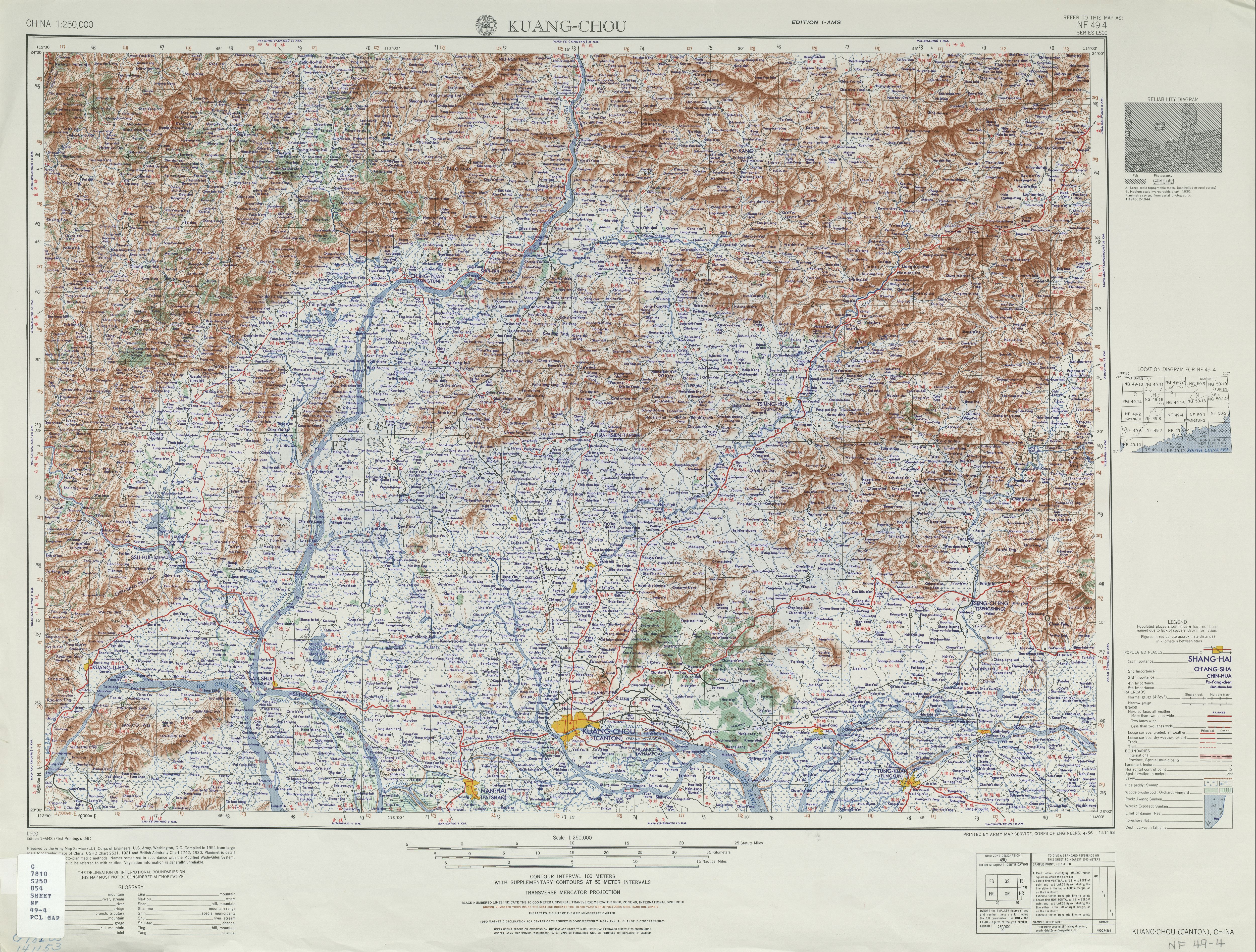
![NF 49-4 KUANG-CHOU (CANTON) AND VICINITY [verso]](http://www.lib.utexas.edu/maps/ams/china/txu-oclc-10552568-nf49-4-back.jpg)
Subscribe to:
Posts (Atom)