Strictly speaking, there are two words in Chinese for overseas Chinese: huáqiáo (华侨 / 華僑) refers to overseas Chinese who were born in China, while huáyì (华裔 / 華裔) refers to any overseas Chinese with a Chinese ancestry. [1].
Overseas Chinese are not limited to ethnic Chinese populations, but rather include also the diaspora of the entire Chinese nation (zhonghua minzu). For example, ethnic Korean minorities from China who are living in South Korea today are often included in calculations of overseas Chinese, because these ethnic Koreans also identify themselves as part of the Chinese nation (zhonghua minzu). Similarly this also applies to Nusantara Chinese Peranakans in South East Asia.
The Chinese people have a long history of migrating overseas. The overseas Chinese of today can be dated back to the Ming dynasty. When Zheng He became the envoy of Ming, he sent people to explore and trade in the South China Sea and Indian Ocean. Many of them were Cantonese and Hokkien. A large portion stayed and never returned to China. [2]
Tuesday, May 23, 2006

Mao a mass killer - Massey lecturer
Mao a mass killer - Massey lecturer19 May 2006
By GRANT MILLERBrainwashed Chinese students should learn the truth about Mao Zedong, a senior Massey University Chinese lecturer said.
Dong Li said the man the students -adore is a mass murderer.
Mr Li is flabbergasted Chinese students spoke so reverently of Mao, glossing over his murderous regime and comparing him with Jesus Christ, as they protested the lampooning of him on the cover of a student newspaper this week.
He said students have been brainwashed by the Chinese government, which keeps the education sector and media under tight control.
"Mao is depicted as a genius. He was a genius - an evil genius, like Hitler," Mr Li said yesterday.
"Seventy million people died because of his cruel and stupid rule."
Mr Li is a lecturer in Chinese language, modern Chinese society and literature at Massey.
And while he agrees there is racial discrimination against Chinese in New Zealand, Mr Li said he was not impressed that Chinese students angrily confronted the staff of Chaff after the student newspaper depicted Mao in a dress as a send-up of Cosmopolitan magazine.
Mr Li said Chinese students should respect other people's opinions.
"When you are here in this Western democracy, you should not study only science, economics and finance.
"I welcome their presence here, but I advise them to take advantage of opportunities to learn the truth about modern China."
That's what Mr Li did about 20 years ago.
He left China to study the compiling of dictionaries in Leeds, England, and read widely in the library while he was there.
"This opened my eyes."
He led protests at North Arizona University, in the United States, over the Tiananmen Square massacre of pro-democracy students in 1989.
"One of the things I hate is the huge portrait of Mao in Tiananmen Square."
It's hypocritical that the communist government continues to promote the Mao personality cult while dismantling most of his reforms, Mr Li said.
The image of Mao is used to prop up the legitimacy of Communist Party rule, Mr Li said, but the reality of Mao's leadership is kept quiet.
"The Great Leap Forward was 100-percent folly, which resulted in 30 to 40 million people - mostly peasants - starving to death."
Mao's Cultural Revolution forced the closure of schools and universities while large numbers of teachers, professors, journalists, engineers, officials and doctors were persecuted, he said.
"At least 2 million people were murdered or forced to commit suicide."
Books were burned while temples, churches and cultural relics were also destroyed.
The ancestral home of philosopher Confucius was dismantled.
"All this should be directly blamed on Mao," Mr Li said.
"He was a cultural destroyer, a murderer - even his personal life was full of dirty womanising. He is not a model for Chinese youth."
Ironically, the day Massey students staged their protest - May 16 - was the 40th anniversary of the start of the Cultural Revolution.
"And the man who inflicted untold suffering on tens of millions of people was none other than Mao."
Mr Li said a student's comment about Mao's being equivalent to Jesus was ridiculous.
"It's totally muddle-headed and stupid. Not even Mao himself would say that."
Calling Mao the father of modern China was also wrong, Mr Li said.
"The father of modern China is Dr Sun Yat-sen, who overthrew the imperial dynasty of Qing."
He said the students who protested come from a country where history books are approved by the government's propaganda department.
"They do not know the truth. Some don't want to know."
http://www.stuff.co.nz/stuff/0,2106,3673363a7694,00.html
By GRANT MILLERBrainwashed Chinese students should learn the truth about Mao Zedong, a senior Massey University Chinese lecturer said.
Dong Li said the man the students -adore is a mass murderer.
Mr Li is flabbergasted Chinese students spoke so reverently of Mao, glossing over his murderous regime and comparing him with Jesus Christ, as they protested the lampooning of him on the cover of a student newspaper this week.
He said students have been brainwashed by the Chinese government, which keeps the education sector and media under tight control.
"Mao is depicted as a genius. He was a genius - an evil genius, like Hitler," Mr Li said yesterday.
"Seventy million people died because of his cruel and stupid rule."
Mr Li is a lecturer in Chinese language, modern Chinese society and literature at Massey.
And while he agrees there is racial discrimination against Chinese in New Zealand, Mr Li said he was not impressed that Chinese students angrily confronted the staff of Chaff after the student newspaper depicted Mao in a dress as a send-up of Cosmopolitan magazine.
Mr Li said Chinese students should respect other people's opinions.
"When you are here in this Western democracy, you should not study only science, economics and finance.
"I welcome their presence here, but I advise them to take advantage of opportunities to learn the truth about modern China."
That's what Mr Li did about 20 years ago.
He left China to study the compiling of dictionaries in Leeds, England, and read widely in the library while he was there.
"This opened my eyes."
He led protests at North Arizona University, in the United States, over the Tiananmen Square massacre of pro-democracy students in 1989.
"One of the things I hate is the huge portrait of Mao in Tiananmen Square."
It's hypocritical that the communist government continues to promote the Mao personality cult while dismantling most of his reforms, Mr Li said.
The image of Mao is used to prop up the legitimacy of Communist Party rule, Mr Li said, but the reality of Mao's leadership is kept quiet.
"The Great Leap Forward was 100-percent folly, which resulted in 30 to 40 million people - mostly peasants - starving to death."
Mao's Cultural Revolution forced the closure of schools and universities while large numbers of teachers, professors, journalists, engineers, officials and doctors were persecuted, he said.
"At least 2 million people were murdered or forced to commit suicide."
Books were burned while temples, churches and cultural relics were also destroyed.
The ancestral home of philosopher Confucius was dismantled.
"All this should be directly blamed on Mao," Mr Li said.
"He was a cultural destroyer, a murderer - even his personal life was full of dirty womanising. He is not a model for Chinese youth."
Ironically, the day Massey students staged their protest - May 16 - was the 40th anniversary of the start of the Cultural Revolution.
"And the man who inflicted untold suffering on tens of millions of people was none other than Mao."
Mr Li said a student's comment about Mao's being equivalent to Jesus was ridiculous.
"It's totally muddle-headed and stupid. Not even Mao himself would say that."
Calling Mao the father of modern China was also wrong, Mr Li said.
"The father of modern China is Dr Sun Yat-sen, who overthrew the imperial dynasty of Qing."
He said the students who protested come from a country where history books are approved by the government's propaganda department.
"They do not know the truth. Some don't want to know."
http://www.stuff.co.nz/stuff/0,2106,3673363a7694,00.html
Chinese, NZ poetic quartet
Chinese, NZ poetic quartet show diversity of style and subject
29 April 2006
Flying Against the Arrow, by Jan Fitzgerald, (Wolfdale Publishing, $24.99). Unreal City, by Yang Lian, (Auckland University Press, $24.99). Cup by Alison Wong, (Southern Publishers, $19.99). Hourglass, by Sue Wootton, (Steele-Roberts, $19.95). Reviewed by Peter Dornauf.
The most banal and ordinary elements often provide material for poetry. In Hourglass, Sue Wootton takes small subjects like a dressing gown, a chook or a posh frock as her point of reference for weightier matters.
This is done brilliantly in the poem, Heavy Hen, where grief is described in terms of such an unprepossessing bird.
"Grief is a ball of feathers", it begins. The essence of grief is captured perfectly here and the stratagem is cleverly sustained for the whole poem. A talent to watch.
Jan Fitzgerald's latest collection, Flying Against the Arrow, can be quite visceral. Smells and scents are to the fore. Things to do with fire also predominate in a beautiful suite of poems, one about fireworks which opens with the startling line, "Fireworks are the apparatus of angels". Fireside deals with love on rainy nights, while the poignant Fireplace describes a burnt-out house where only a chimney remains in a "square of daffodils".
Alison Wong, born and raised in Hawke's Bay, brings a Chinese perspective to her poetic observations about family in Cup. A mother's predilection, a father's illness and death, together with childhood reminiscences, are treated with understated poise and an eye for telling domestic detail. Such emotional control is evident in Chinese Settlement, Arrowtown, where prospectors and their dwellings are described.
Yang Lian is a celebrated Chinese poet who came to Auckland in 1989 during the Tiananmen Square massacre, and stayed. His work is now banned in China, lending an edge to any reading.
The poems are difficult –-with a discursive, surreal quality. Huge jumps and disconnected lurches take place between the lines, leaving the reader struggling to find a centralising focus. But within this surging plethora can be found intriguing and stunning pictures.
All four demonstrate the diversity of style and subject matter contemporary New Zealand poetry is enjoying at the moment.
* Peter Dornauf is a Hamilton reviewer.
29 April 2006
Flying Against the Arrow, by Jan Fitzgerald, (Wolfdale Publishing, $24.99). Unreal City, by Yang Lian, (Auckland University Press, $24.99). Cup by Alison Wong, (Southern Publishers, $19.99). Hourglass, by Sue Wootton, (Steele-Roberts, $19.95). Reviewed by Peter Dornauf.
The most banal and ordinary elements often provide material for poetry. In Hourglass, Sue Wootton takes small subjects like a dressing gown, a chook or a posh frock as her point of reference for weightier matters.
This is done brilliantly in the poem, Heavy Hen, where grief is described in terms of such an unprepossessing bird.
"Grief is a ball of feathers", it begins. The essence of grief is captured perfectly here and the stratagem is cleverly sustained for the whole poem. A talent to watch.
Jan Fitzgerald's latest collection, Flying Against the Arrow, can be quite visceral. Smells and scents are to the fore. Things to do with fire also predominate in a beautiful suite of poems, one about fireworks which opens with the startling line, "Fireworks are the apparatus of angels". Fireside deals with love on rainy nights, while the poignant Fireplace describes a burnt-out house where only a chimney remains in a "square of daffodils".
Alison Wong, born and raised in Hawke's Bay, brings a Chinese perspective to her poetic observations about family in Cup. A mother's predilection, a father's illness and death, together with childhood reminiscences, are treated with understated poise and an eye for telling domestic detail. Such emotional control is evident in Chinese Settlement, Arrowtown, where prospectors and their dwellings are described.
Yang Lian is a celebrated Chinese poet who came to Auckland in 1989 during the Tiananmen Square massacre, and stayed. His work is now banned in China, lending an edge to any reading.
The poems are difficult –-with a discursive, surreal quality. Huge jumps and disconnected lurches take place between the lines, leaving the reader struggling to find a centralising focus. But within this surging plethora can be found intriguing and stunning pictures.
All four demonstrate the diversity of style and subject matter contemporary New Zealand poetry is enjoying at the moment.
* Peter Dornauf is a Hamilton reviewer.
Students see red over Mao send-up
A mob of angry Chinese students protested at Massey University yesterday after Chairman Mao was lampooned on the cover of the student newspaper.
Students likened the cover of Chaff, which this week satirises women's magazine Cosmopolitan, to the anti-Muslim cartoons circulated around the world in February.
Tempers flared outside Massey's library as about 50 Chinese Massey and UCOL students and a Chinese lecturer confronted Chaff staff.
Students said the issue is racist and the last straw, as many have also suffered verbal abuse on the streets of Palmerston North.
Tianxiang Mao said it was common for Asian students to be lambasted with racial slurs when driving.
"People yell `F-ing Asians' when we are in the car driving down the road. I don't say anything. What can I do?"
UCOL student Xing Tang said Chaff staff are ignorant of Chinese culture.
"Chairman Mao is like Jesus to us," he said on the verge of tears.
"We pay $20,000 in fees and a Musa fee (which funds Chaff) and this is how we are treated."
Student Ronnie Cao likened the cover to the anti-Muslim cartoons.
"This is discrimination against us."
It will have a huge effect on New Zealand's reputation, Mr Cao said.
However, compared with the United States, New Zealand is still considered a safe place for Chinese parents to send their children, he said.
Yang Chenglin said students are proud of their Chinese culture.
"Mao gave us independence. He's no more a killer than George Washington or George W Bush.
"He is the father of China - without Mao, there is no China."
Mao Zedong, or Chairman Mao, was the founder of the People's Republic of China and one of the most prominent figures in Chinese history.
He is also revered as a great spiritual leader and cultural symbol.
Students gathered in tight circles outside the library yesterday, signing a petition demanding an apology.
Students also want remaining copies pulled out of circulation.
Tensions flared as agitated students confronted Chaff editor Edrei Valath and news editor Matt Russell.
"It was an arbitrary decision to run the cover of Mao," Mr Russell said, adding it was intended as a joke.
"We were looking for a picture of Marx or Lenin and we couldn't use Castro because he had a beard and it just didn't work. I didn't think it would offend."
Mr Valath said students are "enraged for the sake of being enraged".
"It is ironic - in China, the students would have no forum in which to complain."
He said Chinese students studying here should be made aware a good sense of humour is part of Kiwi culture.
But students likened the situation to a racial slur expressed in Victoria University's latest student magazine Salient. The "Top Five Things to Be Wary of" rated the Chinese at No 5.
Dogs also featured in the same line-up, the students said.
Salient editor James Robinson said the Top Five column and the Chaff cover are both "culturally insensitive".
"We are getting hate mail by the minute," Mr Robinson said.
Salient has been in strife over the Top Five column and the item has appeared on a Chinese news website.
Massey University finance lecturer Fei Wu, who's Chinese, said students deserve an explanation.
"This shows no respect to our people.
"There are 1000 Chinese students here who spend a lot of money to study here and this is an insult.
"Students come here for a better environment to get away from class and culture differences. This doesn't solve the problem."
However, Chinese Massey student Tony Song said protesters were being "too sensitive".
"It's been done to the Queen before. I'm not offended at all. I was laughing."
Massey University international office director Bruce Graham said the Chaff cover is in "extremely poor taste". However, he accepted Chaff has editorial independence.
"This shows a lack of respect. Chinese students are an important part of the university's community."
Mr Graham has suggested to Chaff an apology is required
18 May 2006
By CAITLIN MCKAY
Students likened the cover of Chaff, which this week satirises women's magazine Cosmopolitan, to the anti-Muslim cartoons circulated around the world in February.
Tempers flared outside Massey's library as about 50 Chinese Massey and UCOL students and a Chinese lecturer confronted Chaff staff.
Students said the issue is racist and the last straw, as many have also suffered verbal abuse on the streets of Palmerston North.
Tianxiang Mao said it was common for Asian students to be lambasted with racial slurs when driving.
"People yell `F-ing Asians' when we are in the car driving down the road. I don't say anything. What can I do?"
UCOL student Xing Tang said Chaff staff are ignorant of Chinese culture.
"Chairman Mao is like Jesus to us," he said on the verge of tears.
"We pay $20,000 in fees and a Musa fee (which funds Chaff) and this is how we are treated."
Student Ronnie Cao likened the cover to the anti-Muslim cartoons.
"This is discrimination against us."
It will have a huge effect on New Zealand's reputation, Mr Cao said.
However, compared with the United States, New Zealand is still considered a safe place for Chinese parents to send their children, he said.
Yang Chenglin said students are proud of their Chinese culture.
"Mao gave us independence. He's no more a killer than George Washington or George W Bush.
"He is the father of China - without Mao, there is no China."
Mao Zedong, or Chairman Mao, was the founder of the People's Republic of China and one of the most prominent figures in Chinese history.
He is also revered as a great spiritual leader and cultural symbol.
Students gathered in tight circles outside the library yesterday, signing a petition demanding an apology.
Students also want remaining copies pulled out of circulation.
Tensions flared as agitated students confronted Chaff editor Edrei Valath and news editor Matt Russell.
"It was an arbitrary decision to run the cover of Mao," Mr Russell said, adding it was intended as a joke.
"We were looking for a picture of Marx or Lenin and we couldn't use Castro because he had a beard and it just didn't work. I didn't think it would offend."
Mr Valath said students are "enraged for the sake of being enraged".
"It is ironic - in China, the students would have no forum in which to complain."
He said Chinese students studying here should be made aware a good sense of humour is part of Kiwi culture.
But students likened the situation to a racial slur expressed in Victoria University's latest student magazine Salient. The "Top Five Things to Be Wary of" rated the Chinese at No 5.
Dogs also featured in the same line-up, the students said.
Salient editor James Robinson said the Top Five column and the Chaff cover are both "culturally insensitive".
"We are getting hate mail by the minute," Mr Robinson said.
Salient has been in strife over the Top Five column and the item has appeared on a Chinese news website.
Massey University finance lecturer Fei Wu, who's Chinese, said students deserve an explanation.
"This shows no respect to our people.
"There are 1000 Chinese students here who spend a lot of money to study here and this is an insult.
"Students come here for a better environment to get away from class and culture differences. This doesn't solve the problem."
However, Chinese Massey student Tony Song said protesters were being "too sensitive".
"It's been done to the Queen before. I'm not offended at all. I was laughing."
Massey University international office director Bruce Graham said the Chaff cover is in "extremely poor taste". However, he accepted Chaff has editorial independence.
"This shows a lack of respect. Chinese students are an important part of the university's community."
Mr Graham has suggested to Chaff an apology is required
18 May 2006
By CAITLIN MCKAY
Chinese Gooseberry
In the very beginning In 1904, Miss Isabel Fraser, a teacher at a girls’ college in the riverside town of Wanganui, returned from visiting her sister on a mission station in China with some small black seeds. The seeds grew into big-leafed vines hung with hairy russet-skinned berries with bright green flesh. Kiwifruit had arrived in New Zealand.From its first pioneers and champions to today’s growers who consistently produce superior kiwifruit under the world-leading integrated ZESPRI™ System, there is a tradition of passion, innovation and excellence.
Out of 27 fruit analysed in US studies , ZESPRI™ Kiwifruit proved itself to be one of nature's most perfect foods. The fruit's many special qualities can help guard against chronic illness, aid digestion and may even help us feel happier and less stressed. And there are so many delicious ways to eat them
Out of 27 fruit analysed in US studies , ZESPRI™ Kiwifruit proved itself to be one of nature's most perfect foods. The fruit's many special qualities can help guard against chronic illness, aid digestion and may even help us feel happier and less stressed. And there are so many delicious ways to eat them
Sunday, May 21, 2006
Hong Kong still a retail heaven
14.05.06By Rose Pearson
Is your idea of paradise a day shopping for designer labels in a glitzy, multi-storey mall? Or hunting for treasure in tiny side-streets? Or bartering for knock-off bargains in crowded markets? Then welcome to the shopaholics' mecca - Hong Kong. For years, this former British outpost has been famed for its shopping, and no wonder. Not only is this Southeast Asian city easy to reach with direct flights from New Zealand daily, but from the moment you land you're assured of a stress-free holiday (as long as your credit card can keep up). With sensible shoes, my credit card twitching to be used and a suitcase ready to be filled, I hit the busy streets of Hong Kong. It couldn't be easier, as all streets signs are in English, the public transport system is easy to navigate and there's an amazing variety of areas to visit - from the colonial Hong Kong Island, to busy Lantau (where the new airport and Disneyland are), and the bargain areas of Kowloon and the New Territories. While it's relatively simple to shop in Hong Kong, here are some guidelines to ease your way through retail heaven: Quality Tourism Services (QTS) scheme: This is organised by the Hong Kong Tourism Board to help visitors find shops and restaurants they can trust. Those displaying the QTS certificate pass stringent annual assessments. Know your product: Make sure you know what you want in terms of model, features, price, accessories and warranty (such as terms and geographical coverage), especially on electronic goods. Avoid "bait and switch": Some merchants display uncertain prices or request a deposit on a product only to claim later that only an inferior or more expensive product is available. Shop at outlets where prices are clearly displayed. It's also a good idea to compare prices before buying. Inspect your products: Check them before paying and make sure you have all the accessories. Re-check the product before you leave the store. Shop around: In the markets, don't buy the first item you see. Look around as stalls further into the market, away from the main drag, can offer better deals. Just say no: Markets can be intense with huge pressure to buy. If you don't want an item, just say no and walk away. I made the mistake of being obviously keen on a knock-off handbag and was chased through crowded Ladies' Market by a saleswoman screaming ever-decreasing sale prices for "my" bag. No, I didn't buy it. Be prepared: Pack sensible walking shoes and take plenty of bags. Try placing a smaller suitcase inside a larger one so you have two bags to fill. HONG KONG ISLAND This picturesque place has eight defined shopping areas. Central: If you prefer the high end of shopping and are seeking couture clothes and expensive cosmetic lines, then head here. The Landmark, Galleria, Prince's Building, Alexandra House and IFC are upmarket malls with designer shops and exclusive brands. You'll find knock-off stalls in The Lanes, between Queen's Rd, and Des Voeux Rd. The market - with watches, luggage, shoes and such like - is open daily from 10am to 7pm. Western District: The Western Market is a short stroll from Central and is situated in a renovated Edwardian building on the corner of Connaught Rd and Morrison St. It sells Chinese handicrafts and fabrics. Nearby areas have small shops selling Chinese medicine, just don't look too closely at some of the jars on display. Admiralty: This area is famous for its brand-name luxury goods. Try the Pacific Place Mall which is connected to the Admiralty MTR Station. Wan Chai: The historical streets here boast an amazing range of shopping. On Queen's Rd East you'll find Chinese furniture shops which can arrange to have your purchases sent home. Spring Garden Lane is great for export-quality clothes at good prices. Causeway Bay: This area is known as "Little Japan" because of the major Japanese stores specialising in electrical goods. Check out Times Square, Caroline Centre, World Trade Centre, Lee Gardens, Lee Theatre Plaza, Fashion Island and Island Beverley. Tai Koo Shing: Near Quarry Bay, this houses one of Hong Kong's largest purpose-built shopping complexes, Cityplaza, which has an ice rink and an enormous range of shops. Ap Lei Chau: There are bargains galore in this district near Aberdeen. Horizon Plaza, in Ap Lei Chau, has furniture and clothing factory outlets. Stanley: For high-end souvenirs try this famous coastal area. Stanley Market has many stalls and lanes selling Chinese paintings and handicrafts and is open 10am-6pm daily. KOWLOON For a picturesque trip, take the Star Ferry from Central to the Mainland China area of Hong Kong that's well-known for its street hawkers ("Want to buy a Rolex?") and markets. Tsim Sha Tsui: This area has department stores, shopping centres and factory outlets along Granville Rd and the famous Nathan Rd, where the hawkers hang out. Yau Ma Tei: Home of the Temple Street Night Market, this part of Kowloon features neon light displays. Mong Kok: No visit to Hong Kong is complete without a trip to Ladies' Market. This day-long street market is jam-packed with stalls selling every manner of knock-off. But beware, you won't find Lady-like behaviour here - and be prepared to barter. Hung Hom: For an unusual shopping destination, try the inland cruise ship the Whampoa, which is "moored" on the site of a former dry dock. This 110m boat-shaped entertainment centre houses cinemas, shops and clubs. Also well worth a visit is Hung Hom's Factory District that sells clothes and jewellery. Sham Shui Po: For electronic gadgets try this area, especially Apliu St, while Kowloon Tong is one of Hong Kong's newest shopping malls with retail outlets, restaurants, an ice rink and an 11-screen multiplex cinema. NEW TERRITORIES Tsing Yi: Close to the international airport, and ideal for transit passengers, is Maritime Square with more than 200 shops, themed restaurants and a cinema. * * *NEED TO KNOW... Getting there: Air New Zealand currently has a Hong Kong package including five nights' accommodation at the InterContinental Grand Stanford, a complimentary spa treatment and an additional 15kg baggage allowance for $1769 plus costs of $35. This is an internet-only price. For details go to www.airnewzealand.co.nz Retail: Promotions and late-night dining options abound during the Hong Kong Shopping Festival (June 24-August 31). Getting around: The Octopus Card gets you onto all major public transport including the MTR (underground trains), ferries and trams, and is accepted at many stores and restaurants. They cost HK$150 (NZ$30) for adults (HK$50 refund when you return it) and HK$70 (NZ$14) for kids (also HK$50 refund). Top them up at MTR stations.
Tools
Is your idea of paradise a day shopping for designer labels in a glitzy, multi-storey mall? Or hunting for treasure in tiny side-streets? Or bartering for knock-off bargains in crowded markets? Then welcome to the shopaholics' mecca - Hong Kong. For years, this former British outpost has been famed for its shopping, and no wonder. Not only is this Southeast Asian city easy to reach with direct flights from New Zealand daily, but from the moment you land you're assured of a stress-free holiday (as long as your credit card can keep up). With sensible shoes, my credit card twitching to be used and a suitcase ready to be filled, I hit the busy streets of Hong Kong. It couldn't be easier, as all streets signs are in English, the public transport system is easy to navigate and there's an amazing variety of areas to visit - from the colonial Hong Kong Island, to busy Lantau (where the new airport and Disneyland are), and the bargain areas of Kowloon and the New Territories. While it's relatively simple to shop in Hong Kong, here are some guidelines to ease your way through retail heaven: Quality Tourism Services (QTS) scheme: This is organised by the Hong Kong Tourism Board to help visitors find shops and restaurants they can trust. Those displaying the QTS certificate pass stringent annual assessments. Know your product: Make sure you know what you want in terms of model, features, price, accessories and warranty (such as terms and geographical coverage), especially on electronic goods. Avoid "bait and switch": Some merchants display uncertain prices or request a deposit on a product only to claim later that only an inferior or more expensive product is available. Shop at outlets where prices are clearly displayed. It's also a good idea to compare prices before buying. Inspect your products: Check them before paying and make sure you have all the accessories. Re-check the product before you leave the store. Shop around: In the markets, don't buy the first item you see. Look around as stalls further into the market, away from the main drag, can offer better deals. Just say no: Markets can be intense with huge pressure to buy. If you don't want an item, just say no and walk away. I made the mistake of being obviously keen on a knock-off handbag and was chased through crowded Ladies' Market by a saleswoman screaming ever-decreasing sale prices for "my" bag. No, I didn't buy it. Be prepared: Pack sensible walking shoes and take plenty of bags. Try placing a smaller suitcase inside a larger one so you have two bags to fill. HONG KONG ISLAND This picturesque place has eight defined shopping areas. Central: If you prefer the high end of shopping and are seeking couture clothes and expensive cosmetic lines, then head here. The Landmark, Galleria, Prince's Building, Alexandra House and IFC are upmarket malls with designer shops and exclusive brands. You'll find knock-off stalls in The Lanes, between Queen's Rd, and Des Voeux Rd. The market - with watches, luggage, shoes and such like - is open daily from 10am to 7pm. Western District: The Western Market is a short stroll from Central and is situated in a renovated Edwardian building on the corner of Connaught Rd and Morrison St. It sells Chinese handicrafts and fabrics. Nearby areas have small shops selling Chinese medicine, just don't look too closely at some of the jars on display. Admiralty: This area is famous for its brand-name luxury goods. Try the Pacific Place Mall which is connected to the Admiralty MTR Station. Wan Chai: The historical streets here boast an amazing range of shopping. On Queen's Rd East you'll find Chinese furniture shops which can arrange to have your purchases sent home. Spring Garden Lane is great for export-quality clothes at good prices. Causeway Bay: This area is known as "Little Japan" because of the major Japanese stores specialising in electrical goods. Check out Times Square, Caroline Centre, World Trade Centre, Lee Gardens, Lee Theatre Plaza, Fashion Island and Island Beverley. Tai Koo Shing: Near Quarry Bay, this houses one of Hong Kong's largest purpose-built shopping complexes, Cityplaza, which has an ice rink and an enormous range of shops. Ap Lei Chau: There are bargains galore in this district near Aberdeen. Horizon Plaza, in Ap Lei Chau, has furniture and clothing factory outlets. Stanley: For high-end souvenirs try this famous coastal area. Stanley Market has many stalls and lanes selling Chinese paintings and handicrafts and is open 10am-6pm daily. KOWLOON For a picturesque trip, take the Star Ferry from Central to the Mainland China area of Hong Kong that's well-known for its street hawkers ("Want to buy a Rolex?") and markets. Tsim Sha Tsui: This area has department stores, shopping centres and factory outlets along Granville Rd and the famous Nathan Rd, where the hawkers hang out. Yau Ma Tei: Home of the Temple Street Night Market, this part of Kowloon features neon light displays. Mong Kok: No visit to Hong Kong is complete without a trip to Ladies' Market. This day-long street market is jam-packed with stalls selling every manner of knock-off. But beware, you won't find Lady-like behaviour here - and be prepared to barter. Hung Hom: For an unusual shopping destination, try the inland cruise ship the Whampoa, which is "moored" on the site of a former dry dock. This 110m boat-shaped entertainment centre houses cinemas, shops and clubs. Also well worth a visit is Hung Hom's Factory District that sells clothes and jewellery. Sham Shui Po: For electronic gadgets try this area, especially Apliu St, while Kowloon Tong is one of Hong Kong's newest shopping malls with retail outlets, restaurants, an ice rink and an 11-screen multiplex cinema. NEW TERRITORIES Tsing Yi: Close to the international airport, and ideal for transit passengers, is Maritime Square with more than 200 shops, themed restaurants and a cinema. * * *NEED TO KNOW... Getting there: Air New Zealand currently has a Hong Kong package including five nights' accommodation at the InterContinental Grand Stanford, a complimentary spa treatment and an additional 15kg baggage allowance for $1769 plus costs of $35. This is an internet-only price. For details go to www.airnewzealand.co.nz Retail: Promotions and late-night dining options abound during the Hong Kong Shopping Festival (June 24-August 31). Getting around: The Octopus Card gets you onto all major public transport including the MTR (underground trains), ferries and trams, and is accepted at many stores and restaurants. They cost HK$150 (NZ$30) for adults (HK$50 refund when you return it) and HK$70 (NZ$14) for kids (also HK$50 refund). Top them up at MTR stations.
Tools
Lincoln Tan - To live our parents' dreams
15.05.06
I still remember vividly the farewell dinner my parents gave me in Singapore before my permanent move to New Zealand in 1997. My dad, who was never the emotional sort, got rather sentimental that night when he said, "Go to New Zealand and live my dreams." I never really understood what he meant then. His dream never became a reality because life had been hard. His father, my granddad, was killed during the Japanese occupation of Singapore in World War II when Dad was just a teenager. As the only child, he was left to fend for my grandmother, who was illiterate. After marrying my mother, he was the sole breadwinner supporting not only our immediate family - which included Mom, my sister and me - but also Grandma and one unmarried aunt who lived with us. In the tiny two-bedroom government high-rise flat where the six of us lived, there was hardly any room for potted plants, let alone the green pastures and mountains he secretly dreamed his children might enjoy. I still recall the day when my sister opened a letter and was so excited that she had been accepted into Singapore's university. What followed was a long talk with Mom and Dad, and that joy turned into sadness when she found out that she wasn't going to varsity because Dad could not afford the fees. I never knew the sacrifices Dad had made for us because life had been good for me in my growing years. I never had a day hungry. It was only when we were adults - Sis eventually became the director of sales at an international hotel, and me a newspaper journalist - that Dad told us about the many hungry days he had just to make ends meet. At the airport and knowing I knew of his ambition, he repeated those same words: "Go and live my dreams - do everything I've always wanted to do but never got the chance to." As a father I am starting to understand - and was reminded of this when recently working on stories relating to Chinese students in New Zealand . The students we see around us are the first batch of Chinese to reach adulthood since the implementation of the one-child policy in the 80s. They are precious to their parents. As Nancy Hu, the president of the NZ Chinese Students' Association puts it: "Because the law only allows one child, Chinese parents would sacrifice everything and place all their hopes for the future on their son or daughter." Unlike Dad, their sacrifices may not be financial. But letting go of their only child, entrusting them to the unknown, must be difficult. But like Dad, their parents will be living their own dreams in these students. Going overseas for further studies or learning English in a Western country must surely have been their dream, too. They must hope that New Zealand will be their children's ticket to a better life: giving them good academic qualifications that could land them prestigious jobs, perhaps also getting a New Zealand passport allowing them to travel the world freely. They must hope their children meet the right partners, get married, have children of their own and live happily ever after. But some have been sidetracked from the privileged tasks their parents sent them here for - to study, enjoy New Zealand and get a head start. They choose to live the high life: gambling, smoking and buying fancy sports cars with money meant for their living expenses, then turning to crime when they run out of money and places to borrow from. Last week, while working on a story for the Herald, I spoke to a Chinese student who saw her body as the way to easy cash, turning to prostitution when her mother stopped sending money. She let her business studies lapse and then even blamed her mother for her becoming a hooker. In traditional Chinese culture, respect for elders and especially parents plays a very important role. Some Chinese youths are also living in denial - and are not used to hearing or reading anything negative about them. Reading reports in iBall on some non-Chinese responses to the murder of Wan Biao on Good Friday prompted one Chinese student to write saying we were "second-class Chinese" because Charles Chan, my co-editor, was from Malaysia and I was from Singapore. Are these students a picture of China's one-child policy gone wrong? Their parents have no clue about their lives in New Zealand and I cannot imagine the pain they would feel if they found out. How can they be so irresponsible as to turn their parents' dreams into nightmare? With me living in New Zealand, Dad now gets to live his dreams when he makes regular visits. Some of these students would be in a position where they, too, can help their parents to live their dreams - and perhaps repay them a little for the sacrifices that they have made. As I dropped off my son Ryan at school, I think I finally understood what Dad told me before I left Singapore. Parents do live their dreams in their children. In Ryan, I am living my dream, as I watch him grow in a land with green pastures to run around in and mountains to climb - to do the things that I, too, only dreamed of doing as a child. I dream that one day, after he has run around the pastures, he will climb the highest mountain. Then, when he plants the flag, I will be standing there beside him as his very proud dad. * Lincoln Tan is managing editor of iBall, a free fortnightly English language Asian newspaper
Author
•
More by Lincoln Tan
I still remember vividly the farewell dinner my parents gave me in Singapore before my permanent move to New Zealand in 1997. My dad, who was never the emotional sort, got rather sentimental that night when he said, "Go to New Zealand and live my dreams." I never really understood what he meant then. His dream never became a reality because life had been hard. His father, my granddad, was killed during the Japanese occupation of Singapore in World War II when Dad was just a teenager. As the only child, he was left to fend for my grandmother, who was illiterate. After marrying my mother, he was the sole breadwinner supporting not only our immediate family - which included Mom, my sister and me - but also Grandma and one unmarried aunt who lived with us. In the tiny two-bedroom government high-rise flat where the six of us lived, there was hardly any room for potted plants, let alone the green pastures and mountains he secretly dreamed his children might enjoy. I still recall the day when my sister opened a letter and was so excited that she had been accepted into Singapore's university. What followed was a long talk with Mom and Dad, and that joy turned into sadness when she found out that she wasn't going to varsity because Dad could not afford the fees. I never knew the sacrifices Dad had made for us because life had been good for me in my growing years. I never had a day hungry. It was only when we were adults - Sis eventually became the director of sales at an international hotel, and me a newspaper journalist - that Dad told us about the many hungry days he had just to make ends meet. At the airport and knowing I knew of his ambition, he repeated those same words: "Go and live my dreams - do everything I've always wanted to do but never got the chance to." As a father I am starting to understand - and was reminded of this when recently working on stories relating to Chinese students in New Zealand . The students we see around us are the first batch of Chinese to reach adulthood since the implementation of the one-child policy in the 80s. They are precious to their parents. As Nancy Hu, the president of the NZ Chinese Students' Association puts it: "Because the law only allows one child, Chinese parents would sacrifice everything and place all their hopes for the future on their son or daughter." Unlike Dad, their sacrifices may not be financial. But letting go of their only child, entrusting them to the unknown, must be difficult. But like Dad, their parents will be living their own dreams in these students. Going overseas for further studies or learning English in a Western country must surely have been their dream, too. They must hope that New Zealand will be their children's ticket to a better life: giving them good academic qualifications that could land them prestigious jobs, perhaps also getting a New Zealand passport allowing them to travel the world freely. They must hope their children meet the right partners, get married, have children of their own and live happily ever after. But some have been sidetracked from the privileged tasks their parents sent them here for - to study, enjoy New Zealand and get a head start. They choose to live the high life: gambling, smoking and buying fancy sports cars with money meant for their living expenses, then turning to crime when they run out of money and places to borrow from. Last week, while working on a story for the Herald, I spoke to a Chinese student who saw her body as the way to easy cash, turning to prostitution when her mother stopped sending money. She let her business studies lapse and then even blamed her mother for her becoming a hooker. In traditional Chinese culture, respect for elders and especially parents plays a very important role. Some Chinese youths are also living in denial - and are not used to hearing or reading anything negative about them. Reading reports in iBall on some non-Chinese responses to the murder of Wan Biao on Good Friday prompted one Chinese student to write saying we were "second-class Chinese" because Charles Chan, my co-editor, was from Malaysia and I was from Singapore. Are these students a picture of China's one-child policy gone wrong? Their parents have no clue about their lives in New Zealand and I cannot imagine the pain they would feel if they found out. How can they be so irresponsible as to turn their parents' dreams into nightmare? With me living in New Zealand, Dad now gets to live his dreams when he makes regular visits. Some of these students would be in a position where they, too, can help their parents to live their dreams - and perhaps repay them a little for the sacrifices that they have made. As I dropped off my son Ryan at school, I think I finally understood what Dad told me before I left Singapore. Parents do live their dreams in their children. In Ryan, I am living my dream, as I watch him grow in a land with green pastures to run around in and mountains to climb - to do the things that I, too, only dreamed of doing as a child. I dream that one day, after he has run around the pastures, he will climb the highest mountain. Then, when he plants the flag, I will be standing there beside him as his very proud dad. * Lincoln Tan is managing editor of iBall, a free fortnightly English language Asian newspaper
Author
•
More by Lincoln Tan
Student mag in cart for spoofing Mao
Friday May 19, 2006
The Race Relations Commissioner is calling on student magazines to be more responsible following protests against the lampooning of Chairman Mao in a publication.
Angry Chinese students protested at Massey University on Wednesday after Mao was featured on the cover of the student newspaper Chaff.
Commissioner Joris De Bres said although the use of Mao's image was clearly an attempt at humour, the context had to be considered.
"In a context where there is discrimination against a lot of Asian people in New Zealand, you have to be careful you don't unwittingly or deliberately feed that."
He said newspaper editors should bear that in mind.
Chinese students have likened the cover to the anti-Muslim cartoons which caused world controversy in February.
Chairman Mao founded the People's Republic of China and is considered one of the most important figures in the history of the country. He is still considered by many to be a great spiritual leader and cultural symbol.
Anti-Chinese sentiment has also been expressed in Victoria University's latest student magazine, Salient. Among a table of The Top Five Things to Be Wary Of, Chinese were rated at No 5.
Dogs also featured in the same line-up. It is not known if the dogs featured above or below Chinese.
Chaff editor Matt Russell said Chinese students should be made aware that a good sense of humour is part of Kiwi culture.
Mr De Bres said the problem is when that sense of humour crosses the line - "when stereotypes that manifestly by anecdote, research or observation, experience higher levels of discrimination than others.
"The fact is that at the moment in terms of surveys we've done, Asian people are among those who face the most discrimination in New Zealand," he said.
"Now is not the best time to be exercising your sense of humour."
Mr De Bres said there was no greater case of a stereotype being wrong than with the suggestion that Asian students are bad drivers.
"If you go to the police or Road Safety New Zealand you'll find the stereotypes about Asian drivers do not stack up."
- NZPA
The Race Relations Commissioner is calling on student magazines to be more responsible following protests against the lampooning of Chairman Mao in a publication.
Angry Chinese students protested at Massey University on Wednesday after Mao was featured on the cover of the student newspaper Chaff.
Commissioner Joris De Bres said although the use of Mao's image was clearly an attempt at humour, the context had to be considered.
"In a context where there is discrimination against a lot of Asian people in New Zealand, you have to be careful you don't unwittingly or deliberately feed that."
He said newspaper editors should bear that in mind.
Chinese students have likened the cover to the anti-Muslim cartoons which caused world controversy in February.
Chairman Mao founded the People's Republic of China and is considered one of the most important figures in the history of the country. He is still considered by many to be a great spiritual leader and cultural symbol.
Anti-Chinese sentiment has also been expressed in Victoria University's latest student magazine, Salient. Among a table of The Top Five Things to Be Wary Of, Chinese were rated at No 5.
Dogs also featured in the same line-up. It is not known if the dogs featured above or below Chinese.
Chaff editor Matt Russell said Chinese students should be made aware that a good sense of humour is part of Kiwi culture.
Mr De Bres said the problem is when that sense of humour crosses the line - "when stereotypes that manifestly by anecdote, research or observation, experience higher levels of discrimination than others.
"The fact is that at the moment in terms of surveys we've done, Asian people are among those who face the most discrimination in New Zealand," he said.
"Now is not the best time to be exercising your sense of humour."
Mr De Bres said there was no greater case of a stereotype being wrong than with the suggestion that Asian students are bad drivers.
"If you go to the police or Road Safety New Zealand you'll find the stereotypes about Asian drivers do not stack up."
- NZPA
From Catwalk to Parade Ground
From catwalk to parade ground
Saturday May 20, 2006
N Z Herald By Julie Middleton
Janette Ma says she doesn't feel like a trailblazer - although she is the New Zealand Army's only female officer cadet of Chinese ethnicity. And there's no doubt that she's the only Army staffer who is a former Miss Chinese New Zealand.
Ms Ma, 20, a full-time student in her third year of a five-year law and psychology degree at the University of Auckland, was drawn to a part-time Army role because she loves the outdoors and "wanted to do something exciting. And I thought it would be a great way to get overseas".
Her mother, beauty therapist Isabella To, was dismayed when her only child, who grew up in New Zealand from the age of 8, announced she wanted to enlist.
Ms To was worried about her daughter's safety, but didn't stand in her way: "She's got a good mind and she's very mature."
The seven weeks of Army basic training, says Ms Ma, were "definitely the toughest thing I have ever done in my life, but it was rewarding".
Earlier this year she passed the tests for officer training - which included a five-day assessment during which a psychologist studied everything she did.
Ms Ma relishes Army life - though it took a while for her petite 1.59cm, 55kg frame to adjust to a 25-30kg pack.
She admits, however, she is not really comfortable being in the spotlight, and confesses she entered Miss Chinese New Zealand in 2004 to please her mother.
"My mom and her friends thought it would be pretty exciting. Personally, I haven't wanted to be an entertainer."
They were all "shocked" when Ms Ma won, earning her a place at the Miss Chinese International in her native Hong Kong (she was unplaced).
Ms Ma, whose roots are in China's Guangdong province, is in the Third Auckland Northland Regiment, where her 11-member officer cadet platoon - she is the only woman - is named Gallipoli.
Army recruiters hope that Ms Ma's story will prompt other women and other Chinese to join: just 33 men and four women of its 4484 staff are of Asian descent - that's just 0.82 per cent. Six of them are officers, and the bulk are aged between 18 and 24.
Greater diversity is always desirable, says recruitment director Major Kate Lee, but no special campaigns are planned. "I think most organisations like to be ethnically diverse - it makes sense. You need to be representative of New Zealand."
Another trailblazer is Second Lieutenant Jeong Min Park, believed to be the country's first soldier of Korean ancestry.
Mr Park, who was raised in Wellington, where he gained a political science degree, has been in the Army for two years. He is serving in Bosnia on a United Nations mission.
Author
• More by Julie Middleton
• Email Julie Middleton
Saturday May 20, 2006
N Z Herald By Julie Middleton
Janette Ma says she doesn't feel like a trailblazer - although she is the New Zealand Army's only female officer cadet of Chinese ethnicity. And there's no doubt that she's the only Army staffer who is a former Miss Chinese New Zealand.
Ms Ma, 20, a full-time student in her third year of a five-year law and psychology degree at the University of Auckland, was drawn to a part-time Army role because she loves the outdoors and "wanted to do something exciting. And I thought it would be a great way to get overseas".
Her mother, beauty therapist Isabella To, was dismayed when her only child, who grew up in New Zealand from the age of 8, announced she wanted to enlist.
Ms To was worried about her daughter's safety, but didn't stand in her way: "She's got a good mind and she's very mature."
The seven weeks of Army basic training, says Ms Ma, were "definitely the toughest thing I have ever done in my life, but it was rewarding".
Earlier this year she passed the tests for officer training - which included a five-day assessment during which a psychologist studied everything she did.
Ms Ma relishes Army life - though it took a while for her petite 1.59cm, 55kg frame to adjust to a 25-30kg pack.
She admits, however, she is not really comfortable being in the spotlight, and confesses she entered Miss Chinese New Zealand in 2004 to please her mother.
"My mom and her friends thought it would be pretty exciting. Personally, I haven't wanted to be an entertainer."
They were all "shocked" when Ms Ma won, earning her a place at the Miss Chinese International in her native Hong Kong (she was unplaced).
Ms Ma, whose roots are in China's Guangdong province, is in the Third Auckland Northland Regiment, where her 11-member officer cadet platoon - she is the only woman - is named Gallipoli.
Army recruiters hope that Ms Ma's story will prompt other women and other Chinese to join: just 33 men and four women of its 4484 staff are of Asian descent - that's just 0.82 per cent. Six of them are officers, and the bulk are aged between 18 and 24.
Greater diversity is always desirable, says recruitment director Major Kate Lee, but no special campaigns are planned. "I think most organisations like to be ethnically diverse - it makes sense. You need to be representative of New Zealand."
Another trailblazer is Second Lieutenant Jeong Min Park, believed to be the country's first soldier of Korean ancestry.
Mr Park, who was raised in Wellington, where he gained a political science degree, has been in the Army for two years. He is serving in Bosnia on a United Nations mission.
Author
• More by Julie Middleton
• Email Julie Middleton
Tung Jung Association
Celebrating the 80th anniversary
The 80th anniversary of the Association is being celebrated with a buffet dinner and dance function on Saturday 5 August 2006 at the Wellington Chinese Sports and Cultural Centre in Wellington (NZ) starting at 6.00pm.
The book, Zengcheng New Zealanders, a History for the 80th Anniversary of the Tung Jung Association of New Zealand Inc. will also be launched at the function. Many people have contributed to this book. It will have chapters about the migration of Chinese from Zengcheng to New Zealand, the history of the Tung Jung Association since its beginning in 1926, stories about the villages in China and the families of the people who came to New Zealand all those years ago, and a specific chapter about Zengcheng women. The book will illustrate the colourful and often painful journey experienced by the early Chinese highlighting their success in becoming established and respected in the New Zealand society. This book will be of interest to families and researchers alike.
Tickets for the function are available from any member of the committee.
The 80th anniversary of the Association is being celebrated with a buffet dinner and dance function on Saturday 5 August 2006 at the Wellington Chinese Sports and Cultural Centre in Wellington (NZ) starting at 6.00pm.
The book, Zengcheng New Zealanders, a History for the 80th Anniversary of the Tung Jung Association of New Zealand Inc. will also be launched at the function. Many people have contributed to this book. It will have chapters about the migration of Chinese from Zengcheng to New Zealand, the history of the Tung Jung Association since its beginning in 1926, stories about the villages in China and the families of the people who came to New Zealand all those years ago, and a specific chapter about Zengcheng women. The book will illustrate the colourful and often painful journey experienced by the early Chinese highlighting their success in becoming established and respected in the New Zealand society. This book will be of interest to families and researchers alike.
Tickets for the function are available from any member of the committee.
Saturday, May 20, 2006
A Daughter ‘s Sorrow
by Rebecca Tam " Granddaughter of a Head Tax payer
Postman! You brought such great sadness to my family every time I saw you.
Ever since I was a little girl growing up in Hong Kong in the 1960’s, there was nothing I worried more about than the sight of the postman trotting down our street with the mail in his hands.
The scene that followed was all too familiar to all of us: Mom would sign for the registered mail and the postman would hand over a thick letter from Canada to her. Mom would go into her room, open the letter and sob while she read and re-read carefully every single line from her parents who were living in Canada. My mom clung to every word in those letters as if her very own existence depended on it. And who could blame her? Only through these words and scenes that were described in these bi-weekly letters, was she able to get a glimpse of what life would be like with a father and a mother. She could hardly imagine what life would like with a dad. My mom had not seen my grandpa since the day she was born.
I was born in Macau, but my grandparents were from Canton, China. Both of my grandfathers went to North America hoping to better themselves and find gainful employment overseas. In fact, my maternal great-grandfather came to work in Canada and grandfather followed him.
Grandpa landed in Vancouver, on April 18, 1918, paying the $500.00 head tax upon stepping on to Canadian soil. He was 15 years old, a young man eager to work, learn and start a new life in the land of milk and honey. However, life was not easy in this strange new land. Chinese workers were discriminated against and employment opportunities were limited to difficult jobs with long hours, generally unwanted menial labour or dangerous jobs, such as laundry workers, domestic servants and railroad workers.
Grandpa worked extremely hard and after years of labouring in Canada, he was able to save enough money to go back to China in 1925 where he found himself a blushing young bride. Grandpa sailed across the Pacific Ocean; he and Grandma were married that year in China. Grandpa might have had a premonition of the political events to come for he stayed as long as he could with his new bride. The new couple had a long honeymoon and Grandpa stayed almost a year in China after the wedding.
My grandpa left China for Canada in 1926, shortly after my mother was born. After returning to Canada, Grandpa spent every ounce of his energy and waking moments working, trying to save enough money to bring his new wife and baby daughter to Canada. He spent a lot of time and money travelling to town to see the lawyers and he made numerous appeals to his M.P. asking for help, but all to no avail.
1923 " 1947 " The darkest period in Canada’s history when our government openly and legally discriminated against Chinese immigrants. Due to the Chinese Exclusion Act, there was no way for Grandpa or any Chinese person living in Canada to bring family members to Canada during this more than 20 year period.
Grandpa was a very determined hard worker. His dream was to be reunited with his family to provide for them. Even with the very limited opportunities afforded to Chinese workers at the time, Grandpa was able to find employment and save enough money to open his own restaurant in Bearmore, Ontario. He consistently sent letters and money to China to support and care for his wife and daughter. Meanwhile, my mother was growing up fatherless in China. Her constant and only hope since childhood was that one day she would meet her father and get to know him, a wonderful, generous and caring man, as everyone who knew Grandpa kept telling her.
My parents got married in 1945. But there was no possibility for my mother or any one of us to immigrate to Canada.
After WWII, the Chinese Exclusion Act was finally abolished in 1947. Grandpa was granted full Canadian citizenship on February 5, 1952. He could now apply to bring his family to Canada.
After a separation of 27 years from her husband, having raised her only daughter on her own, and going through many red tapes, Grandma was finally allowed to come and join Grandpa in Canada in 1953.
I could never imagine what was going through Grandpa and Grandma’s mind when they met each other again. The last time they saw each other, they were a newly married couple. The second time they saw each other again, they were grandparents themselves with grey hair.
How much suffering and loneliness had they endured? How many possible happy memories and precious time had been stolen from them in these 27 years?
Unfortunately, my Grandparents were not to be reunited with their family due to further immigration restrictions. My mother, who was then 26 years old, a married woman with children of her own, was not allowed to come to Canada. The reason: she was an adult, no longer a dependent, therefore, she was not qualified to come as a dependent child.
Again, the letters went back and forth between Canada and Hong Kong " still the only link between Grandpa and Mom. More tears were shed every time when the postman arrived. Grandpa kept trying to bring us to Canada and to fulfill his life-long dream of seeing his only daughter and now his 7 grandchildren as well. However, the immigration process was not going smoothly even though by then Grandpa was very well established in the community and was a proud owner of a very successful restaurant employing many workers.
The Canadian Government started to open the doors to non-European immigrants in 1967 when we could apply as a family to immigrate to Canada. However, the selection process was lengthy and the criteria were strenuous.
Finally, we received news at the beginning of 1971 that our whole family, all nine of us, had been granted immigrant status. There was a lot of excitement preparing for our move to Canada. My mother was bubbly, elated and hardly able to contain her girlish anticipation and happiness of meeting her father at last for the first time. “Oh, there is so much catching up to do! And your Grandpa will spoil you children rotten since he has never had a chance to play with his only child. But he will have all 7 grandchildren to play with!” Mom was sharing her happiness with us as our family prepared our move to Canada in July, allowing us to finish school in June.
1971 - A day in March, the saddest day in our family history. The postman came and the familiar scene repeated for the umpteenth time. Except this time, within minutes after Mom went into her room, she let out the most horrifying and ear piercing wailing I had ever heard. My mother was sobbing uncontrollably. My Dad and my older siblings went into her room to find out what had happened. More crying and sobbing came from the rest of my family. Oh, my God, what had happened? Why was everyone crying as if the sky had fallen?
“Your grandfather had a heart attack and died recently. He was 65,” my father announced to us. I had never seen my mother so sad in my entire life. Her life-long dream of seeing her father was shattered. Her whole world was caving in and she did not see any meaning in life and she saw no hope at all. Mom stayed in her room all day and night and sobbed for days. She refused to eat; she refused to come out of her room or to be consoled. She didn’t understand why life was so cruel to her. All her life, she didn’t ask for wealth or anything, but just a chance to say, “Hi Dad, how are you?” in person. She had been robbed of a father, deprived of a normal family life and an opportunity of knowing the most important, wonderful and caring person in her life.
O Grandpa, thank you for everything you have done for us. I am sorry I never had the opportunity to meet you or know you. I know you must have been a terrific person and the best Grandpa anyone could have. Even though you have been gone since 1971, on many occasions, and recently, I still run into people who knew you from before and they couldn’t stop talking about your kindness, generosity and your restaurant. Grandpa, I know you would have been very proud of Mom and your 7 grandchildren and many great grandchildren. We have all grown up and we are doing really well. Thank you for being coming to Canada, and enduring so much suffering and pain so that we can enjoy our rights and privileges now. We love you and we will never forget you.
Your granddaughter,
Rebecca Tam
Toronto
April 20, 2006
Postman! You brought such great sadness to my family every time I saw you.
Ever since I was a little girl growing up in Hong Kong in the 1960’s, there was nothing I worried more about than the sight of the postman trotting down our street with the mail in his hands.
The scene that followed was all too familiar to all of us: Mom would sign for the registered mail and the postman would hand over a thick letter from Canada to her. Mom would go into her room, open the letter and sob while she read and re-read carefully every single line from her parents who were living in Canada. My mom clung to every word in those letters as if her very own existence depended on it. And who could blame her? Only through these words and scenes that were described in these bi-weekly letters, was she able to get a glimpse of what life would be like with a father and a mother. She could hardly imagine what life would like with a dad. My mom had not seen my grandpa since the day she was born.
I was born in Macau, but my grandparents were from Canton, China. Both of my grandfathers went to North America hoping to better themselves and find gainful employment overseas. In fact, my maternal great-grandfather came to work in Canada and grandfather followed him.
Grandpa landed in Vancouver, on April 18, 1918, paying the $500.00 head tax upon stepping on to Canadian soil. He was 15 years old, a young man eager to work, learn and start a new life in the land of milk and honey. However, life was not easy in this strange new land. Chinese workers were discriminated against and employment opportunities were limited to difficult jobs with long hours, generally unwanted menial labour or dangerous jobs, such as laundry workers, domestic servants and railroad workers.
Grandpa worked extremely hard and after years of labouring in Canada, he was able to save enough money to go back to China in 1925 where he found himself a blushing young bride. Grandpa sailed across the Pacific Ocean; he and Grandma were married that year in China. Grandpa might have had a premonition of the political events to come for he stayed as long as he could with his new bride. The new couple had a long honeymoon and Grandpa stayed almost a year in China after the wedding.
My grandpa left China for Canada in 1926, shortly after my mother was born. After returning to Canada, Grandpa spent every ounce of his energy and waking moments working, trying to save enough money to bring his new wife and baby daughter to Canada. He spent a lot of time and money travelling to town to see the lawyers and he made numerous appeals to his M.P. asking for help, but all to no avail.
1923 " 1947 " The darkest period in Canada’s history when our government openly and legally discriminated against Chinese immigrants. Due to the Chinese Exclusion Act, there was no way for Grandpa or any Chinese person living in Canada to bring family members to Canada during this more than 20 year period.
Grandpa was a very determined hard worker. His dream was to be reunited with his family to provide for them. Even with the very limited opportunities afforded to Chinese workers at the time, Grandpa was able to find employment and save enough money to open his own restaurant in Bearmore, Ontario. He consistently sent letters and money to China to support and care for his wife and daughter. Meanwhile, my mother was growing up fatherless in China. Her constant and only hope since childhood was that one day she would meet her father and get to know him, a wonderful, generous and caring man, as everyone who knew Grandpa kept telling her.
My parents got married in 1945. But there was no possibility for my mother or any one of us to immigrate to Canada.
After WWII, the Chinese Exclusion Act was finally abolished in 1947. Grandpa was granted full Canadian citizenship on February 5, 1952. He could now apply to bring his family to Canada.
After a separation of 27 years from her husband, having raised her only daughter on her own, and going through many red tapes, Grandma was finally allowed to come and join Grandpa in Canada in 1953.
I could never imagine what was going through Grandpa and Grandma’s mind when they met each other again. The last time they saw each other, they were a newly married couple. The second time they saw each other again, they were grandparents themselves with grey hair.
How much suffering and loneliness had they endured? How many possible happy memories and precious time had been stolen from them in these 27 years?
Unfortunately, my Grandparents were not to be reunited with their family due to further immigration restrictions. My mother, who was then 26 years old, a married woman with children of her own, was not allowed to come to Canada. The reason: she was an adult, no longer a dependent, therefore, she was not qualified to come as a dependent child.
Again, the letters went back and forth between Canada and Hong Kong " still the only link between Grandpa and Mom. More tears were shed every time when the postman arrived. Grandpa kept trying to bring us to Canada and to fulfill his life-long dream of seeing his only daughter and now his 7 grandchildren as well. However, the immigration process was not going smoothly even though by then Grandpa was very well established in the community and was a proud owner of a very successful restaurant employing many workers.
The Canadian Government started to open the doors to non-European immigrants in 1967 when we could apply as a family to immigrate to Canada. However, the selection process was lengthy and the criteria were strenuous.
Finally, we received news at the beginning of 1971 that our whole family, all nine of us, had been granted immigrant status. There was a lot of excitement preparing for our move to Canada. My mother was bubbly, elated and hardly able to contain her girlish anticipation and happiness of meeting her father at last for the first time. “Oh, there is so much catching up to do! And your Grandpa will spoil you children rotten since he has never had a chance to play with his only child. But he will have all 7 grandchildren to play with!” Mom was sharing her happiness with us as our family prepared our move to Canada in July, allowing us to finish school in June.
1971 - A day in March, the saddest day in our family history. The postman came and the familiar scene repeated for the umpteenth time. Except this time, within minutes after Mom went into her room, she let out the most horrifying and ear piercing wailing I had ever heard. My mother was sobbing uncontrollably. My Dad and my older siblings went into her room to find out what had happened. More crying and sobbing came from the rest of my family. Oh, my God, what had happened? Why was everyone crying as if the sky had fallen?
“Your grandfather had a heart attack and died recently. He was 65,” my father announced to us. I had never seen my mother so sad in my entire life. Her life-long dream of seeing her father was shattered. Her whole world was caving in and she did not see any meaning in life and she saw no hope at all. Mom stayed in her room all day and night and sobbed for days. She refused to eat; she refused to come out of her room or to be consoled. She didn’t understand why life was so cruel to her. All her life, she didn’t ask for wealth or anything, but just a chance to say, “Hi Dad, how are you?” in person. She had been robbed of a father, deprived of a normal family life and an opportunity of knowing the most important, wonderful and caring person in her life.
O Grandpa, thank you for everything you have done for us. I am sorry I never had the opportunity to meet you or know you. I know you must have been a terrific person and the best Grandpa anyone could have. Even though you have been gone since 1971, on many occasions, and recently, I still run into people who knew you from before and they couldn’t stop talking about your kindness, generosity and your restaurant. Grandpa, I know you would have been very proud of Mom and your 7 grandchildren and many great grandchildren. We have all grown up and we are doing really well. Thank you for being coming to Canada, and enduring so much suffering and pain so that we can enjoy our rights and privileges now. We love you and we will never forget you.
Your granddaughter,
Rebecca Tam
Toronto
April 20, 2006
Chinese Movies
There are 5 films in this series titled Chinese Restaurants. Basically, the film director wanted to document how Chinese have settled in all parts of the world and how the common denominator in these overseas Chinese communities is often a Chinese restaurant that was built not because of culinary expertise or inclination but because of survival instincts. As many of us know, there is a Chinese restaurant everywhere in the world
In Peru, there's a famous Chinese cooking show on TV hosted by a Chinese man who also runs a real restaurant in Lima. He married a Peruvian woman who confessed that she would prefer their 2 biracial daughters marry Chinese men because Chinese values are so much better AND "I love small Chinese eyes! So beautiful! I want grand kids with small eyes!" *LOL* However in another Peru clip, a tearful HongKong immigrant recalls being instructed by her parents to marry out of HK so she could have a better life. Her marriage was basically arranged. The marriage ended in a divorce but she has 2 biracial Chinese Peruvian children who do not understand Chinese and thus holds her back from returning to HK
The Turkey story was the most fascinating for me since I cannot imagine Chinese living there -- even though it is at a junction between Asia/Europe and has witnessed thousands of years of Asian trade and migration. The focus was on the family who opened Turkey's very first Chinese restaurant in 1957! They were Chinese Muslims who were basically kicked out by Communists in 1940s and spent almost a decade slowly migrating toward Turkey (including trekking over mountains in horses and camels and watching family members die during this trek). Their Chinese restaurant in Istanbul refuses to serve pork because they're serious Muslims. Today the kids from the family has married Turks, Germans, and Taiwanese. They've all re-settled in different parts of the world but reunite regularly in Istanbul where Chinese grandma calls home.
http://zocalo.livejournal.com/180912.html
In Peru, there's a famous Chinese cooking show on TV hosted by a Chinese man who also runs a real restaurant in Lima. He married a Peruvian woman who confessed that she would prefer their 2 biracial daughters marry Chinese men because Chinese values are so much better AND "I love small Chinese eyes! So beautiful! I want grand kids with small eyes!" *LOL* However in another Peru clip, a tearful HongKong immigrant recalls being instructed by her parents to marry out of HK so she could have a better life. Her marriage was basically arranged. The marriage ended in a divorce but she has 2 biracial Chinese Peruvian children who do not understand Chinese and thus holds her back from returning to HK
The Turkey story was the most fascinating for me since I cannot imagine Chinese living there -- even though it is at a junction between Asia/Europe and has witnessed thousands of years of Asian trade and migration. The focus was on the family who opened Turkey's very first Chinese restaurant in 1957! They were Chinese Muslims who were basically kicked out by Communists in 1940s and spent almost a decade slowly migrating toward Turkey (including trekking over mountains in horses and camels and watching family members die during this trek). Their Chinese restaurant in Istanbul refuses to serve pork because they're serious Muslims. Today the kids from the family has married Turks, Germans, and Taiwanese. They've all re-settled in different parts of the world but reunite regularly in Istanbul where Chinese grandma calls home.
http://zocalo.livejournal.com/180912.html
Massacre
Massacre survivors vow to bring Japan to int'l court
www.chinaview.cn 2006-05-19 20:10:16
SHENYANG, May 19 (Xinhua) -- Survivors of the Pingdingshan Massacre, in which more than 3,000 Chinese civilians were slaughtered by Japanese soldiers in 1932, say they will bring the Japanese government to international court after their 10-year-long lawsuit for an apology and compensation was rejected by the Japanese Supreme Court.
"We will continue the lawsuit even if we have to go to the international court," said Yang Baoshan, and 83-year-old survivor and spokesperson for the Pingdingshan Massacre claimants.
Three survivors including Yang Baoshan launched their original lawsuit in 1996, demanding the Japanese government admit the crime and apologize and pay survivors compensate of 20 million yen (about 182,000 U.S. dollars).
The Japanese Supreme Court rejected on Tuesday the lawsuit although it acknowledged there was a massacre. It was the third Japanese court to reject the same lawsuit.
The Tokyo District Court and the Tokyo High Court ruled against the plaintiffs in 2002 and 2005. All three courts said that the Japanese government cannot be sued for acts committed prior to the State Compensation Law which was enacted in 1947.
A VILLAGE WAS WIPED OUT
The Pingdingshan massacre is seen as one of the most despicable crimes of World War Two. More than 3,000 women, children and elderly of Pingdingshan Village near Fushun city in northeast China's Liaoning Province, were killed by invading Japanese soldiers on September 16, 1932. The villagers were murdered just aday after the Mid-Autumn Festival which celebrates the harvest moon and for centuries has been a time for family re-unions in China.
"The Japanese soldiers told us they were going to take our picture and gathered us in a group. But under the black cloth they didn't have cameras, they had machine guns. The soldiers even bayoneted bodies to ensure the villagers were dead," said Yang Yufen, a 83-year-old survivor, who was just nine-years-old.
"I survived because my parents shielded me with their bodies. Eighteen members of my family were massacred," said Yang Yufen.
It's estimated that 20 to 30 villagers survived the massacre.
The Japanese soldiers burned and buried all the bodies the day after they shot them. They also burned down 800 houses in the village, wiping it off the face of the earth.
Yang Baoshan, the elderly plaintiff, was just 11 years old whenhe lost his parents in the massacre. He was shot twice and still remembers that there were six machine guns firing at the villagers.
Since then he has never been able to sleep on the on the Mid Autumn Festival.
10-YEAR-LONG LAWSUIT
Before the lawsuit Japan would not even acknowledge the massacre had occurred.
The Tokyo District Court heard the lawsuit the first time in March 1997. Mo Desheng was 75 when he traveled to Japan to appear in court and accuse the Japanese of their crime.
In its ruling in June 2002 the Tokyo District Court finally acknowledged that there was a massacre. Yet it rejected the need for an apology and the compensation claims.
The case next went to the Tokyo High Court on appeal.
Mo Desheng died 10 days after the Tokyo High Court ruling in May 2005 upheld the lower court's ruling.
Only six survivors of the tragedy are still alive. The youngest is 73 years old, while the most elderly is 92.
The lawsuit can now only continue in Japanese courts if other plaintiffs come forward, lawyers said. The survivors and their lawyers are discussing what action they might take next.
The lawsuit has at least raised awareness of the terrible truth with the Japanese public, said Ooe Kyoko, a Japanese lawyer for the plaintiffs. There are thousands of web pages on the Pingdingshan Massacre in Japan.
JAPAN SHOULD APOLOGIZE: EXPERT
As a signatory to international laws, the Japanese government should own up to its responsibilities, said Fu Bo, head of Fushun Academy of Social Sciences and leader of the Supporting Association for the Pingdingshan Massacre Survivors.
Fu said, the Japanese courts are using the Compensation Law as an excuse to avoid providing atonement to the survivors of the massacre.
Japanese courts have made similar rulings in dismissing similarlawsuits against the brutal acts committed by Japanese soldiers inAsian countries.
"We do not sue for money. I'll give up the compensation claim but the Japanese government must apologize or else the dead will not rest in peace," said Yang Baoshan. Enditem
Editor: Mu Xuequan
Related Story
- Japan's supreme court rejects Chinese damages lawsuits for massacre
www.chinaview.cn 2006-05-19 20:10:16
SHENYANG, May 19 (Xinhua) -- Survivors of the Pingdingshan Massacre, in which more than 3,000 Chinese civilians were slaughtered by Japanese soldiers in 1932, say they will bring the Japanese government to international court after their 10-year-long lawsuit for an apology and compensation was rejected by the Japanese Supreme Court.
"We will continue the lawsuit even if we have to go to the international court," said Yang Baoshan, and 83-year-old survivor and spokesperson for the Pingdingshan Massacre claimants.
Three survivors including Yang Baoshan launched their original lawsuit in 1996, demanding the Japanese government admit the crime and apologize and pay survivors compensate of 20 million yen (about 182,000 U.S. dollars).
The Japanese Supreme Court rejected on Tuesday the lawsuit although it acknowledged there was a massacre. It was the third Japanese court to reject the same lawsuit.
The Tokyo District Court and the Tokyo High Court ruled against the plaintiffs in 2002 and 2005. All three courts said that the Japanese government cannot be sued for acts committed prior to the State Compensation Law which was enacted in 1947.
A VILLAGE WAS WIPED OUT
The Pingdingshan massacre is seen as one of the most despicable crimes of World War Two. More than 3,000 women, children and elderly of Pingdingshan Village near Fushun city in northeast China's Liaoning Province, were killed by invading Japanese soldiers on September 16, 1932. The villagers were murdered just aday after the Mid-Autumn Festival which celebrates the harvest moon and for centuries has been a time for family re-unions in China.
"The Japanese soldiers told us they were going to take our picture and gathered us in a group. But under the black cloth they didn't have cameras, they had machine guns. The soldiers even bayoneted bodies to ensure the villagers were dead," said Yang Yufen, a 83-year-old survivor, who was just nine-years-old.
"I survived because my parents shielded me with their bodies. Eighteen members of my family were massacred," said Yang Yufen.
It's estimated that 20 to 30 villagers survived the massacre.
The Japanese soldiers burned and buried all the bodies the day after they shot them. They also burned down 800 houses in the village, wiping it off the face of the earth.
Yang Baoshan, the elderly plaintiff, was just 11 years old whenhe lost his parents in the massacre. He was shot twice and still remembers that there were six machine guns firing at the villagers.
Since then he has never been able to sleep on the on the Mid Autumn Festival.
10-YEAR-LONG LAWSUIT
Before the lawsuit Japan would not even acknowledge the massacre had occurred.
The Tokyo District Court heard the lawsuit the first time in March 1997. Mo Desheng was 75 when he traveled to Japan to appear in court and accuse the Japanese of their crime.
In its ruling in June 2002 the Tokyo District Court finally acknowledged that there was a massacre. Yet it rejected the need for an apology and the compensation claims.
The case next went to the Tokyo High Court on appeal.
Mo Desheng died 10 days after the Tokyo High Court ruling in May 2005 upheld the lower court's ruling.
Only six survivors of the tragedy are still alive. The youngest is 73 years old, while the most elderly is 92.
The lawsuit can now only continue in Japanese courts if other plaintiffs come forward, lawyers said. The survivors and their lawyers are discussing what action they might take next.
The lawsuit has at least raised awareness of the terrible truth with the Japanese public, said Ooe Kyoko, a Japanese lawyer for the plaintiffs. There are thousands of web pages on the Pingdingshan Massacre in Japan.
JAPAN SHOULD APOLOGIZE: EXPERT
As a signatory to international laws, the Japanese government should own up to its responsibilities, said Fu Bo, head of Fushun Academy of Social Sciences and leader of the Supporting Association for the Pingdingshan Massacre Survivors.
Fu said, the Japanese courts are using the Compensation Law as an excuse to avoid providing atonement to the survivors of the massacre.
Japanese courts have made similar rulings in dismissing similarlawsuits against the brutal acts committed by Japanese soldiers inAsian countries.
"We do not sue for money. I'll give up the compensation claim but the Japanese government must apologize or else the dead will not rest in peace," said Yang Baoshan. Enditem
Editor: Mu Xuequan
Related Story
- Japan's supreme court rejects Chinese damages lawsuits for massacre
Solomons Chinese
Chinese back home after nightmare in Solomons
www.chinaview.cn 2006-04-26 04:04:38
GUANGZHOU, April 25 (Xinhua) -- After a six-hour flight and nearly four-hours on a bumpy bus, Ma Peizhu finally saw her parents' grey-brick house on the outskirt of Taishan, a southern Chinese city and the ancestral home of generations of overseas Chinese.
"Thank God I am home." said Ma who burst into tears as she hugged her parents tightly. Her two-year-old daughter, understanding little of what was happening, turned on a beaming smile for grandparents.
Ma and the other four members of her family were among the hundreds of Chinese who have returned home from the Solomon Islands after escaping recent riots there.
THE JOURNEY HOME
At half past midnight on Tuesday morning, 310 overseas Chinese including 21 Hong Kong citizens arrived in Guangzhou City in South China's Guangdong Province after being air-lifted from Solomon Islands.
Outside the airport, local officials from the nearby cities of Jiangmen, Kaiping, Enping, Taishan waited for hours with idling buses to pick them up.
At 3:00 a.m., a coach carrying 45 weary Chinese from the Solomon Islands heads to Taishan. Most of them fell asleep shortly after the bus departs.
Three hours later, they were received with warm hugs and foods.
Twenty-year-old Feng Youyu looked terrified recalling the nightmare experience.
"Local people broke in as I rushed out from the shop's back door. They took away everything they could and smashed the things that were too heavy to move," said Feng, who went to the Pacific country for two months.
"I'm so relieved he's finally home. I was so worried I stayed in front of TV all day long following the situation," Feng's father said.
Over 1,000 Chinese nationals or people of Chinese origin lived in the Solomon Islands before violence erupted in the country's capital Honiara and local rioters looted the city's Chinatown.
Lu Xiongwei, an official with the Guangdong Provincial office for overseas Chinese affairs, said most of the returned Chinese were from his province and many had worked in the Solomon Islands for ten to twenty years.
"Most of them have families or relatives in Guangdong. Our top task is to help them back home," he said.
A NARROW ESCAPE
As home province of many of the overseas Chinese, Lu said Guangdong learned about the unrest in the Solomon Islands on April 19, one day after the violence broke out. The province immediately reported the information to the Central Government.
Since China and the Solomon Islands have no diplomatic ties, the Chinese Foreign Ministry made urgent contact with the governments of Australia, New Zealand and Papua New Guinea, asking them to provide assistance to Chinese citizens if required.
Meanwhile, the ministry also ordered the Chinese Embassy in Papua New Guinea to immediately dispatch diplomats to the Solomon Islands to contact local Chinese people.
"I was born and grew up in the Solomon Islands and had good relations with local people. I had never imagined that I would be looted," said Li Qingji, a man with Hong Kong citizenship.
Li said he and his wife woke up at night when local people broke into the hotel where they were staying. Finding nowhere to hide they ran toward the sea shore, where they found a boat and stayed on board the entire night.
"Watching towering fires from the boat, fleeing the place was the only thing I had in mind," he said.
With the help of the Chinese Embassy in Papua New Guinea, most of the Chinese in the Solomon Islands managed to find safety in the local police headquarters. Most then left for Papua New Guineaon charter flights rented by the Chinese government.
On Monday, China sent chartered planes to bring the Chinese home from Papua New Guinea.
"This is the first time I have come back to the homeland. I never expected I would return under such circumstances," Li said bitterly.
With the arrival of the second group of 310 overseas Chinese evacuees from the Solomon Islands early Tuesday morning, China announced that it had completed its rescue of overseas Chinese from Solomon Islands.
A total of 325 Chinese people were brought back home safe and sound.
"It was fortunate that we had no casualties in the disaster considering all the property damage," Ma Zhongming, whose two shops were set ablaze by the rioters. He estimates his losses to be 2.5 million yuan (312,000 US dollars).
"The government's quick response helped us survive the disaster," he said.
Ma said he felt the rescue work had been conducted quite orderly.
"Old people, children and women left first. There was no disagreement with such arrangements. We all believed that the Chinese government must have ways to help us out."
A special work group, consisting of officials from the Foreign Ministry, the Ministry of Public Security, the Office of Overseas Chinese Affairs of the State Council, and the Hong Kong and Macao Affairs Office of the State Council, remains in Guangzhou helping with the resettlement mission. Enditem
Editor: Luan Shanglin
www.chinaview.cn 2006-04-26 04:04:38
GUANGZHOU, April 25 (Xinhua) -- After a six-hour flight and nearly four-hours on a bumpy bus, Ma Peizhu finally saw her parents' grey-brick house on the outskirt of Taishan, a southern Chinese city and the ancestral home of generations of overseas Chinese.
"Thank God I am home." said Ma who burst into tears as she hugged her parents tightly. Her two-year-old daughter, understanding little of what was happening, turned on a beaming smile for grandparents.
Ma and the other four members of her family were among the hundreds of Chinese who have returned home from the Solomon Islands after escaping recent riots there.
THE JOURNEY HOME
At half past midnight on Tuesday morning, 310 overseas Chinese including 21 Hong Kong citizens arrived in Guangzhou City in South China's Guangdong Province after being air-lifted from Solomon Islands.
Outside the airport, local officials from the nearby cities of Jiangmen, Kaiping, Enping, Taishan waited for hours with idling buses to pick them up.
At 3:00 a.m., a coach carrying 45 weary Chinese from the Solomon Islands heads to Taishan. Most of them fell asleep shortly after the bus departs.
Three hours later, they were received with warm hugs and foods.
Twenty-year-old Feng Youyu looked terrified recalling the nightmare experience.
"Local people broke in as I rushed out from the shop's back door. They took away everything they could and smashed the things that were too heavy to move," said Feng, who went to the Pacific country for two months.
"I'm so relieved he's finally home. I was so worried I stayed in front of TV all day long following the situation," Feng's father said.
Over 1,000 Chinese nationals or people of Chinese origin lived in the Solomon Islands before violence erupted in the country's capital Honiara and local rioters looted the city's Chinatown.
Lu Xiongwei, an official with the Guangdong Provincial office for overseas Chinese affairs, said most of the returned Chinese were from his province and many had worked in the Solomon Islands for ten to twenty years.
"Most of them have families or relatives in Guangdong. Our top task is to help them back home," he said.
A NARROW ESCAPE
As home province of many of the overseas Chinese, Lu said Guangdong learned about the unrest in the Solomon Islands on April 19, one day after the violence broke out. The province immediately reported the information to the Central Government.
Since China and the Solomon Islands have no diplomatic ties, the Chinese Foreign Ministry made urgent contact with the governments of Australia, New Zealand and Papua New Guinea, asking them to provide assistance to Chinese citizens if required.
Meanwhile, the ministry also ordered the Chinese Embassy in Papua New Guinea to immediately dispatch diplomats to the Solomon Islands to contact local Chinese people.
"I was born and grew up in the Solomon Islands and had good relations with local people. I had never imagined that I would be looted," said Li Qingji, a man with Hong Kong citizenship.
Li said he and his wife woke up at night when local people broke into the hotel where they were staying. Finding nowhere to hide they ran toward the sea shore, where they found a boat and stayed on board the entire night.
"Watching towering fires from the boat, fleeing the place was the only thing I had in mind," he said.
With the help of the Chinese Embassy in Papua New Guinea, most of the Chinese in the Solomon Islands managed to find safety in the local police headquarters. Most then left for Papua New Guineaon charter flights rented by the Chinese government.
On Monday, China sent chartered planes to bring the Chinese home from Papua New Guinea.
"This is the first time I have come back to the homeland. I never expected I would return under such circumstances," Li said bitterly.
With the arrival of the second group of 310 overseas Chinese evacuees from the Solomon Islands early Tuesday morning, China announced that it had completed its rescue of overseas Chinese from Solomon Islands.
A total of 325 Chinese people were brought back home safe and sound.
"It was fortunate that we had no casualties in the disaster considering all the property damage," Ma Zhongming, whose two shops were set ablaze by the rioters. He estimates his losses to be 2.5 million yuan (312,000 US dollars).
"The government's quick response helped us survive the disaster," he said.
Ma said he felt the rescue work had been conducted quite orderly.
"Old people, children and women left first. There was no disagreement with such arrangements. We all believed that the Chinese government must have ways to help us out."
A special work group, consisting of officials from the Foreign Ministry, the Ministry of Public Security, the Office of Overseas Chinese Affairs of the State Council, and the Hong Kong and Macao Affairs Office of the State Council, remains in Guangzhou helping with the resettlement mission. Enditem
Editor: Luan Shanglin
"The best advice I ever got was from an elephant trainer in the jungle outside Bangalore. I was doing a hike through the jungle as a tourist. I saw these large elephants tethered to a small stake.
I asked him "How can you keep such a large elephant tied to such a small stake?"
He said "When the elephants are small, they try to pull out the stake and they fail. When they grow large, they never try to pull out the stake again."
Moral - we have to go for what we think we’re fully capable of, not limit ourselves by what we’ve been in the past.
I asked him "How can you keep such a large elephant tied to such a small stake?"
He said "When the elephants are small, they try to pull out the stake and they fail. When they grow large, they never try to pull out the stake again."
Moral - we have to go for what we think we’re fully capable of, not limit ourselves by what we’ve been in the past.
Alberta Chinese
Alberta: The Chinese Canadian Perspective - Past and Present
Yesterday, Sharon, Annie and I attended the 7th annual Western Canadian History Lecture on "Alberta: the Chinese Canadian Perspective - Past and Present" at the Hotel MacDonald. The lecture is sponsored by the University of Alberta Faculty of Arts and is given by Honourable Vivienne Poy who is a Senator in the Senate of Canada and a Chancellor of the University of Toronto. We missed the first 15 minutes of the lecture but still got to hear her speak for about a hour. Here are some points I remember from the lecture:
Anti-chinese sentiment was very high in the past
Vivienne cited a quote from a letter written by a Chinese in the early 1890s/1900s (not verbatim): "You send missionaries to our country to preach. If you don't think we're good enough to live here [Canada], then why do you try to send us to heaven?"
During the depression in 1930, welfare payments for white people was about $2.50 but only a little more than a $1 for chinese people. After a few deaths due to malnutrition and the frigid winter, the government increased it to around $2 - still lower than that of White people.
Surname associations such as Tong or Wong assocations were actually formed to help fellow chinese out.
If I remember correctly, the first chinese business was a laundry service. It was one of the most popular businesses among chinese people at the time as the only real investment was manual labor to wash the clothes.
The first chinese Edmontonian actually came from Calgary. He was quarantined for small pox and after he was released, a mob burned his business down and tried to drive him out. He decided to move to Edmonton along with his family.
In the 1940s, there were only about 350 chinese women out of the total 3500 chinese people living in Alberta. This was mainly due to the head tax enacted in 1885 followed by the immigration act in 1923. The head tax provided a strong obstacle for potential immigrants who had to pay an exuberant amount of money. The immigration act virtually banned all Chinese immigrants from coming to the country. Ironically, this act was introduced on Canada Day - July 1st, 1923.
In World War II, many Chinese Canadian volunteered for the war. This began to change the face for chinese people.
In more recent years, immigration to Alberta has actually decreased but interprovincial migration has increased. Alberta has the highest postivie interprovincial migration rate.
She talked about how the face of Chinese people in Alberta and Canada has really changed and even noted people like Gary Mar and honorable Norman Kwong.
Surprisingly, the demographics of the audience comprised of mostly non chinese people. It would have been nice if some notable chinese figures from the community made an appearance. I really enjoyed the first half of her speech and wish I caught the first 15 minutes. However, I did not enjoy the later half as much as she drifted off topic and it became more statistical praising of Alberta. Sharon and I agree that she sounded like a spokesperson for the Alberta government. In any case, I did learn quite abit about the past life of Chinese Canadians and also enjoyed some wine and cheese at the reception afterwards.
You can learn more about Canadian Chinese History here.
Canada Alberta History Chinese China Canadian Edmonton Vivienne Poy
Yesterday, Sharon, Annie and I attended the 7th annual Western Canadian History Lecture on "Alberta: the Chinese Canadian Perspective - Past and Present" at the Hotel MacDonald. The lecture is sponsored by the University of Alberta Faculty of Arts and is given by Honourable Vivienne Poy who is a Senator in the Senate of Canada and a Chancellor of the University of Toronto. We missed the first 15 minutes of the lecture but still got to hear her speak for about a hour. Here are some points I remember from the lecture:
Anti-chinese sentiment was very high in the past
Vivienne cited a quote from a letter written by a Chinese in the early 1890s/1900s (not verbatim): "You send missionaries to our country to preach. If you don't think we're good enough to live here [Canada], then why do you try to send us to heaven?"
During the depression in 1930, welfare payments for white people was about $2.50 but only a little more than a $1 for chinese people. After a few deaths due to malnutrition and the frigid winter, the government increased it to around $2 - still lower than that of White people.
Surname associations such as Tong or Wong assocations were actually formed to help fellow chinese out.
If I remember correctly, the first chinese business was a laundry service. It was one of the most popular businesses among chinese people at the time as the only real investment was manual labor to wash the clothes.
The first chinese Edmontonian actually came from Calgary. He was quarantined for small pox and after he was released, a mob burned his business down and tried to drive him out. He decided to move to Edmonton along with his family.
In the 1940s, there were only about 350 chinese women out of the total 3500 chinese people living in Alberta. This was mainly due to the head tax enacted in 1885 followed by the immigration act in 1923. The head tax provided a strong obstacle for potential immigrants who had to pay an exuberant amount of money. The immigration act virtually banned all Chinese immigrants from coming to the country. Ironically, this act was introduced on Canada Day - July 1st, 1923.
In World War II, many Chinese Canadian volunteered for the war. This began to change the face for chinese people.
In more recent years, immigration to Alberta has actually decreased but interprovincial migration has increased. Alberta has the highest postivie interprovincial migration rate.
She talked about how the face of Chinese people in Alberta and Canada has really changed and even noted people like Gary Mar and honorable Norman Kwong.
Surprisingly, the demographics of the audience comprised of mostly non chinese people. It would have been nice if some notable chinese figures from the community made an appearance. I really enjoyed the first half of her speech and wish I caught the first 15 minutes. However, I did not enjoy the later half as much as she drifted off topic and it became more statistical praising of Alberta. Sharon and I agree that she sounded like a spokesperson for the Alberta government. In any case, I did learn quite abit about the past life of Chinese Canadians and also enjoyed some wine and cheese at the reception afterwards.
You can learn more about Canadian Chinese History here.
Canada Alberta History Chinese China Canadian Edmonton Vivienne Poy
Thursday, May 18, 2006

Tuesday, May 16, 2006

Sunday, May 14, 2006
Paua Debt
Paua debt link to alleged hit
13 May 2006
By DEBORAH DIAZThe alleged hitman in a Triad shooting may have killed his "very good brother" for $10,000 because of a debt from the illegal paua trade, a court has been told.
Tam Yam Ah, 37, was shot once in the chest by a masked assassin outside an Auckland karaoke bar in July last year.
In Auckland District Court yesterday, Wellington man Chow Wan Yee – nicknamed Gao Lo, or the Tall Man – was committed to trial for Tam's murder. He had earlier pleaded not guilty.
A key witness in the case is a self-confessed "petty criminal" from Hutt Valley who claims to have driven Chow, 53, to Auckland to collect a paua debt.
Tam was shot instead and, after a panicked drive south, the handgun used in the killing was concealed in a paint bucket and buried in scrub on Hayward's Hill.
Chow's lawyer, Peter Kaye, advised that the evidence presented to the court had yet to be tested.
Crown prosecutor Emma Barrett made successful applications to suppress the identities of all civilian witnesses so publicity did not discourage them from taking part in the trial.
The witness, who has an extensive criminal record, said he had known Chow for a decade and they were, at times, partners in crime.
Chow had asked him to go on a debt-collection mission to Auckland and, before leaving Wellington on July 6, the accused had met some men at a restaurant.
During the drive north, Chow allegedly confided that they would collect $10,000 from one of the men on their return.
The witness claimed they reached Auckland about dusk and first set about watching Tam's Flower City Restaurant in Anzac Ave before parking near his flat, which was above the Symonds St karaoke bar.
There Chow put on a balaclava, took a handgun from a bag in the boot and tucked it in his pants, then left the witness in the car. While waiting, the witness had to go to the toilet and – as he went into some bushes – heard a bang.
Chow came back two or three minutes later. The witness "started to freak out and felt dizzy".
He claimed Chow told him: "Only you and me know about this murder. The police don't know, the gang members don't know, no one knows that it was us.
"Now if I get charged, you get charged, that means you said something to the police and your life will be in danger."
The witness claimed he helped bury the gun and that he also dumped the balaclava along with two guns and his own ammunition on Paekakariki Hill.
When he spoke to police in November after being arrested for burglary, he told them Chow's family had made threats on his life.
Another witness, a woman with Tam the night he was killed, said Chow and Tam were "very good brothers". Chow is due to reappear in court on June 28.
13 May 2006
By DEBORAH DIAZThe alleged hitman in a Triad shooting may have killed his "very good brother" for $10,000 because of a debt from the illegal paua trade, a court has been told.
Tam Yam Ah, 37, was shot once in the chest by a masked assassin outside an Auckland karaoke bar in July last year.
In Auckland District Court yesterday, Wellington man Chow Wan Yee – nicknamed Gao Lo, or the Tall Man – was committed to trial for Tam's murder. He had earlier pleaded not guilty.
A key witness in the case is a self-confessed "petty criminal" from Hutt Valley who claims to have driven Chow, 53, to Auckland to collect a paua debt.
Tam was shot instead and, after a panicked drive south, the handgun used in the killing was concealed in a paint bucket and buried in scrub on Hayward's Hill.
Chow's lawyer, Peter Kaye, advised that the evidence presented to the court had yet to be tested.
Crown prosecutor Emma Barrett made successful applications to suppress the identities of all civilian witnesses so publicity did not discourage them from taking part in the trial.
The witness, who has an extensive criminal record, said he had known Chow for a decade and they were, at times, partners in crime.
Chow had asked him to go on a debt-collection mission to Auckland and, before leaving Wellington on July 6, the accused had met some men at a restaurant.
During the drive north, Chow allegedly confided that they would collect $10,000 from one of the men on their return.
The witness claimed they reached Auckland about dusk and first set about watching Tam's Flower City Restaurant in Anzac Ave before parking near his flat, which was above the Symonds St karaoke bar.
There Chow put on a balaclava, took a handgun from a bag in the boot and tucked it in his pants, then left the witness in the car. While waiting, the witness had to go to the toilet and – as he went into some bushes – heard a bang.
Chow came back two or three minutes later. The witness "started to freak out and felt dizzy".
He claimed Chow told him: "Only you and me know about this murder. The police don't know, the gang members don't know, no one knows that it was us.
"Now if I get charged, you get charged, that means you said something to the police and your life will be in danger."
The witness claimed he helped bury the gun and that he also dumped the balaclava along with two guns and his own ammunition on Paekakariki Hill.
When he spoke to police in November after being arrested for burglary, he told them Chow's family had made threats on his life.
Another witness, a woman with Tam the night he was killed, said Chow and Tam were "very good brothers". Chow is due to reappear in court on June 28.
Friday, May 12, 2006
Canada Chinese
I know you are aware of the excellent Chinese genealogy resources of the Vancouver Public Library - are you also aware of the Historical Chinese Language Materials In British Columbia: An electronic inventory:"....to develop the Web page which comprises a database of records of archival materials, virtual exhibition of photo collections, images, links to related materials and listings of organizations. We offer a comprehensive inventory of the materials, searchable on the Web by keywords in Chinese, English and Pinyin and advice on options for preservation so that information is not lost with the memory of those involved or decay of materials.Since the inception of the project in 2000, we have documented over 13,000 records and uploaded more than 500 images of archival materials contributed by 17 resource centres, 9 pioneer families and numerous individuals. With these achievements, known sources that are interested in participation were all covered and the core collection of the database completed. The focus is now on digitisation of major collections by stages. "http://www.sfu.ca/davidlamcentre/hclmbc/
Sunday, May 07, 2006

The Pig Ovens - Lees Garden Mangere
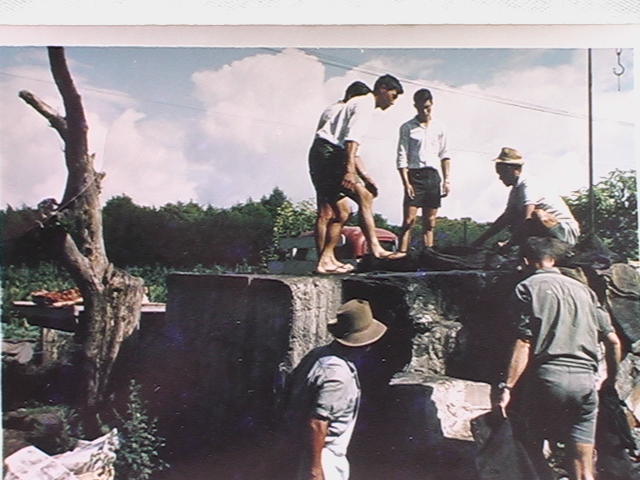
Cantonese roast duckCategories: Chinese Poultry Yield: 6 servings
1 Duckling rubbed inside and out with 2 tablespoon salt
2 tb Sherry
2 tb Hoisin sauce
2 tb Dark corn syrup
1 ts Five spice powder
1 tb round brown bean sauceRub duck inside and out with salt and refrigerate overnight. Mix remaining ingredients and rub on duck inside and our until used up. Preheat oven to 300 degrees. Place duck on rack, breast side up, in pan with 1 inch of water. Roast 1 hour, turn duck over, roast 1 hour more. Turn duck breast side up, increase heat to 350 degrees and roast 30 minutes. Remove from pan and cool. To serve, carve in the chinese manner, bones and all. Or carve as you would poultry. If carved chinese style, the duckling may be wrapped in foil after carving and frozen. Reheat in foil in 300 degree oven for 30 minutes.
Learn Mandarin and Cantonese
Go to this site and download the FSI Standard Chinese (Mandarin) course:http://fsi-language-courses.com/StandardChinese.aspx Many American universities have used this course for teaching Chinese.It's put out by the Foreign Service Institute, originally to teach US Diplomatic Corps personnel. Because it was written by the US government there is supposedly no copyright on the material so many different publishers have put out versions of the material. Now a guy has put all the stuff on the Internet.There are many other languages available as well as for the Cantonese dialect:http://fsi-language-courses.com/CantoneseBasic.aspx Put the audio on your mp3 player and enjoy the pleasures of learning another dialect or language.Learn the language of your ancestors!
Saturday, May 06, 2006
Pings Pie Cart - New Plymouth
Ping's Pie Cart - Pride of the West
By Rhonda Bartle
Pie cart on Ariki Street
For more than 25 years, Ping's Pie Cart stood on a vacant lot next to the Army Stores on Ariki Street and served hot nosh to late night diners. After midnight, Ping became the most popular man in town.
Most of his patrons on a Friday or Saturday night would head first to the pictures at the State, the Regent, the Opera House or Mayfair, before heading to the back bar of the Royal for a sly pint after hours.
Or there was usually a dance to rock up to, first at the Trades Hall and later at the War Memorial Hall or the Star Gym. And after all that socialising, there was always the stop at Ping's for pea, pie and pud.
Ping, Ping the ChinamanIf he can't cook it, nobody can…
After midnight, Ping Choy Leong became the most popular man in town. Image Puke Ariki Pictorial Collection TS2006_1004.
Ping Choy Leong
Ping Choy Leong was Chinese, short of stature and long on patience. He wore a black apron and had big hands for a small man. He could pass a plate with one while pouring tea with the other.
A market gardener and former fruit shop owner, he began selling fast food in the 1950s. His caravan, with its duckboard at ankle height to keep patrons up off the pavement, and metal shutter over its narrow serving window, opened at 5.30pm each night and didn't close till dawn.
Though it was called a pie cart, the menu boasted 24 items, all variations on the usual theme of pies, steak, eggs and chips. Everything came with tea or coffee and you paid when the plate arrived.
Ping's reputation for cooking at the speed of light and delivering just as fast meant his loyal clientele quickly grew to impressive numbers.
And the food was always good. Legend has it that hungry revellers often sent an empty taxi to pick up an after party order on the strength of his fried egg sandwiches alone.
Having fun with Ping
People loved to bait Ping to see what he would do. They'd take the fish slice from out of the groove where he kept it next to the cooker and scratch their heads with it. Once, though it's never been proven, someone caught Ping doing his laundry in the dish washer. Next time Ping took an order, it was for "socks and underpants on toast."
One of the funniest yarns is about his so-called meat supply, when a local hunter apparently slung a bloody possum carcass across Ping's countertop. "That's the last you get from me! You don't get another until you pay me!"
There's one about the local fisherman arriving with a large, wet octopus and telling Ping to, "Cook this!" The same man was said to have once hooked his ute up to the caravan in a threat to tow it away.
There's a story that someone actually did take Ping's pie cart on a tiki tour. And word has it that Ping shifted his trays of eggs from out of the reach of punters, after they were stolen one at a time and then pelted up and down the street.
Ping and the police
Though rumour has it Ping's caravan was wired directly to the police station so a touch of a button would bring the law running, it was always understood that Ping could sort out trouble by himself.
"You behave or I call police!" he'd warn his most unmanageable diners. But stories exist that Ping often chased errant patrons down the street, swinging a meat cleaver over his head, while shouting loudly in his unfathomable English.
Ping's language was known by some as 'Chinese otherwise." But what sounded like abuse was possibly just his version of "Don't you *&^%$#@ come back!"
Yet, Ping was quite fair-minded. One New Plymouth woman recalls gathering up loose change dropped by blokes who'd been in the pub too long, and trying to give it back to the pie cart proprietor only to be told, "You find it, you keep it."
Henry Leong serves the long-haired crowd in 1975. Image Daily News. Copy from Puke Ariki Pictorial Collection TS2006_1003.
Henry Leong
If Ping was world famous in New Plymouth, then Henry Leong, Ping's cousin, and Daisy Lee, Ping's niece, weren't far behind. For years they worked behind the counter, first with Ping and then without him when Ping retired and Henry took over the business.
Henry was a small man too, but according to Jock Ross, a young constable at the time, he would have made a brilliant policeman. The man could pour oil on troubled waters as easily as tomato sauce on pies.
Even today, Henry Leong has a fresh, infectious laugh despite the fact he's old enough to have retired many moons ago. "I worked at the pie cart for 14 years, on and off," he says. "From 16 to 30."
His cheerful voice comes down the phone from Tauranga where he moved post-pie cart, post-the Chalet Coffee Lounge, post-his Golden Phoenix restaurant in Currie Street.
When asked if he enjoyed the late night work, his tinkling laugh rings out even stronger. "I wouldn't say I enjoyed it. I meet a lot of people. Some crazy people, some good people. We had doctors, mayors, city councillors; all came to the pie cart.
"Lot's of funny people, you know? But mostly quite good. Usually have the rugbies and singers like the Howard Morrisons and Eddie Lowes and people like that."
The most famous man Henry served was All Black Ross Brown and the most popular order of the day was always pea, pie and pud. "After dances, after pictures, after parties, after pub, people just come in. Even rough people were sort of friends. We treated everybody the same, no matter. People from the street. Even Mongrel Mob.
Always treated them the same."
Sometimes there'd be impromptu sing-alongs, when a guitar would suddenly appear and everyone launched into song.
Henry has no idea how many pies were sold over the years. "Hundreds. Maybe eight or nine dozen a day. Might have made more money if we make those pies ourselves," he says. The next popular choice was steak and eggs, followed by those famous fried egg sandwiches.
He only closed early once, on a single day in February 1971 when downtown New Plymouth flooded due to heavy rain. "Water up to the parking meter," Henry chortles. "But we didn't float away. No. No. No. No damage either. We just close down and go and have a look around."
His voice drops to a whisper. "When we close for good, we had sad people, you know? One woman was crying outside."
On the job in 1975 - the lovely Daisy Lee. Image Daily News. Copy from Puke Ariki Pictorial Collection TS2006_1001.
Daisy Lee
Even today, Henry and Daisy are remembered as "lovely, lovely people," and there's no doubt that Daisy was the loveliest of all.
Rumour has it the young men, who worked at the Social Security Department directly across the road, would wander into the typing pool late in the day, not to chat up the typists but to stand on tip-toe at the window, trying to catch a glimpse of Daisy with her beehive hairdo and her short-short mini skirts.
To Daisy, those days seem a hundred years ago. "I was only young, for God's sake," she giggles." It's not surprising she was such a stand-out babe back then because, in 2006, she still has the figure, the hair, the smile. And she's still in the food industry, serving customers with her customary charm at the Aromas Café in Devon St.
The speed with which she and Henry worked together was legendary. They developed a kind of sixth sense. "It was like we knew what the other was thinking. Besides, I love him like my brother. He's such a great guy. I would have done anything for him. But we did work well together."
After Ping's closed, she continued to work with Henry at the Chalet Coffee Lounge in the Manchester Arcade.
She says the era spent behind the counter at the pie cart was a memorable one. "It was a good time to be a teenager, with only beer, and no drugs or hard alcohol."
Coming from a big family meant she enjoyed the customers and, like Henry, made it a rule to treat everyone the same. The police, too, were always friends and never the enemy.
When the pie cart closed, for some strange reason, she took the menu boards home with her and stored them in the basement. Today's she's quite pleased, as they're a tangible link to the past.
An early shot of Ping and his young family, with Henry on the right. Image Puke Ariki Pictorial Collection TS2006_1005.
Jock Ross - policeman
Talk to anyone of a certain age and memories of Ping's Pie Cart flow like mushy peas. Jock Ross, who was on the beat during its heyday, says it was a wonderful place for young coppers to go for a feed at 3 o'clock in the morning.
"Henry was very good to us, serving us great plates of steak, eggs and chips at Henry's prices. We looked after Henry and he looked after us, but you didn't abuse it. No one ever abused it."
He has no doubt the meat cleaver story is true, though he says Ping would never ever have picked a fight. "Ping was a man who wouldn't take any nonsense, and he and Henry together would have been quite formidable if they'd decided to lose their rag. But there was no aggression with them at all."
Jock, newly arrived from Glasgow, says Henry could usually break up a fight with a simple look or phrase. "I knew, if the chips were down - if you'll pardon the pun - Henry could look after himself. Henry had the gift of the gab and his English was probably better than mine!"
On the other hand, he doubts the tale of the panic button hooked directly to the police station is for real. "Ping might have had a big red button, but it wouldn't have been connected. Not in those days. He had a whistle that he'd blow if there was trouble, though there was never a lot of trouble, just usually a couple of punchies (sic)and then it was all over."
And the police always attended knuckle-ups once they heard a fight was on. "Usually it got back to us. Someone would come rushing in the front door of the station and say there was a punch up, or a taxi would ring us, or scream up out front and we'd all jump in the back and shoot off down there."
When Ping's closed, even the force went into mourning. "We weren't very happy. We were quite upset. It was hugely popular. I never heard a bad thing about Henry and I remember him with great affection. He was a terrific guy."
An original Ping's menu in shillings and pence: Image Puke Ariki Pictorial Collection TS2006_1006.
Pie cart poscript
It's not hard to imagine the hole the pie cart left when the vats were turned off and the tables cleared for the last time in March, 1975.
For two and a half decades, Ping's had squatted on its familiar concrete pad, with a few stools and tables at one end, serving all who fronted up.
It had fed bodgies and sailors and long-haired louts imitating The Beatles, as well as those kissing couples who had met at the Be-Bops dance on Saturday night. A rowdy witness to a myriad of social trends, even 10 o'clock closing had failed to quiet the tills.
In 2001, in the wake of an announcement of the name for the grand new library and museum which would occupy Ping's old site, a local wit was prompted to write a letter to the editor of Taranaki Daily News.
It ran under the heading A Steak in the City's Heritage: "I was interested to read last Saturday's Daily News that the full name for the project was "Puke Ariki Information, Knowledge and Heritage Centre for Taranaki.
"If we take the first letter of each word, we come up with PAIKAHCFT. If we drop three letters and add one, we could come up with Pai Kart."
The letter continued: "Those of us over 40 can well remember the Pai Kart. This was a truly multicultural centre, a place of huge knowledge where I, personally, had my heritage explained to me on several occasions…This was truly a centre for the exchange of information, a place where people could gather, enjoy a good feed and take part in interactive displays - like police training exercises, or watching couples frolic in the doorway of the Army Stores, or enjoy the pleasure of New Plymouth's first and only outdoor urinal."
And ended: "To think all of this is gone only to be replaced with a stuffy and boring museum and library that is going to cost the ratepayers millions of dollars - a civil disgrace, I'd say. I demand the name Puke Ariki etc be replaced by Pai Kart, and all the people who support me should gather at the Wind Wand at 3am tomorrow. I know the Pai Kart would attract a far better class of punter."
The response was a small one-liner. "Bring back Ping's and get rid of Puke Ariki."
The one time Ping's closed early was during the flood of 1971, when water rose up to the parking meters in town. This photo was taken outside Whites in Devon Street: Image Puke Ariki Pictorial Collection.
Published 28 April 2006
Comment on this Story
Add your own Story
http://www.pukeariki.com/en/stories/newtaranakistories/pingspies.asp
By Rhonda Bartle
Pie cart on Ariki Street
For more than 25 years, Ping's Pie Cart stood on a vacant lot next to the Army Stores on Ariki Street and served hot nosh to late night diners. After midnight, Ping became the most popular man in town.
Most of his patrons on a Friday or Saturday night would head first to the pictures at the State, the Regent, the Opera House or Mayfair, before heading to the back bar of the Royal for a sly pint after hours.
Or there was usually a dance to rock up to, first at the Trades Hall and later at the War Memorial Hall or the Star Gym. And after all that socialising, there was always the stop at Ping's for pea, pie and pud.
Ping, Ping the ChinamanIf he can't cook it, nobody can…
After midnight, Ping Choy Leong became the most popular man in town. Image Puke Ariki Pictorial Collection TS2006_1004.
Ping Choy Leong
Ping Choy Leong was Chinese, short of stature and long on patience. He wore a black apron and had big hands for a small man. He could pass a plate with one while pouring tea with the other.
A market gardener and former fruit shop owner, he began selling fast food in the 1950s. His caravan, with its duckboard at ankle height to keep patrons up off the pavement, and metal shutter over its narrow serving window, opened at 5.30pm each night and didn't close till dawn.
Though it was called a pie cart, the menu boasted 24 items, all variations on the usual theme of pies, steak, eggs and chips. Everything came with tea or coffee and you paid when the plate arrived.
Ping's reputation for cooking at the speed of light and delivering just as fast meant his loyal clientele quickly grew to impressive numbers.
And the food was always good. Legend has it that hungry revellers often sent an empty taxi to pick up an after party order on the strength of his fried egg sandwiches alone.
Having fun with Ping
People loved to bait Ping to see what he would do. They'd take the fish slice from out of the groove where he kept it next to the cooker and scratch their heads with it. Once, though it's never been proven, someone caught Ping doing his laundry in the dish washer. Next time Ping took an order, it was for "socks and underpants on toast."
One of the funniest yarns is about his so-called meat supply, when a local hunter apparently slung a bloody possum carcass across Ping's countertop. "That's the last you get from me! You don't get another until you pay me!"
There's one about the local fisherman arriving with a large, wet octopus and telling Ping to, "Cook this!" The same man was said to have once hooked his ute up to the caravan in a threat to tow it away.
There's a story that someone actually did take Ping's pie cart on a tiki tour. And word has it that Ping shifted his trays of eggs from out of the reach of punters, after they were stolen one at a time and then pelted up and down the street.
Ping and the police
Though rumour has it Ping's caravan was wired directly to the police station so a touch of a button would bring the law running, it was always understood that Ping could sort out trouble by himself.
"You behave or I call police!" he'd warn his most unmanageable diners. But stories exist that Ping often chased errant patrons down the street, swinging a meat cleaver over his head, while shouting loudly in his unfathomable English.
Ping's language was known by some as 'Chinese otherwise." But what sounded like abuse was possibly just his version of "Don't you *&^%$#@ come back!"
Yet, Ping was quite fair-minded. One New Plymouth woman recalls gathering up loose change dropped by blokes who'd been in the pub too long, and trying to give it back to the pie cart proprietor only to be told, "You find it, you keep it."
Henry Leong serves the long-haired crowd in 1975. Image Daily News. Copy from Puke Ariki Pictorial Collection TS2006_1003.
Henry Leong
If Ping was world famous in New Plymouth, then Henry Leong, Ping's cousin, and Daisy Lee, Ping's niece, weren't far behind. For years they worked behind the counter, first with Ping and then without him when Ping retired and Henry took over the business.
Henry was a small man too, but according to Jock Ross, a young constable at the time, he would have made a brilliant policeman. The man could pour oil on troubled waters as easily as tomato sauce on pies.
Even today, Henry Leong has a fresh, infectious laugh despite the fact he's old enough to have retired many moons ago. "I worked at the pie cart for 14 years, on and off," he says. "From 16 to 30."
His cheerful voice comes down the phone from Tauranga where he moved post-pie cart, post-the Chalet Coffee Lounge, post-his Golden Phoenix restaurant in Currie Street.
When asked if he enjoyed the late night work, his tinkling laugh rings out even stronger. "I wouldn't say I enjoyed it. I meet a lot of people. Some crazy people, some good people. We had doctors, mayors, city councillors; all came to the pie cart.
"Lot's of funny people, you know? But mostly quite good. Usually have the rugbies and singers like the Howard Morrisons and Eddie Lowes and people like that."
The most famous man Henry served was All Black Ross Brown and the most popular order of the day was always pea, pie and pud. "After dances, after pictures, after parties, after pub, people just come in. Even rough people were sort of friends. We treated everybody the same, no matter. People from the street. Even Mongrel Mob.
Always treated them the same."
Sometimes there'd be impromptu sing-alongs, when a guitar would suddenly appear and everyone launched into song.
Henry has no idea how many pies were sold over the years. "Hundreds. Maybe eight or nine dozen a day. Might have made more money if we make those pies ourselves," he says. The next popular choice was steak and eggs, followed by those famous fried egg sandwiches.
He only closed early once, on a single day in February 1971 when downtown New Plymouth flooded due to heavy rain. "Water up to the parking meter," Henry chortles. "But we didn't float away. No. No. No. No damage either. We just close down and go and have a look around."
His voice drops to a whisper. "When we close for good, we had sad people, you know? One woman was crying outside."
On the job in 1975 - the lovely Daisy Lee. Image Daily News. Copy from Puke Ariki Pictorial Collection TS2006_1001.
Daisy Lee
Even today, Henry and Daisy are remembered as "lovely, lovely people," and there's no doubt that Daisy was the loveliest of all.
Rumour has it the young men, who worked at the Social Security Department directly across the road, would wander into the typing pool late in the day, not to chat up the typists but to stand on tip-toe at the window, trying to catch a glimpse of Daisy with her beehive hairdo and her short-short mini skirts.
To Daisy, those days seem a hundred years ago. "I was only young, for God's sake," she giggles." It's not surprising she was such a stand-out babe back then because, in 2006, she still has the figure, the hair, the smile. And she's still in the food industry, serving customers with her customary charm at the Aromas Café in Devon St.
The speed with which she and Henry worked together was legendary. They developed a kind of sixth sense. "It was like we knew what the other was thinking. Besides, I love him like my brother. He's such a great guy. I would have done anything for him. But we did work well together."
After Ping's closed, she continued to work with Henry at the Chalet Coffee Lounge in the Manchester Arcade.
She says the era spent behind the counter at the pie cart was a memorable one. "It was a good time to be a teenager, with only beer, and no drugs or hard alcohol."
Coming from a big family meant she enjoyed the customers and, like Henry, made it a rule to treat everyone the same. The police, too, were always friends and never the enemy.
When the pie cart closed, for some strange reason, she took the menu boards home with her and stored them in the basement. Today's she's quite pleased, as they're a tangible link to the past.
An early shot of Ping and his young family, with Henry on the right. Image Puke Ariki Pictorial Collection TS2006_1005.
Jock Ross - policeman
Talk to anyone of a certain age and memories of Ping's Pie Cart flow like mushy peas. Jock Ross, who was on the beat during its heyday, says it was a wonderful place for young coppers to go for a feed at 3 o'clock in the morning.
"Henry was very good to us, serving us great plates of steak, eggs and chips at Henry's prices. We looked after Henry and he looked after us, but you didn't abuse it. No one ever abused it."
He has no doubt the meat cleaver story is true, though he says Ping would never ever have picked a fight. "Ping was a man who wouldn't take any nonsense, and he and Henry together would have been quite formidable if they'd decided to lose their rag. But there was no aggression with them at all."
Jock, newly arrived from Glasgow, says Henry could usually break up a fight with a simple look or phrase. "I knew, if the chips were down - if you'll pardon the pun - Henry could look after himself. Henry had the gift of the gab and his English was probably better than mine!"
On the other hand, he doubts the tale of the panic button hooked directly to the police station is for real. "Ping might have had a big red button, but it wouldn't have been connected. Not in those days. He had a whistle that he'd blow if there was trouble, though there was never a lot of trouble, just usually a couple of punchies (sic)and then it was all over."
And the police always attended knuckle-ups once they heard a fight was on. "Usually it got back to us. Someone would come rushing in the front door of the station and say there was a punch up, or a taxi would ring us, or scream up out front and we'd all jump in the back and shoot off down there."
When Ping's closed, even the force went into mourning. "We weren't very happy. We were quite upset. It was hugely popular. I never heard a bad thing about Henry and I remember him with great affection. He was a terrific guy."
An original Ping's menu in shillings and pence: Image Puke Ariki Pictorial Collection TS2006_1006.
Pie cart poscript
It's not hard to imagine the hole the pie cart left when the vats were turned off and the tables cleared for the last time in March, 1975.
For two and a half decades, Ping's had squatted on its familiar concrete pad, with a few stools and tables at one end, serving all who fronted up.
It had fed bodgies and sailors and long-haired louts imitating The Beatles, as well as those kissing couples who had met at the Be-Bops dance on Saturday night. A rowdy witness to a myriad of social trends, even 10 o'clock closing had failed to quiet the tills.
In 2001, in the wake of an announcement of the name for the grand new library and museum which would occupy Ping's old site, a local wit was prompted to write a letter to the editor of Taranaki Daily News.
It ran under the heading A Steak in the City's Heritage: "I was interested to read last Saturday's Daily News that the full name for the project was "Puke Ariki Information, Knowledge and Heritage Centre for Taranaki.
"If we take the first letter of each word, we come up with PAIKAHCFT. If we drop three letters and add one, we could come up with Pai Kart."
The letter continued: "Those of us over 40 can well remember the Pai Kart. This was a truly multicultural centre, a place of huge knowledge where I, personally, had my heritage explained to me on several occasions…This was truly a centre for the exchange of information, a place where people could gather, enjoy a good feed and take part in interactive displays - like police training exercises, or watching couples frolic in the doorway of the Army Stores, or enjoy the pleasure of New Plymouth's first and only outdoor urinal."
And ended: "To think all of this is gone only to be replaced with a stuffy and boring museum and library that is going to cost the ratepayers millions of dollars - a civil disgrace, I'd say. I demand the name Puke Ariki etc be replaced by Pai Kart, and all the people who support me should gather at the Wind Wand at 3am tomorrow. I know the Pai Kart would attract a far better class of punter."
The response was a small one-liner. "Bring back Ping's and get rid of Puke Ariki."
The one time Ping's closed early was during the flood of 1971, when water rose up to the parking meters in town. This photo was taken outside Whites in Devon Street: Image Puke Ariki Pictorial Collection.
Published 28 April 2006
Comment on this Story
Add your own Story
http://www.pukeariki.com/en/stories/newtaranakistories/pingspies.asp
Monday, May 01, 2006
Saturday, April 29, 2006
Allen Chang visit to China 2004
A glance of hometown from Allen
Latest Updated by2004-06-06 09:44:49
Allen Chang is the deputy chairman of Tung Jung Association of New Zealand. In March 2004, he joined a tour to China. The following are some experience and impression he would like to share with us.
Earlier this year the Tung Jung Association of New Zealand Inc, organised a tour to China. The 18 participants were greeted by Mr Lu Wei Xiong, Director of the Chinese Overseas Affairs Office of the Guangdong Provincial Government who formally welcomed them and invited them to suggest ways in which his office could assist overseas Chinese.
The group visited their home villages in Zengcheng such as Sun Gai, Bak Shek, Wong Sha To, Gwa Liang, Tong Mee, Sarbo, Nga Yew, Har Gee, and had the opportunity to see many of the famous sights in Guangzhou such as the Chen Ancestral Temple, Sun Yat Sen Memorial, Yuexiu Park, and an evening cruise on the Pearl River.
The tour schedule took the group to Xintang, Kunming, Li Jiang, Chengdu, Beijing, Shanghai and Hong Kong, visiting many of the well known tourist places such as the Great Wall of China and Tiannamen Square and some of those not so well known like the Stone Forest in Kunming and the world heritage town in Lijiang.
The group noted the huge progress being made in China and the stark contrast with just a few years ago. New roads and motorways, new office and apartment blocks, greater emphasis on cleanliness, cellphone towers and improved communications, more new cars and less bicycles. The changes taking place in the villages where many of the farmers are now leasing their land to others and concentrating on building businesses employing other people was a clear indicator of the changes and progress being made in China and especially in Guangdong. While there is still much to be done, the progressis obvious.
http://gocn.southcn.com/English/impression/200406060001.htm
Latest Updated by2004-06-06 09:44:49
Allen Chang is the deputy chairman of Tung Jung Association of New Zealand. In March 2004, he joined a tour to China. The following are some experience and impression he would like to share with us.
Earlier this year the Tung Jung Association of New Zealand Inc, organised a tour to China. The 18 participants were greeted by Mr Lu Wei Xiong, Director of the Chinese Overseas Affairs Office of the Guangdong Provincial Government who formally welcomed them and invited them to suggest ways in which his office could assist overseas Chinese.
The group visited their home villages in Zengcheng such as Sun Gai, Bak Shek, Wong Sha To, Gwa Liang, Tong Mee, Sarbo, Nga Yew, Har Gee, and had the opportunity to see many of the famous sights in Guangzhou such as the Chen Ancestral Temple, Sun Yat Sen Memorial, Yuexiu Park, and an evening cruise on the Pearl River.
The tour schedule took the group to Xintang, Kunming, Li Jiang, Chengdu, Beijing, Shanghai and Hong Kong, visiting many of the well known tourist places such as the Great Wall of China and Tiannamen Square and some of those not so well known like the Stone Forest in Kunming and the world heritage town in Lijiang.
The group noted the huge progress being made in China and the stark contrast with just a few years ago. New roads and motorways, new office and apartment blocks, greater emphasis on cleanliness, cellphone towers and improved communications, more new cars and less bicycles. The changes taking place in the villages where many of the farmers are now leasing their land to others and concentrating on building businesses employing other people was a clear indicator of the changes and progress being made in China and especially in Guangdong. While there is still much to be done, the progressis obvious.
http://gocn.southcn.com/English/impression/200406060001.htm
Thursday, April 27, 2006
Glen Joe Basketballer
Joe comes full circle 07 April 2006
By TOBY ROBSON Glen Joe was hoping his hoop dreams would come true when he dropped everything and boarded a plane for China late last year.
He resigned from his job at the New Zealand Academy of Sport, farewelled his Auckland Stars teammates and focused on a fresh start.
The plan was to fall back on the heritage of his parents, who emigrated to New Zealand from China in the 1970s, before he was born, and gain citizenship to the world's most populated nation.
"I saw Brendon Polyblank and Phill Jones and those guys playing in Europe as locals," Joe explained. "Both my parents were born in China and even though they came here at a young age, I thought there was a chance I could go and play there as a local."
Joe arrived in the large Chinese city of New Xiamen, coincidentally Wellington's sister city, and began training and playing for his new team Fugian in the buildup to the China Basketball Association season.
But nothing is simple in the massive communist state and China's immigration officials decided a Kiwi hoopster was not going to sneak in the side door.
"It's a little disappointing, but you chase opportunities as far as you can and if they don't eventuate you know you have given it your best shot," Joe said.
"I was away for about five months and played and trained with the team for about two months, but the Chinese are pretty patriotic and I couldn't get a passport.
"It was an eye-opening experience to see what another country does. I can speak fluent Cantonese, but my Mandarin's not so good, so I was able to pick up on that."
He also missed out on a healthy pay cheque.
"You could make good money. In two months I made more than I made in New Zealand in a year from basketball. It's big money, big populations and a big playing base. In China you are either filthy rich or dirt poor."
Surprisingly, Joe said the league that produced NBA star Yao Ming was not as impressive as its billing.
"It was decent, but I was surprised it was not as good as New Zealand. They were big boys, (but) skill-wise not as good. They trained a lot, but I don't know why (they weren't as good as Kiwis). I guess they didn't train smart."
Joe would know. He holds a masters degree in sports science and has juggled basketball with a job at the New Zealand Academy of Sport in Auckland for the past five years, also lecturing at Auckland University and the Unitech.
China's loss is Wellington's gain after the club finally called Joe at the right time.
"They have been giving me a call at the end of the season pretty much for the last two or three years. It's just timing. When I went to China I had to quit all my jobs in Auckland, so I was not so committed this time."
And though it's not the way he planned it, Joe is glad he will still get the chance to reconnect with his roots.
Born in Lower Hutt he went to Naenae College with Saints teammate George Le'afa and former Wellington forward David Hopoi.
Joe laughs aloud as he recalls his early days at intermediate school in the Hutt Valley.
Back then he was the little Asian kid giving away height and weight to his Samoan classmate Le'afa.
"He was a two guard and I was point guard because he was bigger.
"And he could shoot the ball better back then," he said. "It was funny because by the time I came into the NBL he had been forced to play the one spot (point guard) because of his size and I was a two."
These days Joe, at 1.90m, has a distinct height advantage over his old mate.
The pair have not played much together since those early days in the Hutt Valley, but this year they will jostle for court time with the Wellington Saints.
In his fifth NBL season, which has included several years with Waikato and a title with the Stars last year, Joe is an important addition for the Saints. He'll run the point guard position mostly, but also fills the sharp shooting role vacated by Troy McLean's departure to North Harbour.
He hasn't given up on playing for the Tall Blacks or going overseas next season and is eyeing the Hong Kong national league where he hopes to play as an import.
But for now he's keen to add to his one NBL title.
He's got first-hand experience of how tough Le'afa and the Saints can be. In 2003 Joe scored 17 points for the Waikato Titans in the NBL final a 97-88 overtime loss to the Saints in Hamilton
By TOBY ROBSON Glen Joe was hoping his hoop dreams would come true when he dropped everything and boarded a plane for China late last year.
He resigned from his job at the New Zealand Academy of Sport, farewelled his Auckland Stars teammates and focused on a fresh start.
The plan was to fall back on the heritage of his parents, who emigrated to New Zealand from China in the 1970s, before he was born, and gain citizenship to the world's most populated nation.
"I saw Brendon Polyblank and Phill Jones and those guys playing in Europe as locals," Joe explained. "Both my parents were born in China and even though they came here at a young age, I thought there was a chance I could go and play there as a local."
Joe arrived in the large Chinese city of New Xiamen, coincidentally Wellington's sister city, and began training and playing for his new team Fugian in the buildup to the China Basketball Association season.
But nothing is simple in the massive communist state and China's immigration officials decided a Kiwi hoopster was not going to sneak in the side door.
"It's a little disappointing, but you chase opportunities as far as you can and if they don't eventuate you know you have given it your best shot," Joe said.
"I was away for about five months and played and trained with the team for about two months, but the Chinese are pretty patriotic and I couldn't get a passport.
"It was an eye-opening experience to see what another country does. I can speak fluent Cantonese, but my Mandarin's not so good, so I was able to pick up on that."
He also missed out on a healthy pay cheque.
"You could make good money. In two months I made more than I made in New Zealand in a year from basketball. It's big money, big populations and a big playing base. In China you are either filthy rich or dirt poor."
Surprisingly, Joe said the league that produced NBA star Yao Ming was not as impressive as its billing.
"It was decent, but I was surprised it was not as good as New Zealand. They were big boys, (but) skill-wise not as good. They trained a lot, but I don't know why (they weren't as good as Kiwis). I guess they didn't train smart."
Joe would know. He holds a masters degree in sports science and has juggled basketball with a job at the New Zealand Academy of Sport in Auckland for the past five years, also lecturing at Auckland University and the Unitech.
China's loss is Wellington's gain after the club finally called Joe at the right time.
"They have been giving me a call at the end of the season pretty much for the last two or three years. It's just timing. When I went to China I had to quit all my jobs in Auckland, so I was not so committed this time."
And though it's not the way he planned it, Joe is glad he will still get the chance to reconnect with his roots.
Born in Lower Hutt he went to Naenae College with Saints teammate George Le'afa and former Wellington forward David Hopoi.
Joe laughs aloud as he recalls his early days at intermediate school in the Hutt Valley.
Back then he was the little Asian kid giving away height and weight to his Samoan classmate Le'afa.
"He was a two guard and I was point guard because he was bigger.
"And he could shoot the ball better back then," he said. "It was funny because by the time I came into the NBL he had been forced to play the one spot (point guard) because of his size and I was a two."
These days Joe, at 1.90m, has a distinct height advantage over his old mate.
The pair have not played much together since those early days in the Hutt Valley, but this year they will jostle for court time with the Wellington Saints.
In his fifth NBL season, which has included several years with Waikato and a title with the Stars last year, Joe is an important addition for the Saints. He'll run the point guard position mostly, but also fills the sharp shooting role vacated by Troy McLean's departure to North Harbour.
He hasn't given up on playing for the Tall Blacks or going overseas next season and is eyeing the Hong Kong national league where he hopes to play as an import.
But for now he's keen to add to his one NBL title.
He's got first-hand experience of how tough Le'afa and the Saints can be. In 2003 Joe scored 17 points for the Waikato Titans in the NBL final a 97-88 overtime loss to the Saints in Hamilton
Sunday, April 23, 2006
Chinese First Families Project
Chinese First Families Project
Chinese First Families Register
We are meeting the challenge of making our heritage resources relevant to Chinese Aucklanders for the present and future generations by compiling a register of first families in Auckland from 1840 onwards. This project will register the first families of immigrant groups arriving in New Zealand and their family histories.
The aims of this project are to preserve histories and the living memories of the first Chinese families arriving into New Zealand, as well as providing a place to hold our shared history in trust for future generations.
The Chinese First Families Register forms can be downloaded here:
Guide to filling in the register forms PDF 442 KB
Chinese First Families Register forms PDF 280 KB
If you have trouble printing the forms, they can be obtained through contacting our Family History Librarian.
Chinese woman using a foot operated spindle, Possibly in China or Hong Kong - From the Pirie Photo Albums
Collection Donations
We welcome your donation of family and organisational documents and photographs in the future. These treasures will be preserved and made accessible to the public as part of the Special Collections on the Heritage Floor at the Central Library.
Please contact our Heritage Collection Manager, Theresa Graham for further information on collection donations.
Email: Theresa.Graham@aucklandcity.govt.nz
Ph: (09) 307 7983
Chinese First Families Register
We are meeting the challenge of making our heritage resources relevant to Chinese Aucklanders for the present and future generations by compiling a register of first families in Auckland from 1840 onwards. This project will register the first families of immigrant groups arriving in New Zealand and their family histories.
The aims of this project are to preserve histories and the living memories of the first Chinese families arriving into New Zealand, as well as providing a place to hold our shared history in trust for future generations.
The Chinese First Families Register forms can be downloaded here:
Guide to filling in the register forms PDF 442 KB
Chinese First Families Register forms PDF 280 KB
If you have trouble printing the forms, they can be obtained through contacting our Family History Librarian.
Chinese woman using a foot operated spindle, Possibly in China or Hong Kong - From the Pirie Photo Albums
Collection Donations
We welcome your donation of family and organisational documents and photographs in the future. These treasures will be preserved and made accessible to the public as part of the Special Collections on the Heritage Floor at the Central Library.
Please contact our Heritage Collection Manager, Theresa Graham for further information on collection donations.
Email: Theresa.Graham@aucklandcity.govt.nz
Ph: (09) 307 7983
Chinese Genealogy
Since the arrival of Chinese goldminers in the 1850s, Chinese immigrants and New Zealand Chinese have fast become part of the New Zealand society. However, little has been documented about the Chinese in Auckland.
Auckland City Libraries has the largest family history collection in a public library in New Zealand. Our heritage collections also include many books, maps, manuscripts, photographs and ephemera which chart the changing face of this country and city through its short history. We are in the process of identifying heritage resources relevant to Chinese Aucklanders for present and future generations.
Chinese Refugees
Chinese refugees, 1962–71
Civil war and the establishment of a Communist government in China created large waves of Chinese refugees from the 1940s. New Zealand’s response was slow, probably due to a reluctance to resettle refugees who were not white.
Eventually, small numbers were accepted. In 1962, 50 Chinese orphans from Hong Kong were admitted for adoption by New Zealand families. For a few years in the late 1960s there was a quota of six families a year. Twelve Chinese families from Indonesia were admitted in 1967.
Civil war and the establishment of a Communist government in China created large waves of Chinese refugees from the 1940s. New Zealand’s response was slow, probably due to a reluctance to resettle refugees who were not white.
Eventually, small numbers were accepted. In 1962, 50 Chinese orphans from Hong Kong were admitted for adoption by New Zealand families. For a few years in the late 1960s there was a quota of six families a year. Twelve Chinese families from Indonesia were admitted in 1967.
Life After Death?
Migration has also intersected with culture and religion to create changes among Chinese New Zealanders. "Chinese people I interviewed talked about ... throwing rice into the grave - a tradition that had been lost but is being revived by new migrants coming in," says Ms Schwass. Life after death? Most Chinese believe in some sort of afterlife. Many prefer to be buried so they can enter the afterlife whole, and want to be interred at a spot with good feng shui - that is, chosen to enhance the energy flows of Heaven and Earth which are believed to influence one's life. But the soul, say some Chinese, doesn't go to the afterlife immediately after death, so a family may "comfort" the dead with gifts of food or money. Once in a coffin, jade, gold, coins or other precious objects may be placed on the deceased's mouth, hands or eyes. The idea of a restless soul, says Ms Schwass, came through strongly in Pacific cultures. "There was a sense that if you didn't honour a person properly in their death and burial, you would be left with the potential for a restless soul." http://www.nzherald.co.nz/topic/story.cfm?c_id=147&ObjectID=10350951
NZ Is A Long Way From Home
NZ a long way from home for Chinese
23.04.06 1.00pmBy Lincoln Tan
From the moment the plane hit terra firma, the excitement began to build. Wei Ming, 19, from Shaoxing in China's Zhejiang province had been told that New Zealand was "the most beautiful place on Earth" - and he could not wait to see it for himself. He was on his way to realising his dream of a better life in a place his parents called "Xin Xilan" - "God's own country", a crime-free land of beauty and opportunity. He had been told that New Zealand was so safe that houses had no gates and people could even sleep at night with their doors open. To most New Zealanders Wei Ming, the only child of carpenter Li Cheng and school teacher Li Hui is just one of the many Chinese students. To some Kiwis, he spells trouble - a potential reckless driver, gambling addict, kidnapper or even murderer. As an English language student, Wei Ming will be in a class made up of his own countrymen, or from some other parts of Asia. And like many others who have passed this way, Wei Ming will probably go home without ever making a Pakeha or Maori friend. Every day Kiwis walk past students like Wei Ming. But sadly, for many New Zealanders, they only get acquainted with the Wei Mings through the news headlines when something goes awfully wrong. Lately, it has been as victims of kidnap and murder. The latest murder victim was body-in-the-suitcase victim Wan Biao, and like Wei Ming, he was also 19 and from the Zhejiang province, not far from Shanghai. The murder has sent shockwaves through the Chinese community. Discussion forums have run hot on Chinese websites. There was a feeling of a "loss of face" with one contributor writing: "It is not one person who has lost face here, it is all Chinese." Anger was also directed at the media for insinuating that triads may have been involved. Questions were also asked of the Ministry of Education's statement that New Zealand was still a safe place to study. Newspapers carried reports daily on the murder of Wan Biao, and in death, this one Chinese student was given a face, name and an individual profile. But does it mean things have to go awry before Kiwis get curious about them? Would it have made a difference if Wan Biao had a local friend to turn to? Jimmy Xu, 19, who came to New Zealand in May last year, recounts how difficult it was at first. He has asked for his real name not to be used for fear of repercussions. Before arriving in New Zealand, all he knew about the country was through brochures and photographs: pohutukawa trees lining Tamaki Dr, sandy beaches and the Sky Tower. His initial reaction was like "all the dreams have come true". But that slowly changed when he met his homestay family. "When my New Zealand agent sent me to my homestay family, the only word I knew was hello, so I cannot talk with them," Jimmy said. "On the first day, they showed me my small room and taught me how to take a bus to school and then went out." Unhappy with his homestay situation, he went flatting with two other classmates and they rented a central city apartment. Two months into staying in the apartment, three men stormed in and demanded that he pay $500 for "protection service". He was told that he would likely face severe beatings if the money was not paid. His found out later his flatmate had tipped off the men, and was given 10 per cent for each tip-off on new students. He has since moved out and is now renting a room in Mt Roskill. "People say New Zealand is safe, but it is not a safe place for Chinese students," Jimmy said. He believes students are drawn into crime for easy money. "My friends say if we want to make money from P, or get [extort] money from people, this is the place to do it, because if we try it in China, we may have to face the death penalty," he said. Ironically, it was also this view of New Zealand's lenient laws that deterred Jimmy from reporting his extortion case to the police. New Zealand had now become a cold, dull, dry place. "My parents spend so much money for me to come here to learn English and hopefully get a good education and residency, but I will want to go back home to China soon. I miss it very much." President of the New Zealand Chinese Students Association Nancy Hu said Chinese students were deeply affected by the murder of Wan Biao. "As a Chinese student myself, I cannot imagine the sadness that the parents of Wan Biao must feel," Ms Hu said. "Because the law only allows one child, parents would sacrifice everything and place all their hopes for the future on their son or daughter. "For Wan Biao's parents, it has been all for nothing now." Ms Hu said the association was organising a student safety seminar next month in response to Wan Biao's murder. But she realised that a solution would not be as straightforward as just telling students what to do if they are in trouble. In all likelihood the predator and the intended prey could be sitting in the same room at the seminar. * Lincoln Tan is the editor of iBall newspaper.
23.04.06 1.00pmBy Lincoln Tan
From the moment the plane hit terra firma, the excitement began to build. Wei Ming, 19, from Shaoxing in China's Zhejiang province had been told that New Zealand was "the most beautiful place on Earth" - and he could not wait to see it for himself. He was on his way to realising his dream of a better life in a place his parents called "Xin Xilan" - "God's own country", a crime-free land of beauty and opportunity. He had been told that New Zealand was so safe that houses had no gates and people could even sleep at night with their doors open. To most New Zealanders Wei Ming, the only child of carpenter Li Cheng and school teacher Li Hui is just one of the many Chinese students. To some Kiwis, he spells trouble - a potential reckless driver, gambling addict, kidnapper or even murderer. As an English language student, Wei Ming will be in a class made up of his own countrymen, or from some other parts of Asia. And like many others who have passed this way, Wei Ming will probably go home without ever making a Pakeha or Maori friend. Every day Kiwis walk past students like Wei Ming. But sadly, for many New Zealanders, they only get acquainted with the Wei Mings through the news headlines when something goes awfully wrong. Lately, it has been as victims of kidnap and murder. The latest murder victim was body-in-the-suitcase victim Wan Biao, and like Wei Ming, he was also 19 and from the Zhejiang province, not far from Shanghai. The murder has sent shockwaves through the Chinese community. Discussion forums have run hot on Chinese websites. There was a feeling of a "loss of face" with one contributor writing: "It is not one person who has lost face here, it is all Chinese." Anger was also directed at the media for insinuating that triads may have been involved. Questions were also asked of the Ministry of Education's statement that New Zealand was still a safe place to study. Newspapers carried reports daily on the murder of Wan Biao, and in death, this one Chinese student was given a face, name and an individual profile. But does it mean things have to go awry before Kiwis get curious about them? Would it have made a difference if Wan Biao had a local friend to turn to? Jimmy Xu, 19, who came to New Zealand in May last year, recounts how difficult it was at first. He has asked for his real name not to be used for fear of repercussions. Before arriving in New Zealand, all he knew about the country was through brochures and photographs: pohutukawa trees lining Tamaki Dr, sandy beaches and the Sky Tower. His initial reaction was like "all the dreams have come true". But that slowly changed when he met his homestay family. "When my New Zealand agent sent me to my homestay family, the only word I knew was hello, so I cannot talk with them," Jimmy said. "On the first day, they showed me my small room and taught me how to take a bus to school and then went out." Unhappy with his homestay situation, he went flatting with two other classmates and they rented a central city apartment. Two months into staying in the apartment, three men stormed in and demanded that he pay $500 for "protection service". He was told that he would likely face severe beatings if the money was not paid. His found out later his flatmate had tipped off the men, and was given 10 per cent for each tip-off on new students. He has since moved out and is now renting a room in Mt Roskill. "People say New Zealand is safe, but it is not a safe place for Chinese students," Jimmy said. He believes students are drawn into crime for easy money. "My friends say if we want to make money from P, or get [extort] money from people, this is the place to do it, because if we try it in China, we may have to face the death penalty," he said. Ironically, it was also this view of New Zealand's lenient laws that deterred Jimmy from reporting his extortion case to the police. New Zealand had now become a cold, dull, dry place. "My parents spend so much money for me to come here to learn English and hopefully get a good education and residency, but I will want to go back home to China soon. I miss it very much." President of the New Zealand Chinese Students Association Nancy Hu said Chinese students were deeply affected by the murder of Wan Biao. "As a Chinese student myself, I cannot imagine the sadness that the parents of Wan Biao must feel," Ms Hu said. "Because the law only allows one child, parents would sacrifice everything and place all their hopes for the future on their son or daughter. "For Wan Biao's parents, it has been all for nothing now." Ms Hu said the association was organising a student safety seminar next month in response to Wan Biao's murder. But she realised that a solution would not be as straightforward as just telling students what to do if they are in trouble. In all likelihood the predator and the intended prey could be sitting in the same room at the seminar. * Lincoln Tan is the editor of iBall newspaper.
Thursday, April 20, 2006
Honiara is in Ruins
http://toabaita-authority.blogspot.com/ According to Johnson Honimae of the Government Communications Unit, China Town,the commercial heart of the Solomon Islands capital of Honiara has been left at the mercy of looters and arsonists. Already 90 percent of the buildings which housed among others, retail and wholesale shops, fast-food bars, hardware, furniture and outboard motor engine outlets have been burnt to the ground by protestors and looters since converging at Chinatown early yesterday evening. Police sources say the police have decided to abandon Chinatown because of the risk posed to the police personnel. Mobs and looters have been hurling rocks and bricks at passing patrol police vehicles.
Saturday, April 15, 2006
Grand Mother Wong Ping Yee
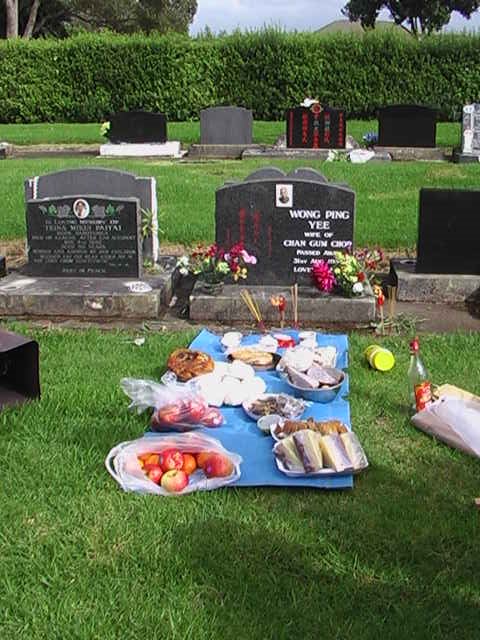
Was in NZ 1930s to mid 1950s - returned to China - and then returned to Auckland early 1980s. Mangere Cemetery April 9 2006
Grandfather Chan Sheen Chong

Manaia - Waimate Plains arrived from Canton 1904 - lived there to 1957. Had the local Fruit and vege shop as well as market gardens

Sunday, April 02, 2006
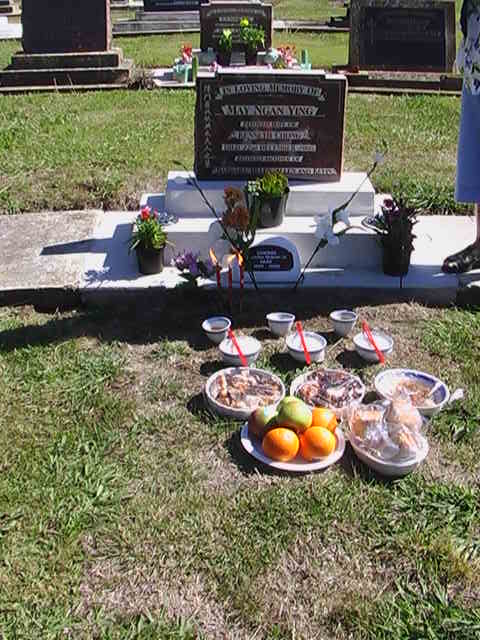
Clear Brightness Festival
Clear Brightness Festival
Date: April 4th, 5th, or 6th of the western calendar. Purpose: To honor ancestors and enjoy spring. Traditions: Clear brightness is called "quing ming" - when the outside air and light becomes pure and clear as in springtime. People go to the graves of their ancestors and clean up the area. They put little pieces of red paper that look like roof tiles on top of the tombstone. They offer food such as dumplings, oranges, meats, vegetables, cakes, and candies set out like a real meal because ancestors are believed to live in an afterworld that's like the world of the living. After these honored guests have enjoyed their meal, the real food is shared with family and friends.
Date: April 4th, 5th, or 6th of the western calendar. Purpose: To honor ancestors and enjoy spring. Traditions: Clear brightness is called "quing ming" - when the outside air and light becomes pure and clear as in springtime. People go to the graves of their ancestors and clean up the area. They put little pieces of red paper that look like roof tiles on top of the tombstone. They offer food such as dumplings, oranges, meats, vegetables, cakes, and candies set out like a real meal because ancestors are believed to live in an afterworld that's like the world of the living. After these honored guests have enjoyed their meal, the real food is shared with family and friends.
Chinese face a burial ban
Wednesday, 8 April, 1998, 13:47 GMT 14:47 UK
Chinese face a burial ban
Chinese clean up the graves of their ancestors in the week leading to Quing Ming, the Grave Sweeping Festival
The Chinese southern province of Guangdong is to prohibit most burials and the creation of new cemeteries, in favour of cremation. Provincial officials said the ban was being introduced because the rapid spread of new cemeteries was eating up precious agricultural land.
Cremation has been encouraged in China for many years. But the official news agency, Xinhua, said many residents of Guangdong preferred traditional tomb-burials. As a result, more than 250 hectares of land were lost in the province every year.
With China's limited arable land already under threat from rapid urban expansion, the authorities have been trying for some years to reverse the spread of cemeteries. The official China Daily newspaper said 670 million hectares of land had been re-claimed in recent years, after the removal of hundreds of millions of old tombs.
Deng Xiaoping set an example
The government has advocated cremation and done its best to overcome traditional taboos about preserving the human body intact. Last year, around 37% of China's dead were cremated - some perhaps inspired by the example of late leader, Deng Xiaoping, who asked for his ashes to be scattered at sea.
But, in southern Guangdong province, the custom for lavish tombs apparently is persistent. Less than a quarter of its dead were cremated last year. In some cities, the figure was just 5%.
Officials said forest and farm land were disappearing, as luxury private cemeteries expanded to cater for more than a quarter of a million annual burials.
A local newspaper quoted one official as saying the province could no longer allow the dead to take land from the living.
Another told the BBC that new cemeteries would now be banned. He said existing graveyards could still be used, but could not expand.
Provincial authorities say they are seeking a 60% cremation rate within three years and hope eventually to reach 100%.
Grave Sweeping Festival
Last Sunday the Chinese celebrated the annual day for remembering the dead, Quing Ming. In the week leading up to Quing Ming, it is customary to clean up the graves of their ancestors, and make offerings of food and drink.
Many traditional Quing Ming activities, such as burning fake money and paper home appliances, which are intended to ensure a comfortable afterlife for the deceased, have been banned by China's Communist Party, which claims they are "feudal superstitions."
The BBC correspondent in Beijing reports that when Guangzhou students launched a campaign in support of cremation on Quing Ming last Sunday, only a dozen people, out of hundreds of thousands, visiting a local cemetery signed up. She says this shows the scale of the problem that the Chinese authorities promoting cremation have to tackle.
Chinese face a burial ban
Chinese clean up the graves of their ancestors in the week leading to Quing Ming, the Grave Sweeping Festival
The Chinese southern province of Guangdong is to prohibit most burials and the creation of new cemeteries, in favour of cremation. Provincial officials said the ban was being introduced because the rapid spread of new cemeteries was eating up precious agricultural land.
Cremation has been encouraged in China for many years. But the official news agency, Xinhua, said many residents of Guangdong preferred traditional tomb-burials. As a result, more than 250 hectares of land were lost in the province every year.
With China's limited arable land already under threat from rapid urban expansion, the authorities have been trying for some years to reverse the spread of cemeteries. The official China Daily newspaper said 670 million hectares of land had been re-claimed in recent years, after the removal of hundreds of millions of old tombs.
Deng Xiaoping set an example
The government has advocated cremation and done its best to overcome traditional taboos about preserving the human body intact. Last year, around 37% of China's dead were cremated - some perhaps inspired by the example of late leader, Deng Xiaoping, who asked for his ashes to be scattered at sea.
But, in southern Guangdong province, the custom for lavish tombs apparently is persistent. Less than a quarter of its dead were cremated last year. In some cities, the figure was just 5%.
Officials said forest and farm land were disappearing, as luxury private cemeteries expanded to cater for more than a quarter of a million annual burials.
A local newspaper quoted one official as saying the province could no longer allow the dead to take land from the living.
Another told the BBC that new cemeteries would now be banned. He said existing graveyards could still be used, but could not expand.
Provincial authorities say they are seeking a 60% cremation rate within three years and hope eventually to reach 100%.
Grave Sweeping Festival
Last Sunday the Chinese celebrated the annual day for remembering the dead, Quing Ming. In the week leading up to Quing Ming, it is customary to clean up the graves of their ancestors, and make offerings of food and drink.
Many traditional Quing Ming activities, such as burning fake money and paper home appliances, which are intended to ensure a comfortable afterlife for the deceased, have been banned by China's Communist Party, which claims they are "feudal superstitions."
The BBC correspondent in Beijing reports that when Guangzhou students launched a campaign in support of cremation on Quing Ming last Sunday, only a dozen people, out of hundreds of thousands, visiting a local cemetery signed up. She says this shows the scale of the problem that the Chinese authorities promoting cremation have to tackle.
Subscribe to:
Posts (Atom)